深圳溯源
无法加载取货服务可用情况
衣服尺寸:
胸围/腰围/臀围:92/72/98 厘米
衣长:91 厘米
细节描述:
图案解析
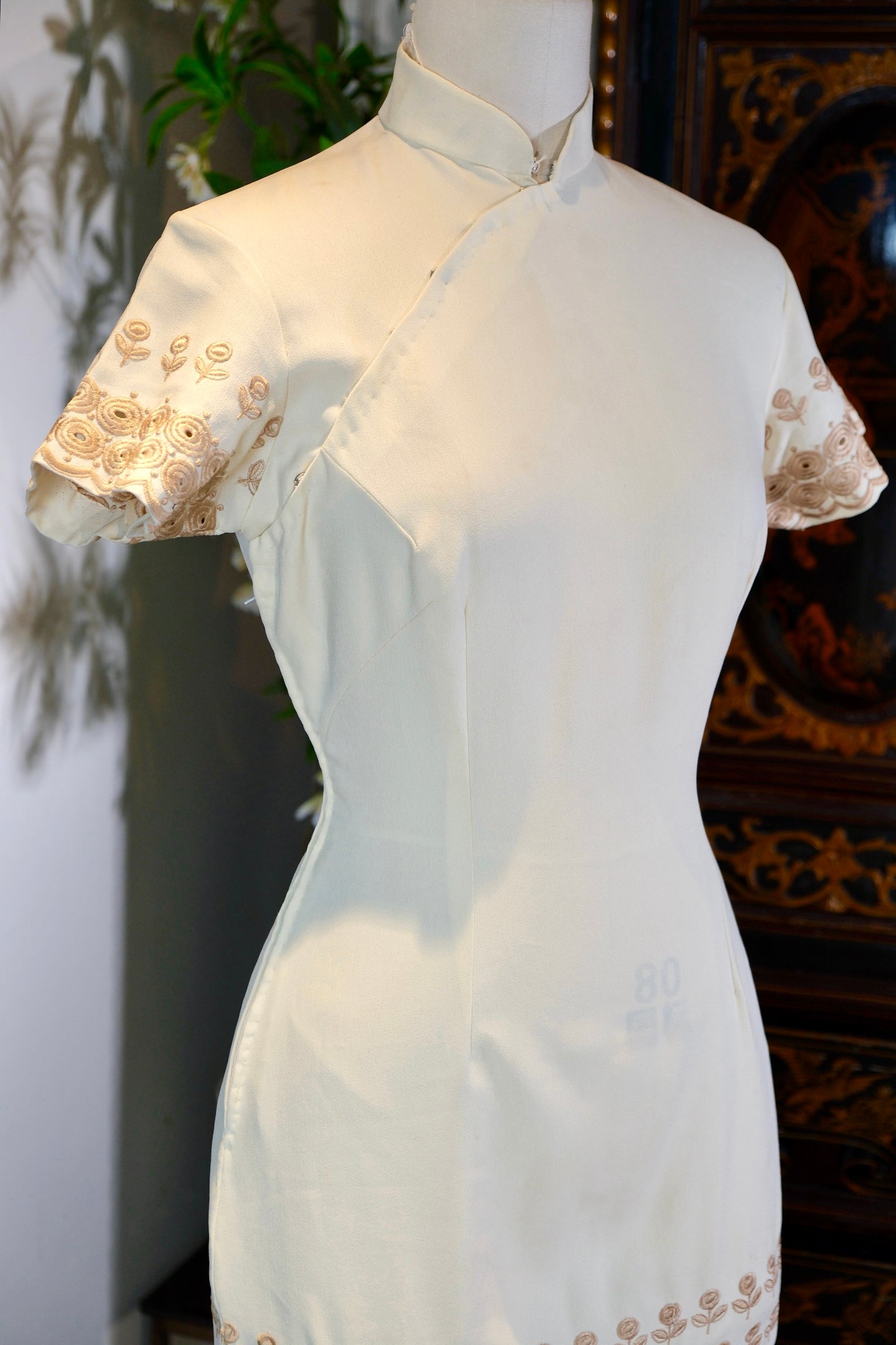
此件旗袍以象牙白为底,袖口与裙摆处饰以定位机绣的金色花卉纹样。袖口绣纹呈缠枝牡丹样式,花瓣层叠如云,枝叶婉转似水,取“富贵绵长”之意;裙摆则绣满缠枝莲纹,莲花含苞待放,枝蔓连绵不绝,暗合“出淤泥而不染”的高洁品格。绣线以金、米双色交织,针脚细密如织,远观似金粉洒落,近看则见针线游走间的气韵流动,既有传统刺绣的精致,又因机绣工艺的规整而更显端庄。
古董衣的故事
二十世纪六十年代,台湾纺织业正处于“进口替代”向“出口导向”转型的关键时期。彼时,台湾引进日本与德国的自动化绣花机,将传统苏绣、粤绣的纹样转化为可批量生产的“定位机绣”工艺——既保留了东方美学的精髓,又赋予服饰工业化的精准与效率。这件旗袍正是这一历史节点的产物:它诞生于台北大稻埕的老字号绣坊,曾是某位外交官夫人的定制礼服,随主人辗转于东南亚的社交场合,见证了冷战时期台湾作为“东方十字路口”的文化交融。
艺术风格与稀缺性
从艺术风格而言,此旗袍融合了“海派旗袍”的修身剪裁与“台湾本土”的装饰趣味。立领、斜襟、收腰、开衩的经典结构,延续了民国时期旗袍的优雅线条;而袖口与裙摆的机绣纹样,则吸收了西方装饰艺术(ArtDeco)的几何韵律,形成“东形西韵”的独特审美。正如服饰史学家王亚蓉在《中国服饰史》中所言:“六十年代的台湾旗袍,是传统工艺与现代工业的对话,是东方美学在全球化浪潮中的自我重构。”
其稀缺性更在于工艺的不可复制性。定位机绣虽为工业化产物,但六十年代的绣花机需人工调整针距与线色,每一件作品的纹样排布皆有细微差异,堪称“机器时代的孤品”。加之当时台湾纺织业以出口为主,本土留存的高品质定制旗袍极少,此件历经半世纪仍保存完好,缎面光泽如初,绣纹无一丝褪色,实为收藏级文物。
结语
这件旗袍不仅是一件衣物,更是一段凝固的历史。它承载着六十年代台湾的经济转型、文化碰撞与女性意识的觉醒,以针线为笔,以缎面为纸,书写着东方美学在现代性浪潮中的坚韧与优雅。正如张爱玲在《更衣记》中所写:“旗袍的变迁,是时代的缩影。”而这件古董旗袍,正是那个风云变幻年代里,最温柔而坚定的注脚。
Measurements / Size Guide:
Bust / Waist / Hips: 92/72/98 cm
Total Length: 91 cm
Detailed Description:
This qipao features an ivory-white base, adorned with gold floral patterns created through "positioned machine embroidery" at the cuffs and hem. The embroidery on the cuffs follows a "twined peony" motif, with petals layered like clouds and stems undulating like water—symbolizing "everlasting prosperity." The hem is fully embroidered with "twined lotus" patterns; the lotus buds, on the verge of blooming with continuous vines, subtly allude to the noble character of "rising unsullied from the mud." The threads intertwine gold and cream hues with stitches as fine as weaving. From a distance, it appears as if gold dust has been scattered across the fabric; up close, one perceives the rhythmic flow of the needlework. It possesses the delicacy of traditional hand-embroidery while gaining a sense of dignified formality from the precision of mechanical craft.
In the 1960s, Taiwan’s textile industry was at a critical turning point, transitioning from "import substitution" to "export orientation." During this period, Taiwan imported automated embroidery machines from Japan and Germany, transforming traditional motifs from Su and Yue embroidery into "positioned machine embroidery" suitable for scaled production. This process preserved the essence of Oriental aesthetics while imbuing garments with industrial precision and efficiency. This qipao is a product of this historical juncture: born in a long-established embroidery workshop in Taipei’s Dadaocheng, it was once a bespoke formal gown for a diplomat’s wife, accompanying its owner through social circles across Southeast Asia and witnessing Taiwan’s role as a "crossroads of the East" during the Cold War.
Artistically, this qipao merges the sleek tailoring of the "Shanghai-style" (Haipai) qipao with the decorative flair of local Taiwanese taste. The classic structure—standing collar, diagonal closure, cinched waist, and side slits—continues the elegant lines of the Republican era. Meanwhile, the embroidery at the cuffs and hem absorbs the geometric rhythm of Western Art Deco, forming a unique aesthetic of "Eastern form with Western resonance." As the costume historian Wang Yarong noted in The History of Chinese Costume: "Taiwanese qipaos of the 1960s represent a dialogue between traditional craft and modern industry—a self-reconstruction of Oriental aesthetics amidst the wave of globalization."
Its scarcity lies in the unrepeatable nature of the process. Although machine embroidery is an industrial product, 1960s machines required manual adjustment of stitch pitch and thread color. Each piece’s pattern arrangement contains subtle variations, making them "sole copies of the machine age." Furthermore, as Taiwan’s textile industry was export-focused at the time, very few high-quality bespoke qipaos remained on the island. This piece, perfectly preserved for half a century with its satin luster intact and embroidery unfaded, is a museum-grade artifact.
This qipao is more than a garment; it is a frozen fragment of history. It carries the economic transformation, cultural collisions, and awakening female consciousness of 1960s Taiwan. Using needles as pens and satin as paper, it writes of the resilience and elegance of Oriental aesthetics within the tide of modernity. As Eileen Chang wrote in Chronicle of Changing Clothes: "The evolution of the qipao is a microcosm of the era." This antique qipao serves as the most tender yet firm footnote to those turbulent years.