深圳溯源
无法加载取货服务可用情况
一、衣上锦绣:几何与花卉的摩登协奏
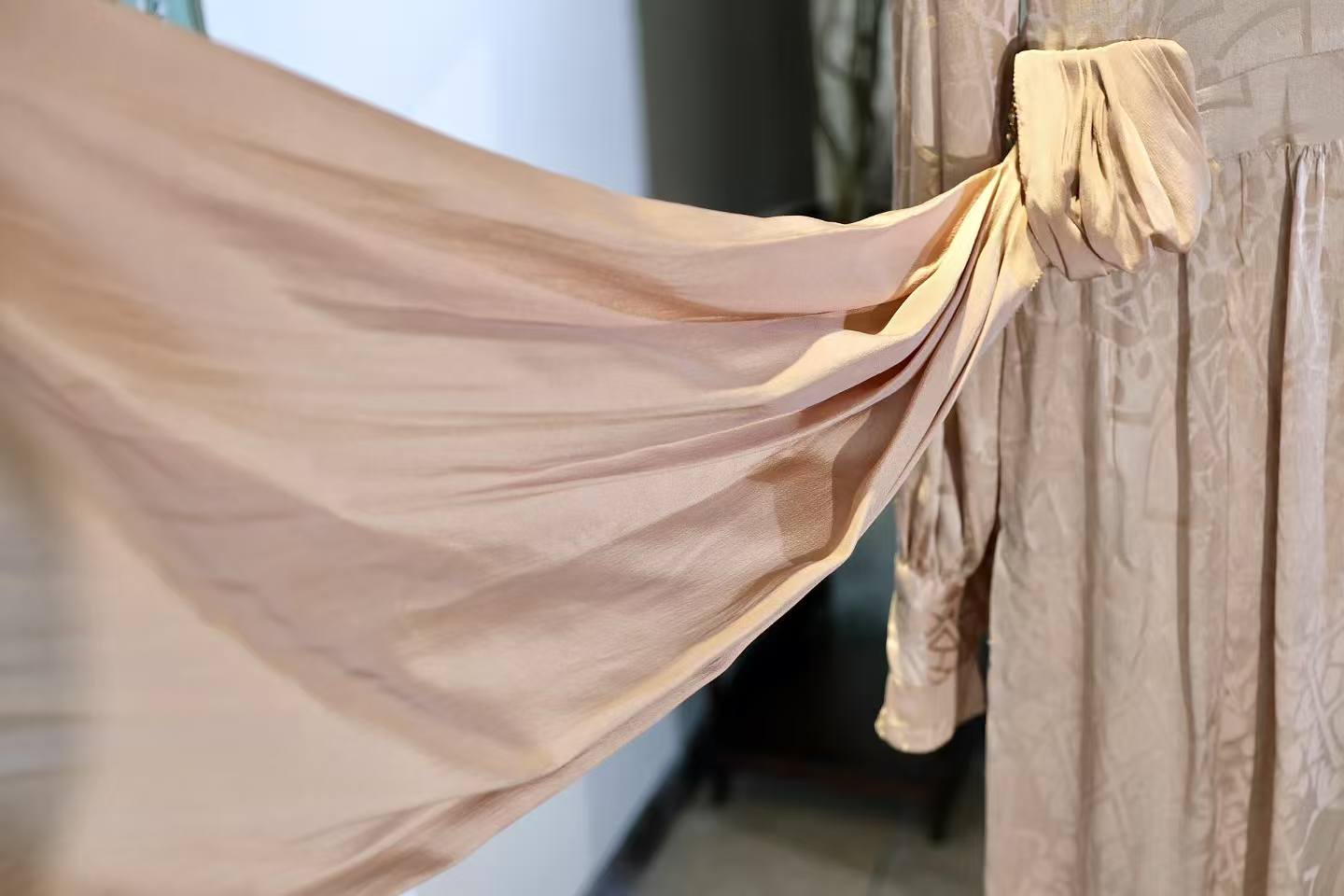
这件1920年代的真丝提花礼服,以浅杏色为底,通体织就的纹样是理解其艺术风格的关键。其图案设计堪称“装饰艺术运动”与东方美学的精妙融合:
- 几何骨架:大面积的菱形格纹与折线纹构成理性骨架,呼应1920年代上海作为“东方巴黎”对西方现代性的追逐。菱形内嵌套的细密网格,暗合《考工记》“天有时,地有气,材有美,工有巧”的造物理念,在机械美学中保留手工温度。
- 光影韵律:真丝提花工艺使纹样在光线下呈现微妙的光泽变化——菱形格纹因织造密度不同而显深浅,花卉轮廓则以更细腻的丝线勾勒,行走间如水面泛起涟漪,暗合1920年代“流动的现代性”审美。
二、岁月留痕:一件礼服的时代叙事
这件礼服的诞生,恰逢中国社会剧烈转型的1920年代。彼时上海租界的舞厅里,爵士乐与旗袍的曲线共同演绎着摩登神话。礼服的直筒廓形(chemise dress)摒弃了清代女装的繁复镶滚,以简洁的线条呼应女性解放的浪潮——正如张爱玲在《更衣记》中所写:“1920年代的女人,开始用衣服的直线来对抗世界的曲线。”
细节处更见时代密码:
- 珠饰流苏:领口垂落的黑色珠串流苏,以米珠与管珠编织成几何吊坠,随步伐轻晃时,既是对西方flapper风格的致敬,又暗藏中国传统“步摇”的仪态美学。
- 腰侧蝴蝶结:腰际不对称的丝绸蝴蝶结,以立体褶皱打破直筒裙的单调,其位置恰好对应1920年代流行的“低腰线”设计,既修饰身形,又暗示着女性对身体自主权的 reclaim。
- 袖口玄机:长袖采用“灯笼袖”改良款,袖口收紧处以暗纹提花呼应衣身图案,既保留传统“宽衣博带”的飘逸感,又通过袖型的结构感彰显现代性。
三、艺术史坐标:稀缺性的三重维度
这件礼服的稀缺性,不仅在于其百年存世的物理状态,更在于其承载的艺术史价值:
- 工艺孤本:1920年代的真丝提花工艺已近失传。衣身纹样需通过“经纬异色”的提花织机织造,每平方厘米的经纬密度高达120根,这种“寸锦寸金”的工艺,在今日机器印花时代已难复制。
- 风格标本:它是“装饰艺术运动”在东方服饰上的罕见实证。相比同期西方礼服的夸张金属色,这件礼服以低饱和度的杏色与抽象纹样,展现了中国设计师对现代性的本土化诠释——正如艺术史家巫鸿所言:“中国现代性从来不是西方的复制品,而是传统的创造性转化。”
- 文化化石:礼服上的几何纹样与花卉纹样,实为1920年代上海“月份牌”广告美学的三维呈现。彼时《良友》画报上的摩登女郎,常着此类融合中西纹样的服装,而这件礼服正是那个“纸醉金迷”时代的物质遗存。
四、结语:穿在身上的历史诗学
这件礼服不仅是衣物,更是一部穿在身上的历史诗学。当指尖抚过真丝提花的纹路,仿佛触摸到1920年代上海滩的晚风——那是爵士乐与留声机的交响,是旗袍与高跟鞋的碰撞,是传统与现代在丝线间达成的微妙和解。正如本雅明所言:“真正的历史对象,是过去与现在的辩证图像。”这件礼服,正是那个时代最鲜活的“辩证图像”。
This 1920s silk jacquard gown, featuring a pale apricot base, holds the key to understanding the artistic style of its era through its intricate woven patterns. The design serves as a masterful fusion of the Art Deco movement and Oriental aesthetics:
The Geometric Skeleton: Large-scale lozenge grids and zigzag patterns form a rational framework, echoing 1920s Shanghai’s pursuit of Western modernity as the "Paris of the East." The fine mesh nested within the lozenges aligns with the creative philosophy from Kao Gong Ji: "Heaven has its seasons, Earth its vitality, materials their beauty, and craftsmen their skill," retaining a sense of manual warmth within machine aesthetics.
The Rhythm of Light: The silk jacquard process allows the motifs to present subtle shifts in luster under varying light—the lozenge grids appear in different depths due to varying weaving densities, while floral silhouettes are outlined with finer silk threads. During movement, the fabric ripples like water, harmonizing with the "fluid modernity" aesthetic of the 1920s.
The birth of this gown coincided with the dramatic social transformation of 1920s China. In the ballrooms of the Shanghai Concessions, jazz music and the curves of the qipao collectively performed a modern myth. The gown’s straight silhouette (chemise dress) abandoned the complex trimmings of Qing Dynasty attire, utilizing clean lines to echo the wave of female liberation—as Eileen Chang wrote in A Record of Changing Clothes: "Women in the 1920s began to use the straight lines of clothing to combat the curves of the world."
The details reveal even more codes of the era:
Beaded Fringe: The black beaded fringe falling from the neckline, woven with seed and bugle beads into geometric pendants, sways with every step. This is both a tribute to the Western flapper style and a hidden nod to the traditional Chinese Buyao (stepping-shake) aesthetic of graceful movement.
Side-Waist Bow: An asymmetrical silk bow at the hip uses three-dimensional pleats to break the monotony of the straight-cut skirt. Its placement corresponds to the "low-waist" design popular in the 1920s, which both modified the figure and hinted at women reclaiming bodily autonomy.
Sleeve Details: The long sleeves adopt an "improved lantern" cut. The tightened cuffs feature dark-weave jacquard echoing the dress patterns, preserving the ethereal feel of traditional "wide robes and broad belts" while highlighting modernity through structural form.
The scarcity of this gown lies not only in its century-old physical survival but in the art-historical value it carries:
Craftsmanship Unicum: The silk jacquard techniques of the 1920s are nearly a lost art. The patterns required weaving on looms with "heterochromatic warp and weft," reaching a density of 120 threads per square centimeter. This "inch of brocade for an inch of gold" craftsmanship is almost impossible to replicate in today's era of machine printing.
Stylistic Specimen: It is a rare physical testament to the Art Deco movement within Oriental dress. Compared to the exaggerated metallic tones of contemporary Western gowns, this piece uses low-saturation apricot and abstract patterns to showcase a localized interpretation of modernity by Chinese designers—as art historian Wu Hung noted: "Chinese modernity was never a replica of the West, but a creative transformation of tradition."
Cultural Fossil: The geometric and floral patterns are three-dimensional manifestations of the 1920s Shanghai "Calendar Girl" (Yuefenpai) advertisement aesthetic. The modern women found in The Young Companion (Liangyou) magazine often wore garments merging Sino-Western motifs; this gown is a material remnant of that "extravagant and gold" era.
This gown is more than clothing; it is a work of historical poetics worn on the body. As your fingertips brush the texture of the silk jacquard, it is as if you are touching the evening breeze of 1920s Shanghai—the concerto of jazz and gramophones, the collision of qipaos and high heels, and the subtle reconciliation between tradition and modernity achieved between silk threads. As Walter Benjamin said: "The true historical object is the dialectical image of the past and the present." This gown is the most vivid "dialectical image" of its time.