深圳溯源
无法加载取货服务可用情况
一、形制与工艺:岭南绣艺的巅峰之作
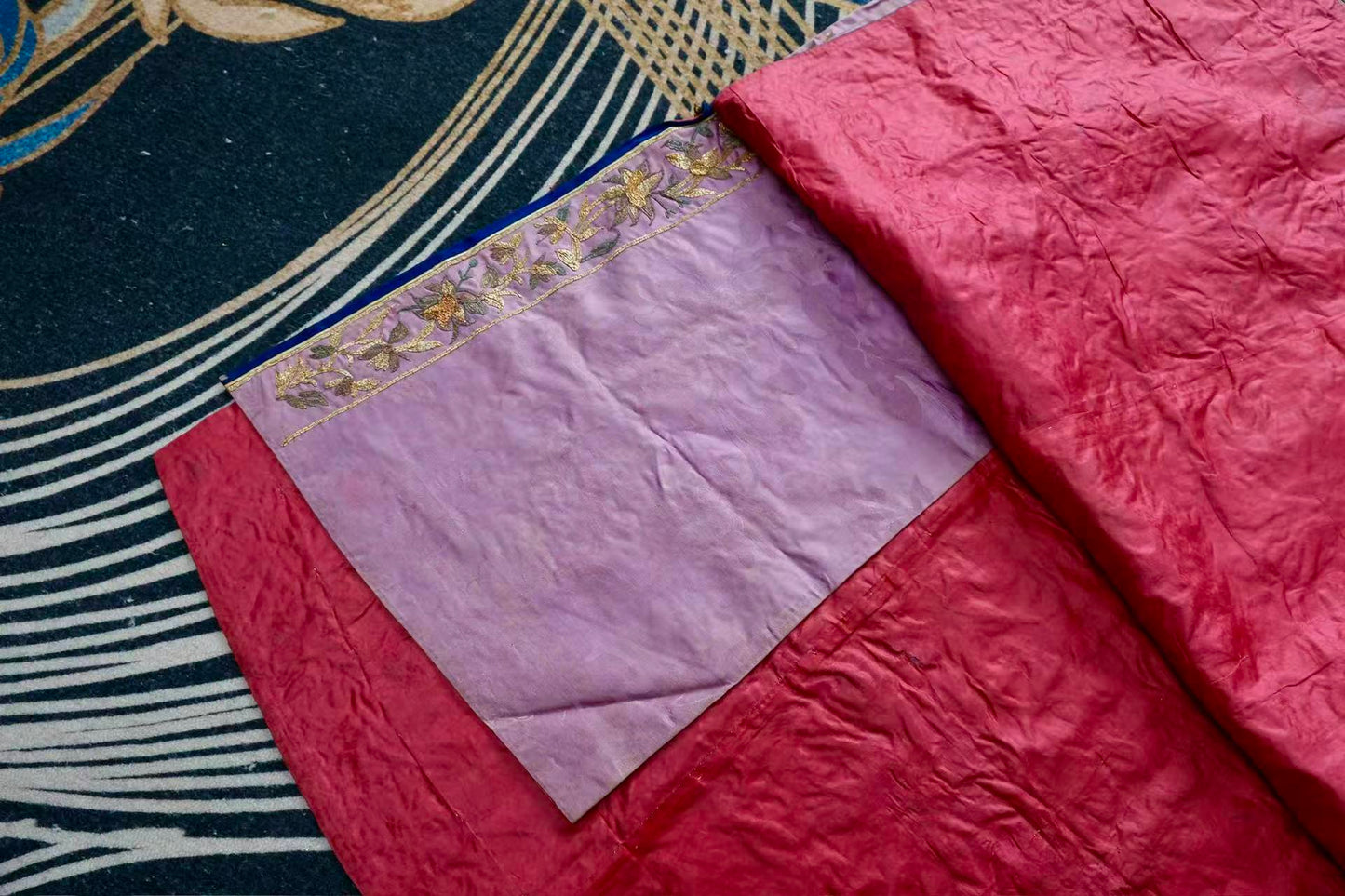
这套民国10年的紫缎盘金粤绣上袄下鱼鳞裙,
- 盘金绣:以金线盘绕出花卉、人物、瑞兽轮廓,再以彩线填绣细节,
- 鱼鳞裙工艺:裙身由数十片梯形缎片拼接而成,
二、图案解码:吉祥纹样中的文化密码
衣身图案繁复而不杂乱,每一处纹样皆暗含传统吉祥寓意,堪称“
- 花卉纹:上袄主体绣满缠枝莲、牡丹、菊花等四季花卉,取“
- 人物纹:襟边两条浅绿色缎带上,绣有仕女与童子形象——
- 瑞兽纹:裙摆下缘绣有麒麟、凤凰等瑞兽,麒麟踏云而来,
- 海水江崖纹:裙摆底部绣海水江崖纹,金线盘出翻滚的波涛,
三、历史叙事:一件古董衣的时代印记
1910年的岭南,正处于传统与现代的交汇点。这套服饰的主人,
- 粤绣的地域特色:粤绣与苏绣、湘绣、蜀绣并称“四大名绣”,
- 稀缺性:民国初年的粤绣服饰存世极少,尤其是“上袄下鱼鳞裙”
四、艺术风格:传统与现代的碰撞
这套服饰的艺术风格,体现了民国初年岭南服饰的“守正与创新”:
- 守正:纹样延续明清传统,如缠枝莲、海水江崖、瑞兽等,皆源于《
- 创新:形制上,上袄缩短至腰际,下裙改为鱼鳞褶,
五、结语:金线绣出的时代风华
这套民国10年紫缎盘金粤绣上袄下鱼鳞裙,不仅是一件服饰,
如今,这样的古董衣已如凤毛麟角,每一针每一线,
This complete ensemble consisting of a purple satin, couched gold, Cantonese-embroidered top (shang'ao) and a fish-scale skirt (yulinqun) from Year 10 of the Republic of China is a quintessential representative of Lingnan garment craftsmanship. The upper garment is a standing-collar, right-overlapping short top, while the lower garment is a pleated fish-scale skirt. Utilizing a light purple patterned satin as the ground fabric, the entire ensemble is lavishly embellished with couched gold embroidery (panjinxiu) and polychrome silk embroidery (caixiu). The sheer volume of gold thread used and the meticulousness of the needlework crown this piece as a "glorious chapter of gold embroidery" within the Cantonese embroidery (Yuexiu) canon.
Couched Gold Embroidery: This technique involves couching gold threads onto the fabric to outline flowers, figures, and auspicious beasts, before filling in the finer details with colored silk threads, yielding a visual effect that is "magnificent and golden yet elegant." For instance, along the neckline and lapel edges, the vines of the scrolling lotus patterns couched in gold thread wind like swimming dragons, while the petals are embroidered with pink, green, and blue silk threads. The distinct layers perfectly manifest the defining traits of Cantonese embroidery: "spreading threads as fine as hair, and inserting needles as rigorously as legal statutes."
Fish-Scale Skirt Technique: The body of the skirt is meticulously spliced together from dozens of trapezoidal satin panels. Each panel's edge is embroidered with couched gold scrolling vine patterns, and the hem drapes in a layered fish-scale pattern. With every step of the wearer, the hem sways like undulating golden waves. This represents a classical silhouette worn by upper-class Lingnan women in the early Republic of China era, and it has become exceptionally rare today.
The motifs on the garment are intricate without being chaotic; every single pattern implicitly carries traditional auspicious meanings, making it a veritable "history of culture worn on the body."
Floral Motifs: The main body of the upper top is fully embroidered with seasonal flora such as scrolling lotuses, peonies, and chrysanthemums, conveying the wishes of "peace throughout the four seasons and everlasting prosperity." Among them, the scrolling lotus motifs utilize gold thread to couch the winding vines, colored threads to embroider the petals, and shades of green, blue, and purple to create gradients on the leaves—subtly aligning with the auspicious imagery of "intertwining vines, continuous and never-ending" as recorded in the historical architectural text Treatise on Architectural Methods (Yingzao Fashi).
Figurative Motifs: Along two light-green satin ribbons on the lapel, figures of elegant ladies and young boys are embroidered—the ladies holding floral branches and the boys playing among the blossoms. This symbolizes "abundant offspring and a thriving clan," which was a common "child-seeking" theme found on wedding and formal attire in the early Republic of China era.
Auspicious Beast Motifs: The lower edge of the skirt hem features embroidered mythical creatures like the qilin and the phoenix. The qilin strides forward upon clouds while the phoenix unfurls its wings to soar. The animal fur, embroidered with gold thread, is defined strand by strand, and the clouds, punctuated with colored silk threads, appear lightweight and drifting. This subtly channels the auspicious culture from The Book of Rites (Liji): "The qilin, the phoenix, the tortoise, and the dragon are called the Four Numinous Beasts."
Deep Sea and River Cliff Motif (Haishui Jiangya): The very bottom of the skirt hem features an embroidered haishui jiangya motif. Gold threads couch the churning, rolling waves, while colored threads embroider the jagged rocks and auspicious clouds. This symbolizes "the eternal stability of the state and boundless longevity." As a classical motif traditionally reserved for court robes and ceremonial dress, its application here on a civilian garment indicates the family's highly prominent social status.
The Lingnan region in 1921 stood precisely at the crossroads of tradition and modernity. The owner of this attire was highly likely a female member of a wealthy Lingnan merchant guild or an official's family. At that time, the Lingnan region enjoyed great economic prosperity, and Cantonese embroidery, as a flagship representative of "Canton Goods" (Guanghuo), was exported globally. Wealthy women actively pursued attire that was "laden with gold embroidery and packed with intricate motifs" to overtly display their status.
Regional Characteristics of Cantonese Embroidery: Cantonese embroidery is celebrated alongside Suzhou, Hunan, and Sichuan embroidery as one of China's "Four Great Famous Embroideries." It is characterized by its "diverse use of threads, rich and intense color palettes, and heavy gold-thread underlays." This attire is a textbook example of the "gold embroidery" style of Yuexiu—the gold thread accounts for over 60% of the total thread count, leaving the colored silk threads to merely accentuate details. This creates a "brilliant and gilded" visual effect that stands in stark contrast to the "refined, light, and delicate" aesthetic of Suzhou embroidery (Suxiu).
Rarity: Authentic Cantonese embroidery attire from the early Republic of China era survives in extremely limited numbers, particularly complete matching sets featuring the "upper top and lower fish-scale skirt." Currently, such examples are only found in a select few museums in the Lingnan area (such as the Guangdong Folk Arts Museum). This specific set is perfectly preserved, with none of the gold threads faded and the embroidery completely intact, rendering it a true "living fossil of Republic of China Cantonese embroidery."
The artistic style of this attire reflects the philosophy of "preserving the orthodox while innovating" within Lingnan fashion during the early Republic of China:
Preserving the Orthodox: The motifs directly inherit Ming and Qing dynasty traditions. Patterns like the scrolling lotus, the deep sea and river cliff, and the auspicious beasts all stem from historical classics such as Yingzao Fashi and The Records of Examination of Crafts (Kaogong Ji). Architecturally rigorous, the execution strictly adheres to ancient Yuexiu techniques, inheriting methods like gold-couching, polychrome silk embroidery, and textile patchwork from the Qing court.
Innovating: In terms of silhouette, the upper top was shortened to stop at the waistlines, and the lower skirt was modified into fish-scale pleats, which better accommodated the early Republic of China trend of women "liberating the body." In terms of palette, the light purple satin ground creates a sophisticated contrast against the gold and colored threads, retaining the traditional "gilded magnificence" while infusing the "fresh and refined" fashion sensibilities of the Republic era.
This purple satin, couched gold, Cantonese-embroidered top and fish-scale skirt from Year 10 of the Republic of China is not merely an article of clothing, but a "history worn on the body." Using gold thread as its pen and colored silk as its ink, it records the prosperity and elegance of early Republic-era Lingnan. Guided by its motifs, it decodes the profound depth of traditional auspicious culture, and certified by its craftsmanship, it stands testament to the artistic zenith of Cantonese embroidery's gilded glory.
Today, such antique garments are as rare as a phoenix feather or a unicorn horn. Every single stitch and thread is a gift from time, richly deserving of preservation, rigorous research, and celebration.