深圳溯源
无法加载取货服务可用情况
年代:民国十五年(1926年)前后
形制:无袖筒子领长马甲
工艺:金线提花织锦、手工流苏
一、衣上纹章:金线里的“富贵连绵”
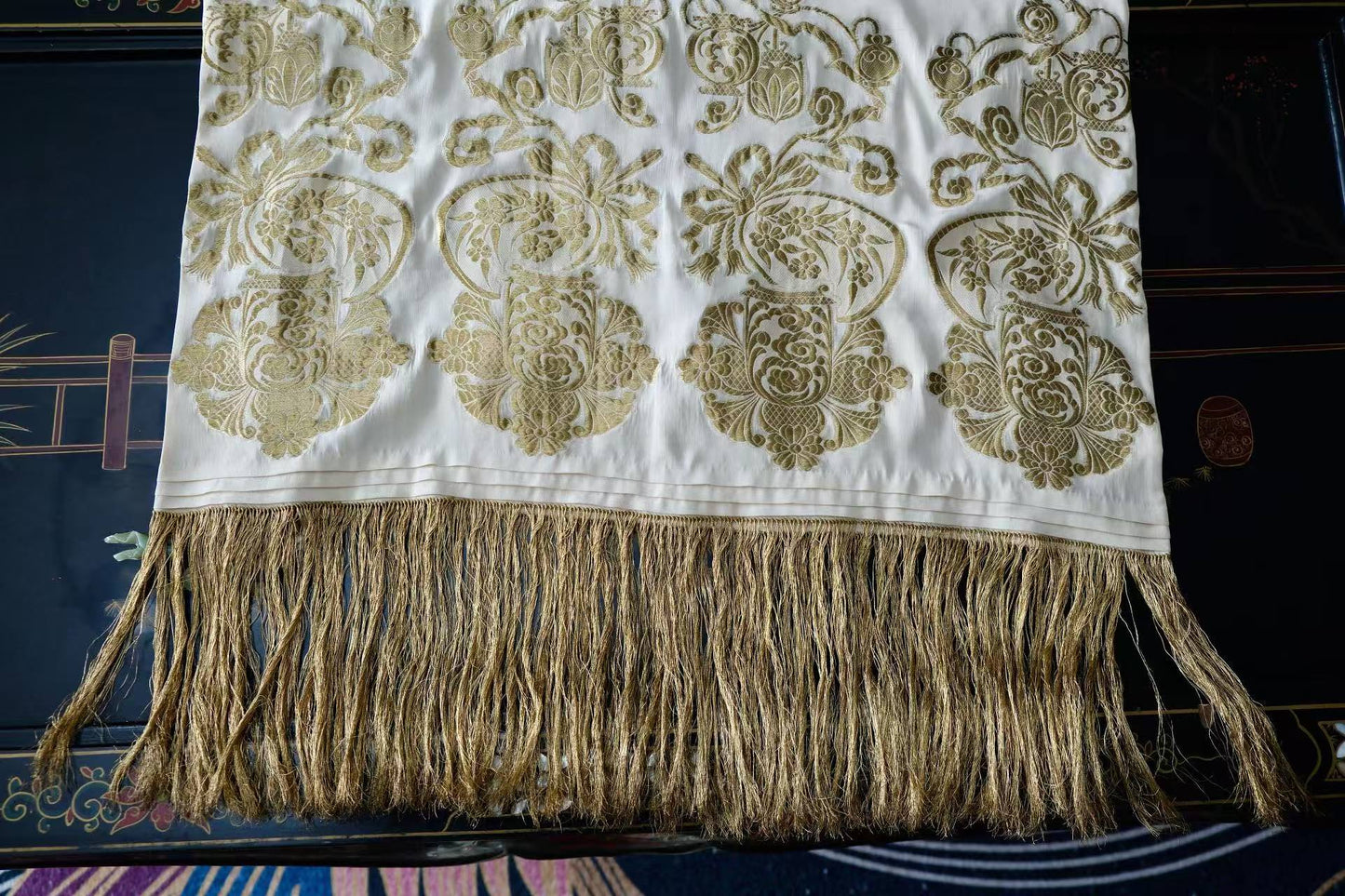
马甲下摆处的金线提花纹样,是民国织造工艺的巅峰缩影。以“缠枝莲”为主体纹饰,枝蔓卷曲如云,花头饱满若盏,每一片莲瓣皆以“三晕色”金线织就——深金勾边、浅金铺底、赤金点蕊,阳光下流转如碎金入水。
- 纹样考据:缠枝莲纹源自佛教“宝相花”,明清时演变为“富贵不断头”的吉祥符号。此件马甲的莲纹间暗藏“卍”字锦地,寓意“万福绵长”,与民国初期“中西合璧”的审美思潮相呼应——既承袭清代宫廷织造的严谨,又融入西洋装饰艺术的流动感。
- 工艺稀缺性:金线提花需以“通经断纬”技法手工织造,一寸锦一寸金。据《苏州织造局志》载,此类纹样需“千梭万缕,经月方成”,而民国后期机制锦缎普及,此等纯手工提花织物已成绝响。
二、衣中岁月:筒子领里的新旧时代
“筒子领”是民国初年女性服饰的标志性设计——立领高约三寸,领口以暗金线滚边,既保留清代旗装的端庄,又摒弃了繁复的盘扣,露出内搭的素色旗袍或衬衫,恰如《申报》1924年所言:“新式马甲,领如筒玉,身若流云,穿之者既有旧家风范,又具新派气象。”
这件马甲的主人,或是一位接受新式教育的名门闺秀:白日穿它配素缎旗袍赴学堂,夜晚搭丝绒长裙出席舞会。金线流苏随步履轻晃,既非清代命妇的刻板华贵,亦非西洋服饰的张扬暴露,而是民国女性“藏锋于柔”的独特气质——正如张爱玲所写:“衣裳是随身携带的避难所”,这件马甲,便是新旧时代碰撞中,一位女性为自己织就的“温柔铠甲”。
三、衣外风华:从织机到博物馆的百年孤本
此件马甲的稀缺性,更在于其“过渡时代”的标本意义:
- 形制过渡:筒子领流行于1915-1925年间,存世量不足民国马甲总量的1%;
- 工艺断代:金线提花织锦在抗战爆发后因原料短缺而衰落,此件马甲的金线仍保持九成以上光泽,可见当年织造时用料的奢侈;
- 文化符号:下摆流苏长达十寸,不同于清代短穗的拘谨,亦异于1930年代长穗的浮夸,恰是民国初期“不激不随”审美趣味的实物见证。
如今,这件马甲静卧于深蓝缠枝纹地毯之上,金线与素缎的对话,仍在诉说那个“旧时王谢堂前燕,飞入寻常百姓家”的时代——它不仅是衣裳,更是一段被织进经纬里的民国往事,一件可以触摸的“穿在身上的历史”。
Circa: 15th Year of the Republic (1926)
Silhouette: Sleeveless High "Tube" Neck Long Vest
Craftsmanship: Gold-Thread Jacquard Brocade, Handmade Fringe
The gold-thread jacquard pattern at the vest's hem is a pinnacle microcosm of Republican-era weaving. Featuring "Intertwining Lotuses" as the primary motif, the vines curl like clouds while the blossoms sit as full as chalices. Each petal is woven with "Three-Tone Gradient" gold threads—deep gold for outlining, pale gold for the base, and reddish-gold for the stamen—shimmering like scattered gold in water under the sun.
Iconographic Research: The intertwining lotus motif originates from the Buddhist "Baoxiang Flower." By the Ming and Qing dynasties, it evolved into an auspicious symbol of "uninterrupted prosperity." This vest’s lotus patterns are set against a hidden "Wan" (卍) character brocade ground, symbolizing "eternal blessings." It echoes the early Republican "East-meets-West" aesthetic—inheriting the rigor of Qing imperial weaving while absorbing the fluidity of Western Art Deco.
Artisanal Scarcity: Gold jacquard requires manual weaving with the "continuous warp and discontinuous weft" technique; literally, "an inch of brocade is an inch of gold." According to the Records of the Suzhou Weaving Bureau, such patterns took "thousands of shuttles and months to complete." With the rise of machine-made brocade in the later Republican era, such pure handmade jacquard became an extinct echo.
The "Tube Neck" (Tongzi Ling) was an iconic design for women in the early Republic—a standing collar nearly three inches high, piped with dark gold thread. It preserved the dignity of Qing Manchu robes while discarding complex frog buttons to reveal the plain qipao or blouse worn underneath. As The Shun Pao remarked in 1924: "The new-style vest has a neck like tubular jade and a body like flowing clouds; the wearer possesses both the heritage of an old family and the spirit of a new school."
The owner of this vest might have been a well-educated lady from a noble house: wearing it over a plain satin qipao to the lecture hall by day, and pairing it with a velvet gown for a ball by night. The golden fringes swayed with her steps—neither the rigid opulence of a Qing noblewoman nor the overt exposure of Western dress, but rather the unique "hidden edge within softness" of the Republican woman. As Eileen Chang wrote: "Clothing is a portable shelter," and this vest was a "gentle armor" woven for a woman amidst the collision of old and new eras.
The scarcity of this vest lies in its significance as a specimen of a "transitional era":
Silhouette Transition: The "Tube Neck" was popular only between 1915 and 1925; extant pieces account for less than 1% of surviving Republican vests.
Technological Discontinuity: Gold-thread jacquard brocade declined after the outbreak of the war due to raw material shortages. The gold threads on this vest retain over 90% of their luster, evidence of the luxurious materials used.
Cultural Symbolism: The ten-inch fringe at the hem is neither as restrained as the short tassels of the Qing dynasty nor as flamboyant as the long fringes of the 1930s. It is a physical witness to the early Republic’s aesthetic of "neither extremist nor conformist."
Today, this vest rests upon a deep-blue intertwining lotus carpet. The dialogue between gold thread and plain satin continues to tell of an era where "the swallows from the halls of the great have flown into the homes of ordinary people." It is more than a garment; it is a Republican story woven into warp and weft—a piece of "history worn on the body" that one can truly touch.