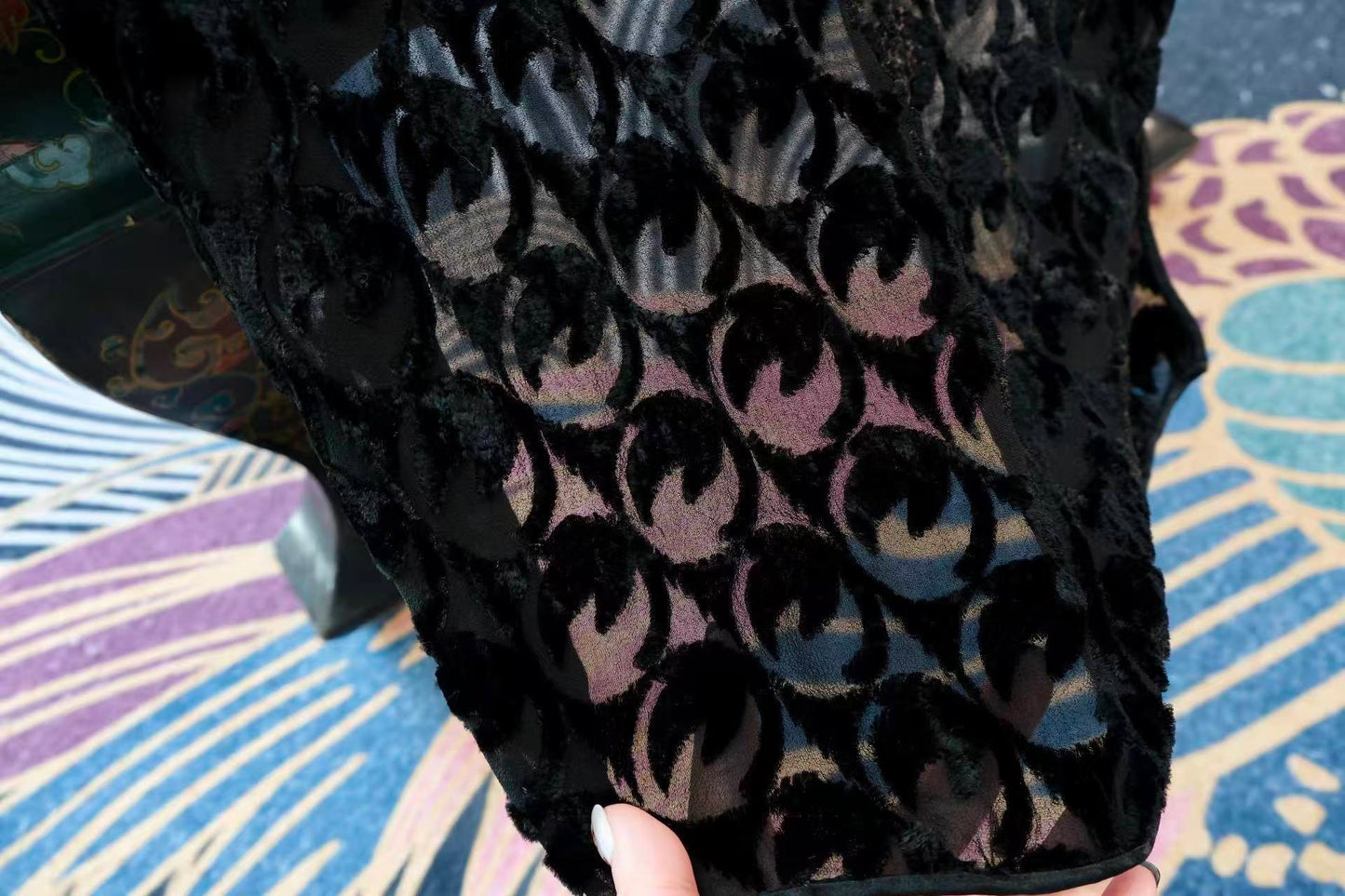
三十年代Art Deco烧花丝绒旗袍:摩登上海的纺织交响诗
这件存世极罕的上世纪三十年代晚期烧花丝绒旗袍,是海派摩登美学与东方诗性文明碰撞出的纺织交响诗。其主体以立体烧花工艺雕琢出循环排列的Art Deco几何云纹——纹样以对称式放射构型为骨,将传统云雷纹的绵延意象解构为棱角分明的几何弧线,形如机械时代锻造的金属云气,又似装饰艺术运动(Art Deco)中“摩登东方”风格的视觉具象。
此云纹可溯源至商周云雷纹的几何化蜕变:汉代漆器云气纹的飘逸线条,在装饰艺术运动的机械美学浪潮中,被重构为棱角锐利的放射状弧形;明代织锦“落花流水”纹样的写意形态,亦在此蜕变为秩序化的几何矩阵。正如1925年巴黎《装饰艺术与现代工业展宣言》所倡:“装饰即秩序,几何即诗意”——纹样中重复、对称、放射的形式语言,既呼应上海外滩建筑群(如沙逊大厦、汇丰银行)的Art Deco立面语言,又暗合《考工记》“天有时,地有气,材有美,工有巧”的造物哲学,将东方吉祥寓意与西方现代主义美学熔铸为一。
烧花工艺的珍贵性更显其文物价值。这种“雕花丝绒”工艺需以化学腐蚀技法精准雕琢丝绒表面,使几何云纹呈现浮雕般的金属质感,这种工艺在民国时期仅见于沪上高端旗袍工坊,且因工艺复杂、成本高昂,存世实物凤毛麟角。据《上海通志》记载,三十年代上海丝绒厂年产量不足百匹,而烧花工艺成品率仅三成,使得这件旗袍成为名副其实的“可移动的纺织工业史标本”。
旗袍领口的盘扣以同色绸缎雕出几何缠枝纹,与主体云纹形成“机械对称”与“东方写意”的张力平衡。
在海派文化语境中,黑色烧花丝绒旗袍是“摩登与传统”的平衡术。三十年代上海名媛钟情黑绒旗袍,《良友》画报1935年刊文称“黑绒配烧花,如外滩夜色中的钢骨水泥”。其修身剪裁与几何云纹的机械美感,既承袭东方“天人合一”的含蓄,又彰显西方现代主义的理性,堪称民国女性解放的物质注脚。
历经八十余载,此旗袍仍保有丝绒的墨色光泽,烧花云纹的几何线条无一丝崩线,实为古董旗袍收藏界的“Art Deco纺织圣物”。正如装饰艺术运动先驱霍瑞修·格里诺所言:“真正的装饰,是让传统在现代性中重生”——这件旗袍,正是民国上海“东西对撞,古今相生”的摩登史诗,其艺术价值与历史价值,将在时光中永续回响。
1930s Art Deco Devoré Velvet Qipao: A Textile Symphony of Modern Shanghai
A Synthesis of Geometry and Poetics This exceptionally rare late-1930s Devoré (burnt-out) velvet qipao is a textile symphony born from the collision of Shanghai’s "Haipai" modernism and Eastern poetic civilization. The garment features a repeating Art Deco geometric cloud motif, meticulously etched into the fabric. The pattern uses a symmetrical radial structure, deconstructing the continuous imagery of traditional "Cloud and Thunder" (Yunlei) patterns into sharp, geometric arcs—resembling metallic clouds forged in the industrial age, and serving as a visual manifestation of "Oriental Modernism" within the Art Deco movement.
The Evolution of the "Cloud" Narrative The motifs trace an evolutionary lineage: the fluid lines of Han Dynasty lacquerware and Ming Dynasty "Falling Flowers and Flowing Water" patterns are here reconstructed into a disciplined geometric matrix. As the 1925 Paris Manifesto of Decorative Arts proclaimed: "Decoration is order; geometry is poetry." The repetitive, symmetrical, and radial language of the patterns echoes the Art Deco facades of the Shanghai Bund (such as the Sassoon House and HSBC Building), while aligning with the ancient Chinese philosophy from Kao Gong Ji: "Heaven has its seasons, Earth its vitality, materials their beauty, and craftsmanship its skill."
The Rarity of Devoré: A Specimen of Industrial History The historical value of this piece is heightened by the rarity of the Devoré technique. This "sculptural velvet" process required chemical etching to precisely carve the pile, giving the geometric clouds a relief-like, metallic texture. In the Republic era, this craft was exclusive to Shanghai’s elite ateliers. According to the Shanghai Annals (Shanghai Tongzhi), the annual output of velvet in 1930s Shanghai was less than a hundred bolts, with a success rate for Devoré finishing at only 30%. This makes the qipao a literal "movable specimen of textile industrial history."
The Dialectics of Shanghai Modernity In the cultural context of old Shanghai, a black Devoré velvet qipao was a masterclass in balancing tradition and modernity. Shanghai socialites of the 1930s adored black velvet; as The Young Companion (Liangyou) noted in 1935: "Black velvet with Devoré patterns is like the steel and concrete of the Bund at night." Its form-fitting cut and industrial-geometric aesthetic preserve the Eastern "Harmony of Heaven and Man" while asserting Western modernist rationality—a material footnote to the liberation of the modern Chinese woman.
Conclusion: An Immortal Echo After eight decades, the velvet retains its deep ink-like luster, and the geometric lines remain impeccably sharp. As Art Deco pioneer Horatio Greenough said: "True decoration is the rebirth of tradition within modernity." This qipao is a modern epic of "East meeting West," whose artistic and historical resonance will continue to echo through time.