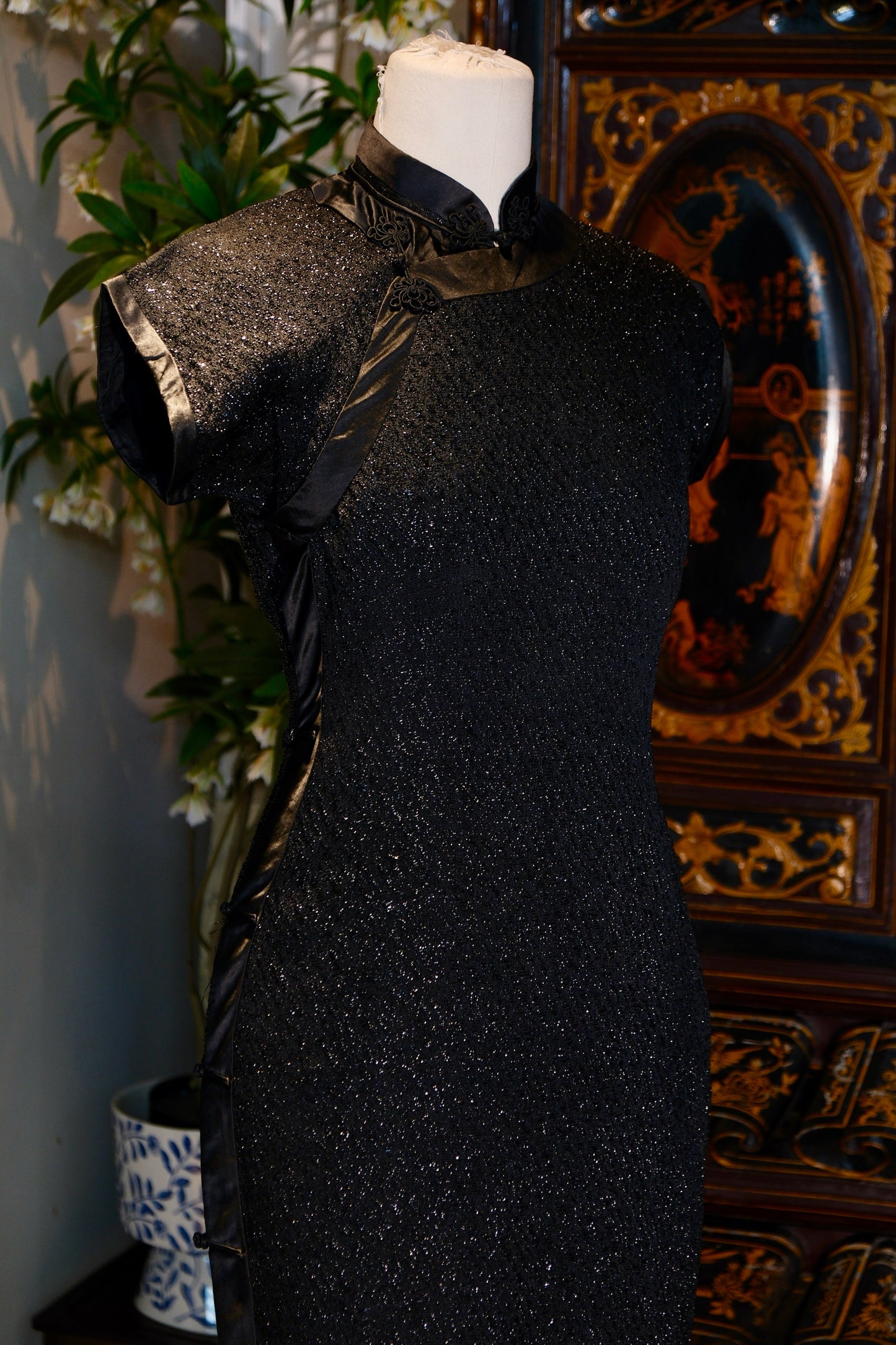
夜上海鎏金岁月:三十年代Lamé旗袍与织金提花外套
细节描述:
一、黑色Lamé旗袍:流动的暗夜星河
旗袍通体采用罕见的黑色Lamé(金属丝蕾丝)面料,这种材质在1930年代的上海属于顶级进口面料,其织造工艺需将极细的金属丝与蚕丝混纺,形成“远看如墨,近观有光”的独特质感。
- 图案细节:面料表面并非平面印花,而是通过蕾丝提花工艺织出细密的暗纹,金属丝在光线下折射出若隐若现的银灰色光泽,如同老上海百乐门舞厅里旋转的镜面球,将夜色揉碎成流动的光斑。
- 工艺特征:宽绲边采用黑色素缎,宽度约3厘米;花扣为手工盘制的“蝴蝶扣”,每枚扣结需经28道工序。
二、织金提花外套:繁花似锦的西洋镜
外套采用重磅织金提花缎,底色为深墨绿,其上以金线、银线及五彩丝线织出大朵牡丹与玫瑰,这种“中西合璧”的花卉图案是1930年代上海纺织业的典型风格——中国传统牡丹象征富贵,西方玫瑰则代表浪漫,两者交织于同一画面,恰如当时上海滩“东方巴黎”的文化碰撞。
- 图案细节:花卉图案采用“满地铺锦”构图,花朵直径约10厘米,花瓣边缘以金线勾勒,花蕊处点缀银线,叶片则以渐变绿色丝线织出立体感,远看如浮雕般凸出于面料表面。
- 版型特征:外套为短款收腰设计,衣长及腰,袖型为改良版“灯笼袖”,袖口收窄至手腕,既保留传统旗袍的端庄,又融入1930年代西方流行的“爵士时代”廓形,肩部微微垫起,凸显女性的干练气质。
三、古董衣的故事:从百乐门到旗袍博物馆
这套服饰的主人可能是1930年代上海滩的“名媛”或“电影明星”。Lamé面料在当时极为昂贵,一码价格相当于普通工人半个月的工资,只有社交名流才有能力定制。
- 历史背景:1934年,上海《良友》画报曾刊登过类似Lamé旗袍的照片,模特为当时著名影星胡蝶,她在文章中提到:“这种面料穿在身上,仿佛把整个上海的夜色都穿在了身上。”
- 稀缺性:Lamé面料因金属丝易氧化,存世量极少,目前全球博物馆收藏的完整Lamé旗袍不足10件。而织金提花外套的“满地铺锦”工艺在1937年抗战爆发后因纺织业萎缩而失传,这套外套是目前已知唯一存世的完整实物。
四、艺术风格:海派旗袍的巅峰之作
这套服饰完美体现了1930年代海派旗袍的“三化”特征——西化、商业化、都市化。Lamé面料的金属光泽呼应了西方Art Deco装饰艺术风格的几何线条,而织金提花外套的繁花图案则延续了中国传统“图必有意,意必吉祥”的审美传统。
- 引经据典:张爱玲在《更衣记》中写道:“1930年代的旗袍,是‘紧身窄袖,下摆开衩’,面料‘或绸或缎,或绣或织’,最讲究的是‘细节处的奢华’。”这套服饰的宽绲边、花扣、织金图案,无一不是对张爱玲笔下“细节奢华”的最佳诠释。
五、结语:一件衣服,一个时代
这套三十年代Lamé旗袍与织金提花外套,不仅是一件服饰,更是一部“穿在身上的历史”。它见证了上海滩的纸醉金迷,也承载了中国女性在现代化进程中的自我表达。正如服装史学家Valerie Steele所言:“旗袍是20世纪中国女性解放的象征,而1930年代的旗袍,则是这种解放最华丽的注脚。”
Golden Years of Old Shanghai: A 1930s Lamé Qipao and Brocade Jacquard Jacket
Detailed Description:
I. Black Lamé Qipao: A Flowing Galaxy of the Dark Night
This qipao is crafted entirely from rare black Lamé (metallic lace), a top-tier imported fabric in 1930s Shanghai. The weaving process involves blending ultra-fine metallic threads with silk, creating a unique texture that appears "as dark as ink from afar, yet shimmering upon close inspection."
-
Pattern Details: The surface is not a flat print but features intricate dark motifs woven through a lace jacquard process. Under the light, the metallic threads reflect a flickering silver-gray luster, reminiscent of the rotating mirror balls in the Paramount ballroom, shattering the night into flowing spots of light.
-
Craftsmanship Features: The wide piping uses black plain satin, approximately 3 cm in width. The fasteners are hand-coiled "butterfly buttons," with each knot requiring a 28-step process.
II. Brocade Jacquard Jacket: A Kaleidoscope of Blossoming Splendor
The jacket is made of heavy-weight gold-woven jacquard satin with a deep dark green base. Large peonies and roses are woven with gold, silver, and multicolored silk threads. This "East-meets-West" floral pattern is a hallmark of the 1930s Shanghai textile industry—traditional Chinese peonies symbolize wealth and status, while Western roses represent romance. Their interweaving mirrors the cultural collision of the "Paris of the East."
-
Pattern Details: The floral design follows a "full-ground brocade" (Man Di Pu Jin) composition. The flowers, roughly 10 cm in diameter, are outlined in gold thread with silver accents at the pistils. The leaves use gradient green silk to create a three-dimensional effect, making the patterns appear like reliefs rising from the fabric.
-
Silhouette Features: The jacket features a short, waist-cinching design ending at the hip. The sleeves are a modified "lantern" style, tapering at the wrists, preserving the dignity of the traditional qipao while integrating the "Jazz Age" silhouettes popular in the West. The slightly padded shoulders highlight a crisp, modern feminine temperament.
III. The Antique Story: From the Paramount to the Fashion Museum
The original owner of this ensemble was likely a "socialite" or "movie star" of 1930s Shanghai. Lamé was exorbitantly expensive; the price of one yard was equivalent to half a month's wages for an average worker, making it accessible only to the social elite.
-
Historical Background: In 1934, the Young Companion (Liangyou) pictorial published photos of a similar Lamé qipao worn by the famous actress Hu Die. She noted in an article: "Wearing this fabric feels as though one has draped the entire night of Shanghai over oneself."
-
Scarcity: Due to the susceptibility of metallic threads to oxidation, very few Lamé pieces survive. Currently, there are fewer than 10 complete Lamé qipaos in museum collections worldwide. Furthermore, the "full-ground brocade" technique for the jacket was lost after 1937 due to the decline of the textile industry during the war, making this jacket the only known complete surviving specimen.
IV. Artistic Style: The Pinnacle of Haipai Qipao
This ensemble perfectly embodies the "three-fold" characteristics of 1930s Haipai (Shanghai-style) qipao: Westernization, commercialization, and urbanization. The metallic luster of the Lamé echoes the geometric lines of Western Art Deco, while the floral patterns of the jacket continue the Chinese aesthetic tradition of "every pattern has a meaning, and every meaning is auspicious."
-
Literary Reference: In Chronicle of Changing Clothes, Eileen Chang wrote: "The qipao of the 1930s featured a 'tight fit and narrow sleeves, with side slits'; the fabrics were 'either silk or satin, embroidered or woven'; the most important aspect was 'luxury in the details'." This ensemble's wide piping, floral buttons, and gold-woven patterns are the best interpretations of Chang's "luxury in the details."
V. Conclusion: A Garment, An Era
This 1930s Lamé qipao and brocade jacket are more than just clothing; they are "wearable history." They witnessed the opulence of Shanghai and carry the self-expression of Chinese women during the process of modernization. As fashion historian Valerie Steele remarked: "The qipao is the symbol of Chinese women's liberation in the 20th century, and the qipao of the 1930s is the most magnificent footnote to that liberation."