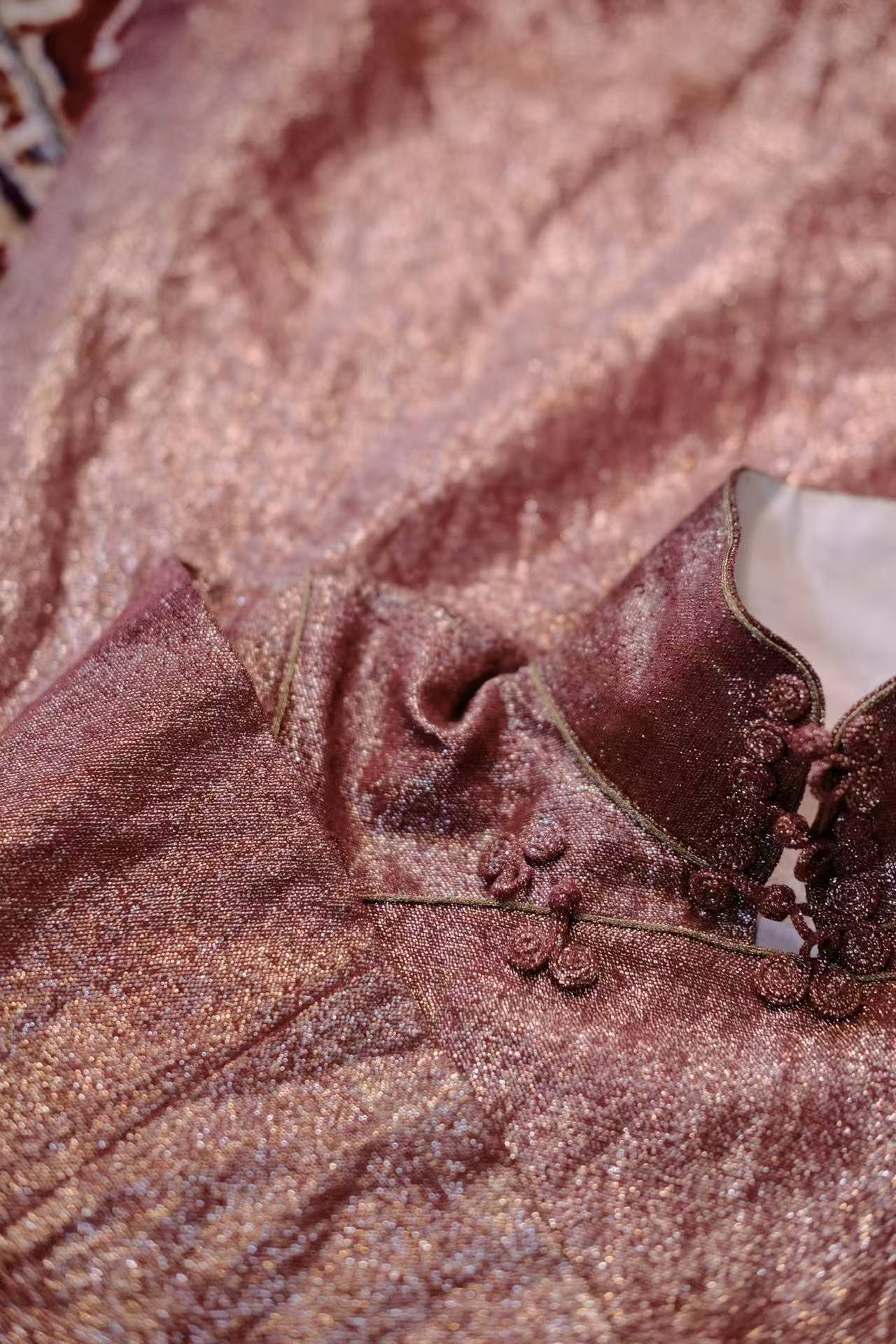
金缕玉衣:民国廿年金属织金双襟旗袍与云肩
一、衣上流光:金属织金的“低调奢华”
这件民国二十年代的金属织金双襟旗袍,以“低调的奢华”诠释了加拿大“老钱”家族的审美密码。旗袍主体采用玫瑰金金属织金面料,经纬间闪烁着“暗香浮动月黄昏”的微光——不同于西方亮片的张扬,这种织金工艺需将极细的金属丝与真丝混纺,织出“似金非金,似玉非玉”的温润质感,恰合《长物志》“宁古无时,宁朴无巧”的造物哲学。
双襟处的盘扣,以同色丝线缠绕成“如意结”,每一枚都需匠人以“千针万线”的耐心,将金属丝的硬与丝线的软完美融合,形成“刚柔并济”的视觉张力。领口与襟边的滚边,以极细的金线锁边,在光线下投下“一线天”的精致,暗合“细节处见真章”的东方智慧。
二、百年旧梦:从温哥华唐人街到蒙特利尔“东方之夜”
这套服饰的主人,正是前文所述加拿大“老钱”家族的闺秀。二十年代,她或许在蒙特利尔的“东方之夜”舞会上,以此套装扮惊艳四座:玫瑰金旗袍衬得她肤色胜雪,金属织金的微光在灯光下流转如“尼罗河的波光”;黑色云肩的珠绣在暗处闪烁如“星汉灿烂”,褶皱随步伐轻扬如“黑天鹅的羽翼”。
三、艺术孤品:跨文化的“衣冠孤本”
此套装的珍稀,在于它是“跨文化时尚”的活化石。金属织金需江南织造局“以丝为骨,以金为肉”的织造技艺,成就了“衣以载道”的跨文化杰作。
四、结语:穿在身上的“东西方对话”
当指尖拂过旗袍的金属织金,仿佛能触摸到百年前温哥华唐人街的繁华——那是华商家族在异域扎根的坚韧;当目光掠过大衣的珠绣星月,又似看见蒙特利尔舞会上的“东方之夜”,名媛们以“摩登”之姿,在传统与现代的夹缝中,走出属于自己的“花样年华”。这套服饰,是民国二十年代的“活化石”,是“衣以载道”的绝佳注脚,更是收藏界“千金易得,一衣难求”的稀世珍品。
Jade Garment with Golden Threads: A Republic of China Year 20 (1930s) Metallic Woven-Gold Double-Front Long Dress and Cloud Shoulder
I. Floating Light Upon the Garment: The "Understated Luxury" of Metallic Woven Gold
This metallic woven-gold double-front long dress from the 1920s and 1930s interprets the aesthetic code of Canadian "old money" families through its "understated luxury." The main body of the dress features a rose-gold metallic woven fabric, shimmering with a faint light between its warp and weft, reminiscent of "shadows moving softly under a twilight moon." Unlike the flashiness of Western sequins, this weaving technique blends ultra-fine metallic threads with pure silk, creating a warm, jade-like luster that is "neither purely gold nor purely jade." This perfectly aligns with the design philosophy from The Treatise on Superfluous Things (Chang Wu Zhi): "Rather antique than fashionable; rather simple than artful."
The frog buttons at the double front are wrapped with matching silk threads into "ruyi knots." Each single button requires the artisan's immense patience through "thousands of stitches and lines" to flawlessly merge the stiffness of the metal wire with the softness of the silk thread, forming a visual tension of "strength tempered with gentleness." The piping along the collar and edges is locked with ultra-fine gold thread, casting a delicate, razor-thin line under the light—subtly echoing the Eastern wisdom that "true mastery is revealed in the details."
II. Century-Old Dreams: From Vancouver's Chinatown to Montreal's "Oriental Night"
The owner of this ensemble was precisely a lady from the aforementioned Canadian "old money" family. In the 1920s and 1930s, she might have stunned the crowd at a "Night of the Orient" gala in Montreal wearing this outfit: the rose-gold dress making her skin appear as fair as snow, while the faint shimmer of the woven gold danced under the chandeliers like "ripples on the Nile." Meanwhile, the bead embroidery on the black cloud shoulder sparkled in the dim light like "the brilliant Milky Way," its pleats swaying gently with her steps like "the wings of a black swan."
III. Artistic Masterpiece: A Cross-Cultural "Unique Fashion Chronicle"
The rarity of this ensemble lies in its status as a living fossil of "cross-cultural fashion." The woven gold technique required the craftsmanship of the Jiangnan Weaving Bureau to create a structure "using silk as the bone and gold as the flesh," resulting in this cross-cultural masterpiece where "the garment carries the culture."
IV. Conclusion: A "Dialogue Between East and West" Worn on the Body
When fingertips brush across the metallic woven gold of the dress, it feels as though one can touch the hustle and bustle of Vancouver's Chinatown from a century ago—reflecting the resilience of Chinese merchant families taking root in a foreign land. When eyes wander across the beaded embroidery of stars and moons on the coat, it conjures visions of that "Night of the Orient" at the Montreal gala, where socialites, with a "modern" posture in the crevice between tradition and modernity, walked their own path through a "reign of flowers" (In the Mood for Love). This attire is a living fossil of the 1920s and 1930s, an excellent footnote to "garments carrying culture," and a rare treasure in the collecting world where "thousands of gold pieces are easily acquired, but a single garment is hard to find."