深圳溯源
无法加载取货服务可用情况
衣服尺寸:
胸围/腰围/臀围:90/68/104 厘米
衣长:99 厘米
细节描述:
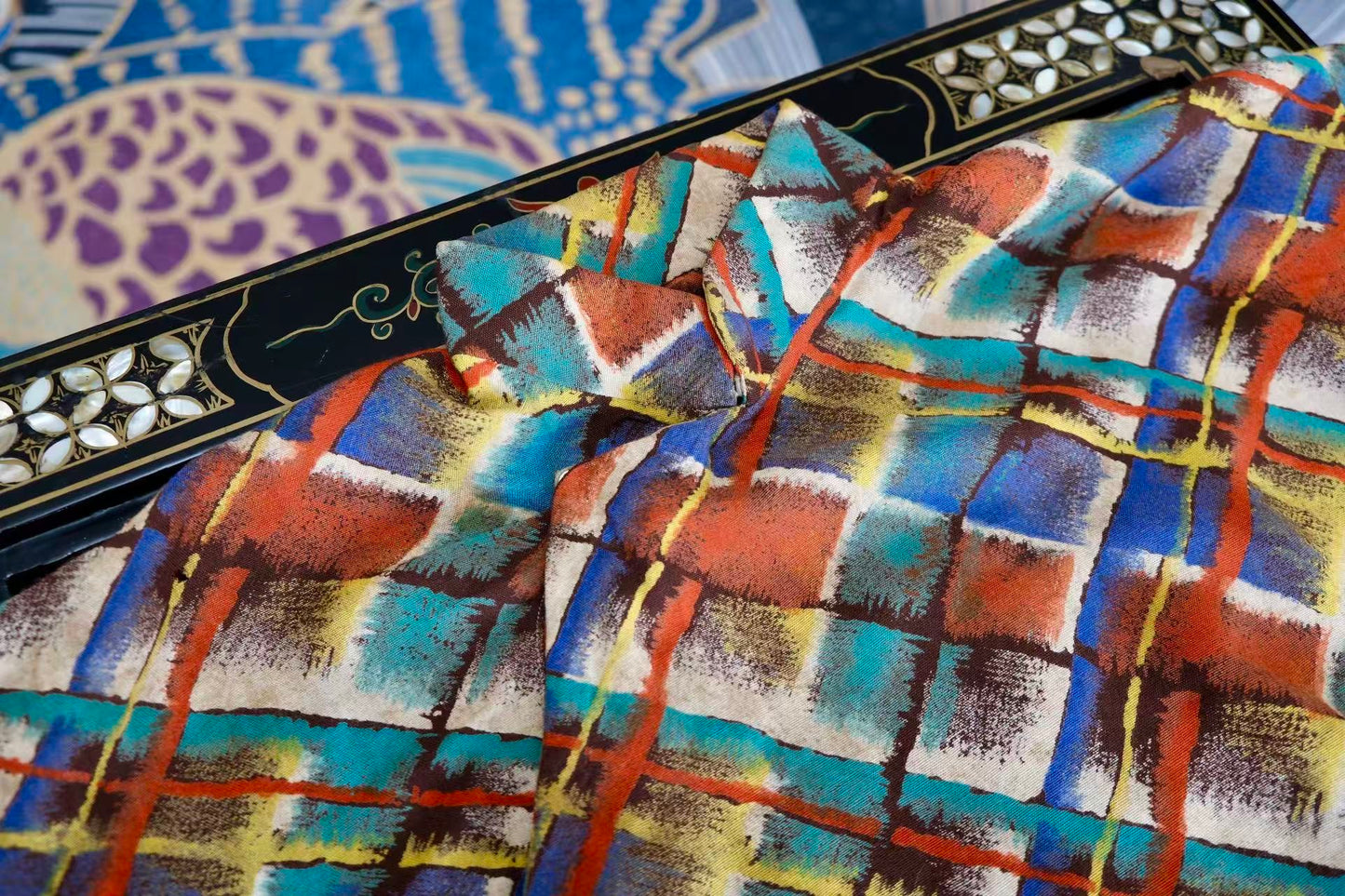
这件旗袍是民国旗袍,具体来说,是一件喷绘印花Art Deco风格旗袍。
它来自20世纪40年代,那个海派文化最鼎盛的时期。
一、图案描述:几何韵律与色彩交响
这件旗袍的图案极具辨识度,是典型的Art Deco(装饰艺术)风格的几何喷绘印花。
1. 构图:流动的秩序感
- 菱形网格:图案以大面积的菱形格(斜格纹)为主体。
- 交错与叠压:菱形格并非简单的平铺,而是通过线条的粗细、
2. 色彩:复古的撞色美学
- 冷暖交织:底色似乎是米白或浅杏色,显得温润。
- 线条色:采用了非常大胆的撞色 - 橙红色:热烈、醒目,作为主线条勾勒轮廓; 宝蓝色/藏青色:沉稳、深邃,与红色形成强烈的对比; 湖蓝色/青色:清新、灵动,增加了画面的透气感; 金黄色:作为点缀,提升了整体的华丽度。
- 喷绘肌理:仔细看细节图,你会发现颜色的边缘有一种晕染、
3. 风格定位:海派摩登
这种几何图案、喷绘工艺以及大胆的配色,
二、古董衣的故事:黄金时代的遗珠
这件旗袍不仅仅是一件衣服,它是一个时代的切片,
1. 时代背景:战乱中的时尚巅峰
20世纪40年代,尽管中国正处于抗战时期,但上海作为“孤岛”
2. 工艺传奇:喷绘印花的绝响
- 稀缺性:喷绘印花(Stenciling/Screen Printing)在当时是一种非常高级且昂贵的工艺。
- 历史价值:这种工艺在建国后逐渐被更高效的机械印花取代,
3. 穿着者画像
想象一下,这件旗袍的主人或许是一位上海滩的名媛,
三、引经据典:衣冠里的文化密码
这件旗袍的艺术价值,可以从文学与美学的维度进行解读:
1. 《更衣记》——张爱玲
张爱玲在《更衣记》中写道:“对于不会说话的人,
这件旗袍正是这样一出“袖珍戏剧”。
2. Art Deco与中国美学的碰撞
Art Deco起源于1925年的巴黎,强调几何对称、
- 东方的骨:旗袍的立领、斜襟、盘扣,保留了东方的含蓄与典雅。
- 西方的魂:几何的图案、鲜艳的对比色,注入了西方的现代与奔放。
正如艺术史学家所言,这一时期的海派旗袍,是“
3. “衣以载道”
在古代,衣冠是礼制的象征;而在民国,衣冠成为了个性的表达。
总结
这件喷绘印花Art Deco旗袍,是民国时尚的集大成者。
Measurements / Size Guide:
Bust / Waist / Hips: 90 / 68 / 104 cm
Total Length: 99 cm
Detailed Description:
This is an authentic Republican-era qipao—specifically, a masterpiece of Art Deco style featuring stencil-print motifs. It hails from the 1940s, the zenith of the "Shanghainese Style" (Haipai) culture.
The pattern of this qipao is highly recognizable, featuring the iconic geometric stencil prints of the Art Deco movement.
Composition: A Sense of Fluid Order
Diamond Lattice: The design is dominated by large-scale diamond grids (bias checks). These diagonal lines break the stagnation of traditional garments, bringing a strong sense of modernity and speed—echoing the era's obsession with modern, industrial, and mechanical aesthetics.
Interlacing and Layering: The diamond grids are not simply flat; they interlace and layer through varying line thicknesses and color depths, creating a three-dimensional, flowing visual effect.
Color: Retro Contrast Aesthetics
Interweaving Warm and Cold: The base color appears to be a warm, gentle cream or light apricot.
Bold Line Colors: The palette utilizes daring contrasts: Orange-Red for bold outlines, Royal/Navy Blue for deep contrast, Cyan/Aqua for a sense of airiness, and Golden Yellow accents for a touch of opulence.
Stencil Texture: Close inspection reveals a misted, sprayed texture at the edges of the colors—the signature of "stencil printing" (Penhui). This artisanal process ensures natural color transitions, lending a hazy beauty akin to ink wash or oil painting, far removed from the rigidity of mechanical printing.
This qipao is a slice of an era, carrying the prosperity and character of 1940s old Shanghai.
Historical Context: Fashion at its Peak Amidst Turmoil In the 1940s, while China was embroiled in war, Shanghai remained a fashion hub. During this period, the qipao evolved to become more modern and practical, with a fit that closely contoured the body—a symbol of the "New Woman" pursuing freedom and liberation.
The Legend of Craftsmanship: The Swan Song of Stencil Printing
Scarcity: Stencil printing was an elite and expensive craft at the time. It required artisans to apply colors manually through a tedious process, resulting in very low output. Each piece is a unique work of art.
Historical Value: This process was gradually replaced by efficient mechanical printing after the 1950s. Consequently, surviving stencil-print qipaos from the 40s are exceptionally rare treasures.
"A Pocket Drama" — Eileen Chang In her essay Chronicle of Changing Clothes, Eileen Chang wrote: "To those who cannot speak, clothes are a language; what one carries with them is a pocket drama." This qipao is exactly such a drama. Its abstract geometric symbols speak of a soul that refuses to follow convention.
Art Deco Meets Chinese Aesthetics Originating in Paris in 1925, Art Deco emphasized symmetry and mechanical beauty. In Shanghai, this met the "Oriental Bone" (mandarin collars and frog fasteners) to create a perfect encounter between Eastern grace and Western Modernism.
"Clothing as Expression" In the Republican era, attire became an expression of individuality. Every block of color and every line on this qipao declares the arrival of a new era for women, serving the wearer's self-aesthetics rather than feudal etiquette.
Conclusion: This qipao is a definitive collector's item of Republican fashion. It wraps the emotional curves of a woman in the rational lines of geometry, narrating a story of beauty, change, and prosperity.