深圳溯源
无法加载取货服务可用情况
四十年代提花织锦缎古董旗袍:金丝织就的流金岁月
在时光的长河中,一件旗袍若能穿越近百年风雨,
一、锦绣华章:织中之圣的工艺密码
旗袍所用的织锦缎,素有“寸锦寸金”之美誉,其工艺之繁复,
二、图案寻真:繁花背后的意象密码
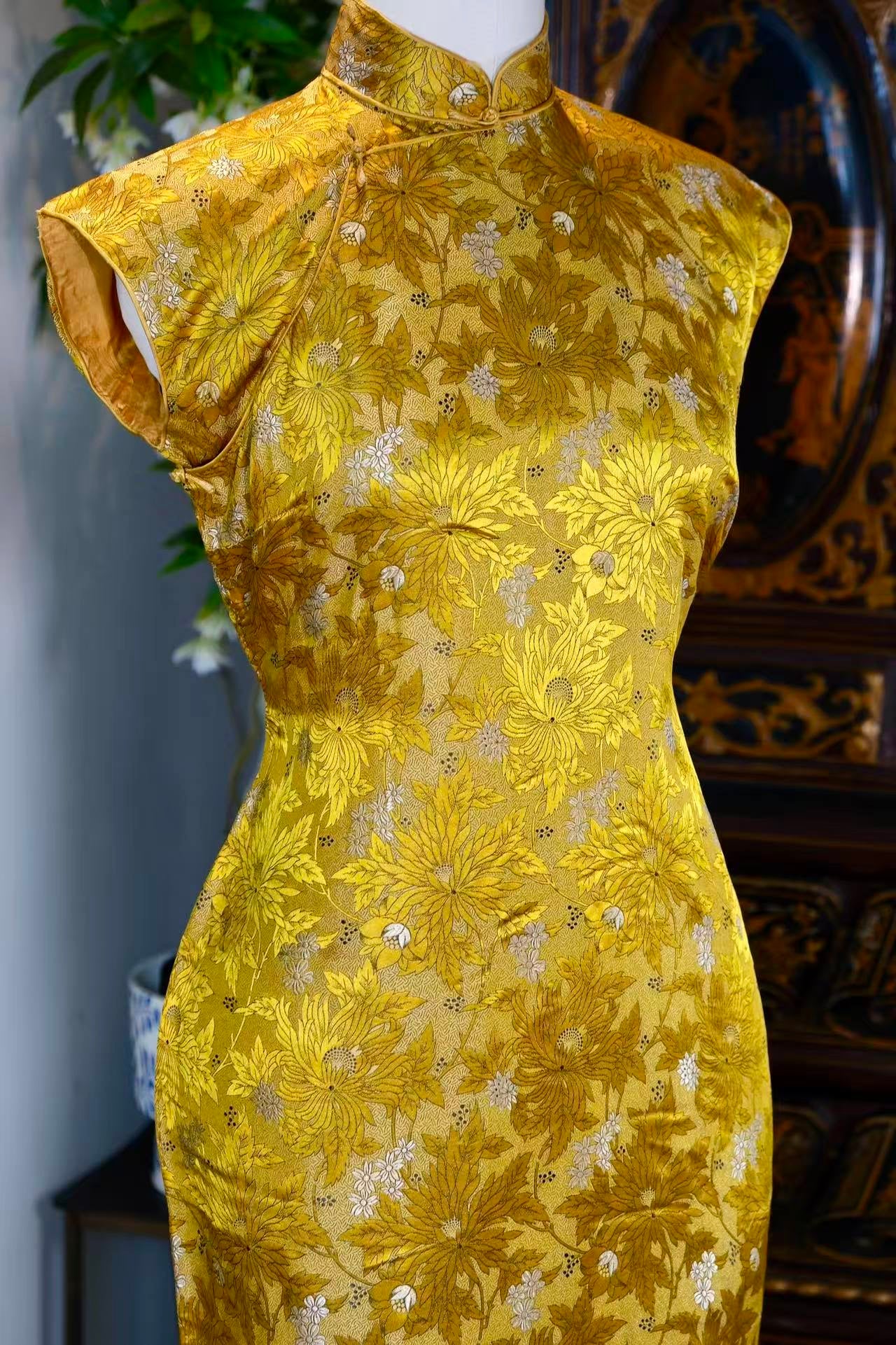
细观旗袍纹样,主体以硕大的菊花与细碎的满天星构成“繁花簇拥”
菊花,自陶渊明“采菊东篱下”的吟咏起,
点缀其间的白色小花,形似满天星,轻盈散布于菊丛之间,
三、风华绝代:海派旗袍的黄金时代
上世纪四十年代,正是海派旗袍的巅峰时期。这件旗袍的剪裁,
更值得注意的是,织锦缎的光泽在不同角度下变幻莫测,
四、结语:穿越时空的美学对话
当指尖轻抚过织锦缎上凸起的花紋,
收藏它,便是收藏了一段流金岁月,一次与历史的深情对话,
"In the river of time, when a garment traverses nearly a century, it transcends being mere attire to become a 'living artifact' of craft, aesthetics, and history."
This 1940s antique brocade Qipao resembles a frozen fragment of an old Shanghai dream, using gold and silver threads as ink to write an eternal chapter of Oriental aesthetics in the depths of time.
The brocade used in this Qipao has long been hailed with the reputation of "an inch of silk, an inch of gold." Its complexity represents the pinnacle of the weaving hierarchy. Interweaving real silk as the warp and gold/silver threads as the weft, it employs the "Discontinuous Weft" (Tongjing Duanwei) technique to construct a three-dimensional, relief-like pattern. As recorded in Tiangong Kaiwu: "Months of weaving yield but an inch of brocade." This fabric condenses the most exquisite skills and the most luxurious investment of time from a bygone era.
The primary motif consists of magnificent chrysanthemums accompanied by delicate gypsophila (baby's breath). This design aligns with traditional Chinese bird-and-flower painting but finds a modern vitality within the Qipao's curves.
The Chrysanthemum, since Tao Yuanming’s poetry, has symbolized noble character and a reclusive spirit. In this piece, deep gold outlines the petals while pale gold fills the hearts. Through varying thread densities, the weaver captured the vivid posture of "dew-kissed petals swaying in the wind." The layers of petals possess both the precision of Gongbi (fine-brush) and the spontaneity of Xieyi (freehand) art.
The scattered white florets break the heaviness of the solid gold, echoing the gardening philosophy of Yuanye: "Though created by man, it appears as a work of nature." The blossoms are not rigidly arranged but grow freely, creating a visual rhythm where "flowers move with the wearer."
The 1940s marked the zenith of the Haipai (Shanghai Style) Qipao. This garment’s tailoring perfectly interprets the era's emphasis on feminine curves: the high standing collar fits snugly against the neck for a dignified air; the sleeveless design adds a touch of allure; and the "willow-waist" cinching flows into a natural hem. Every dart and curve is a tribute to the aesthetics of the female form—a bespoke "second skin."
Furthermore, the luster of the brocade shifts unpredictably from different angles. As the wearer moves, the golden chrysanthemums seem to sway in a play of light and shadow, much like the "dazzling opulence" described in the classic novel Flowers of Shanghai.
To touch the raised patterns on this brocade is to feel the pulse of 1940s Shanghai: the music of the Paramount, the bustling traffic of Avenue Joffre, and the elegant silhouettes of women in Qipaos. This is more than a garment; it is a witness to history and a carrier of culture.
To collect it is to possess a segment of the "Golden Years," a profound dialogue with history, and an aesthetic feast that transcends time and space.