深圳溯源
无法加载取货服务可用情况
衣服尺寸:
胸围/腰围/臀围:100/104/114 厘米
衣长:100 厘米
细节描述:
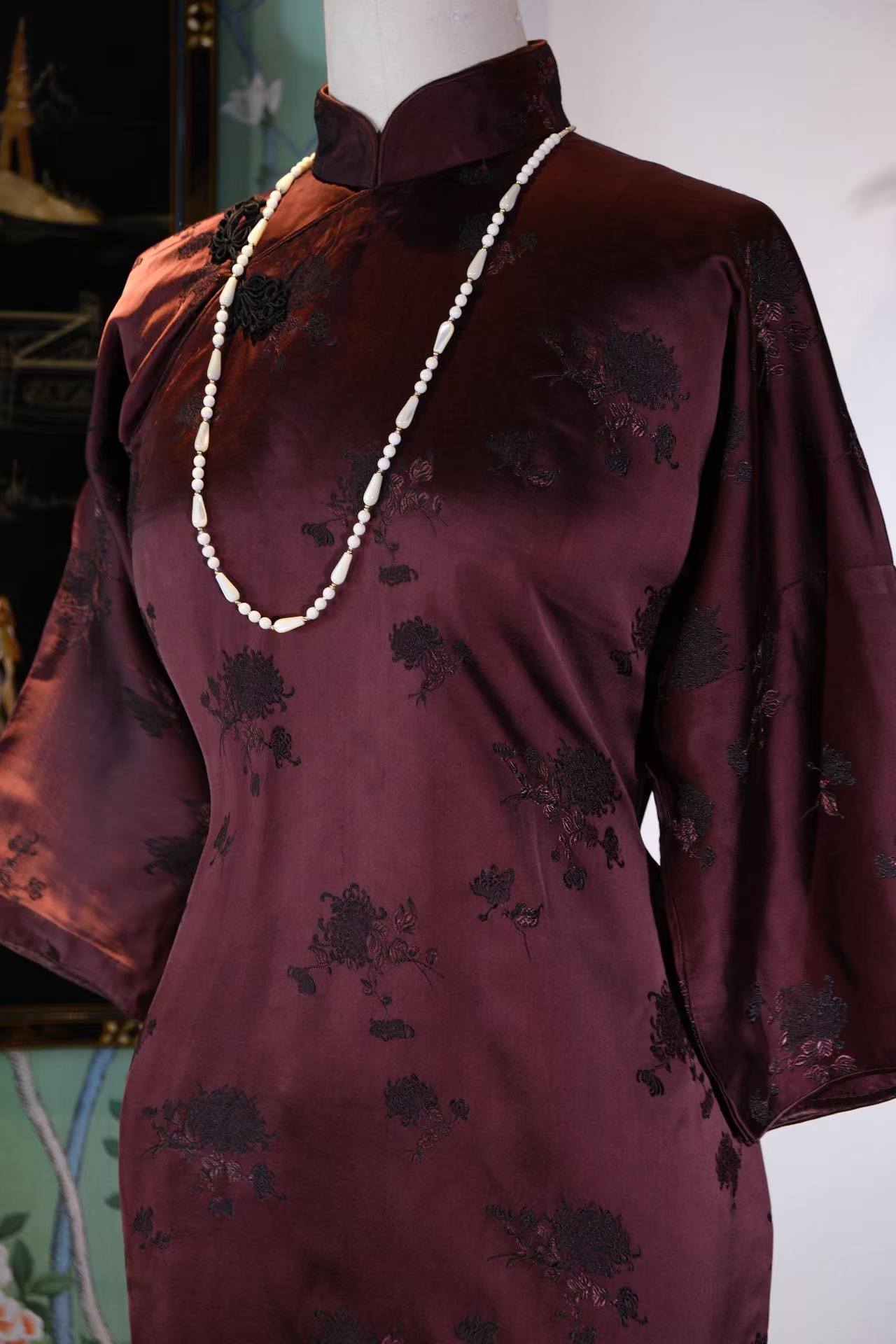
一、 纹样以此寄傲:墨菊与绛云的织物对话
这件旗袍的面料,乃是典型的四十年代末期大陆织造之菊花纹重锦。
观其纹样,绝非市井常见的艳俗花卉,而是极具文人画意境的“墨菊”。底料呈现出一种深沉而醇厚的酱紫绛红,如陈年普洱,又如暮色苍茫。在此底色之上,以深色提花工艺织就的菊花疏影横斜,姿态清奇。
这菊花并非团花簇锦的堆砌,而是有着中国画“留白”的章法。花瓣层层叠叠,枝叶扶疏,仿佛在秋风中傲然挺立。古人云:“宁可枝头抱香死,何曾吹落北风中。”这满幅的菊花纹样,不仅是装饰,更是四十年代末那个动荡年代里,文人雅士与名门闺秀内心风骨的投射——即便世事如棋局局新,内心的那份高洁与傲气,依然要在织锦缎的光泽中,熠熠生辉。
二、 衣中岁月:1949年前夜的最后回眸
这件旗袍诞生于上世纪四十年代末的大陆,那是一个新旧交替、风云变幻的特殊历史节点。
它是民国旗袍“黄金时代”的绝响。彼时的上海、苏州、杭州,织造工艺已臻化境。这件旗袍的版型,保留了四十年代最经典的审美特征:极致的收腰与利落的线条。它不同于五十年代港式旗袍的含蓄,四十年代末的大陆旗袍,敢于展露女性的身体曲线,这是一种觉醒的美,自信而张扬。
我们可以想象,这件旗袍的主人,或许是一位生活在上海霞飞路或苏州园林中的女子。在那个动荡的1948或1949年,她或许曾穿着这件旗袍,在离别前的晚宴上惊鸿一瞥;又或许,这件旗袍被匆匆打包进一只皮箱,随着主人远渡重洋,最终流落异乡,又在数十年后静静回到了我们面前。它身上携带的,是那个“衣香鬓影”时代的余温,是一段关于大时代下个人命运的无声诉说。
三、 艺术与稀缺:不可复制的“绝代风华”
作为一件存世量极少的四十年代末古董衣,其稀缺性体现在以下三个维度:
1. 面料的绝唱:四十年代末的大陆织锦缎,多沿用民国初年引进的提花织机与传统丝线工艺。这种面料光泽感极强,手感厚重如纸,挺括而不失柔韧,这种特殊的“骨感”是后世化纤混纺面料无法模仿的。
2. 剪裁的黄金比例:这件旗袍的剪裁正处于从平面剪裁向立体剪裁过渡的成熟期。其肩部的处理、袖口的弧度(七分袖的优雅),以及腰臀比的把控,都体现了当时顶尖裁缝的功力,是真正的“量体裁衣”之典范。
3. 历史的孤本:由于战乱与年代久远,四十年代末期完好保存至今的织锦缎旗袍凤毛麟角。这件旗袍色泽依然沉稳,图案依然清晰,实乃可遇而不可求的博物馆级藏品。
“花开花落自有时,总赖东君主。”
这件菊花织锦缎旗袍,便是那个时代遗落在人间的一抹最深沉的暮色,等待着懂它的人,来续写它的故事。
Measurements / Size Guide:
Bust / Waist / Hips: 100/104/114 cm
Total Length: 100 cm
Detailed Description:
The fabric of this cheongsam (qipao) is a quintessential heavy brocade featuring chrysanthemum motifs, woven in Mainland China during the late 1940s.
Observe its pattern: these are no common, gaudy blossoms found in street markets, but "Ink Chrysanthemums" imbued with the spirit of literati painting. The base material presents a deep, mellow purplish-crimson—resembling aged Pu-erh tea or the thickening twilight. Upon this ground, dark-toned jacquard chrysanthemums cast sparse, horizontal shadows with an extraordinary posture.
These blossoms are not crowded together; instead, they follow the composition of "white space" (Liu Bai) found in Chinese painting. Petals layer upon layer, while branches and leaves remain airy, as if standing proud in an autumn gale. As the ancients said: "Better to die holding fragrance on the branch than to be blown down into the north wind." This full-canvas pattern is more than decoration; it is a projection of the inner integrity and spirit of the scholars and noble ladies during the turbulent late 40s—even as the world shifted like a game of chess, the purity and pride within continued to shine brilliantly in the luster of the brocade.
Born in Mainland China at the end of the 1940s, this cheongsam emerged at a unique historical junction—a time of transition between the old and the new, where winds of change were blowing fiercely.
It is the final echo of the "Golden Age" of the Republican qipao. At that time, the weaving crafts of Shanghai, Suzhou, and Hangzhou had reached a pinnacle of perfection. The silhouette of this piece retains the most classic aesthetic features of the 1940s: an extreme cinched waist and sharp, clean lines. Unlike the more reserved Hong Kong-style qipao of the 1950s, the Mainland qipao of the late 40s dared to accentuate the female curve. This was an awakened beauty—confident and assertive.
One can imagine the owner of this garment: perhaps a woman living on Avenue Joffre in Shanghai or within a classical garden in Suzhou. In the chaotic year of 1948 or 1949, she might have worn this robe, leaving a stunning impression at a farewell banquet; or perhaps it was hurriedly packed into a leather trunk, crossing oceans with its master to a distant land, only to return quietly to us decades later. It carries the lingering warmth of an era of "fragrant clothes and shadowed hair"—a silent narrative of individual destiny within a monumental age.
As an extremely rare extant antique from the late 1940s, its scarcity is manifested in three dimensions:
The Swan Song of Fabric: Mainland brocades of the late 40s mostly utilized jacquard looms and traditional silk-threading techniques inherited from the early Republican era. This fabric possesses an intense luster and a hand-feel as thick as parchment—crisp yet resilient. This specific "skeletal structure" (Gu Gan) is impossible for later synthetic blends to replicate.
The Golden Ratio of Tailoring: The cut of this qipao sits at the mature transition from flat to three-dimensional tailoring. The shoulder treatment, the curvature of the cuffs (the elegance of the three-quarter sleeve), and the mastery over the waist-to-hip ratio all demonstrate the prowess of the top tailors of that time. It is a true paragon of bespoke craftsmanship.
A Historical Unique: Due to war and the passage of time, late-1940s brocade qipaos preserved in pristine condition are as rare as phoenix feathers. That this garment’s color remains steadfast and its patterns clear makes it a museum-grade treasure that one can only hope to encounter by chance.
"Flowers bloom and fade in their own time, all depending on the Lord of Spring." This chrysanthemum brocade cheongsam is a streak of the deepest twilight left behind by that era, waiting for someone who understands its soul to continue its story.