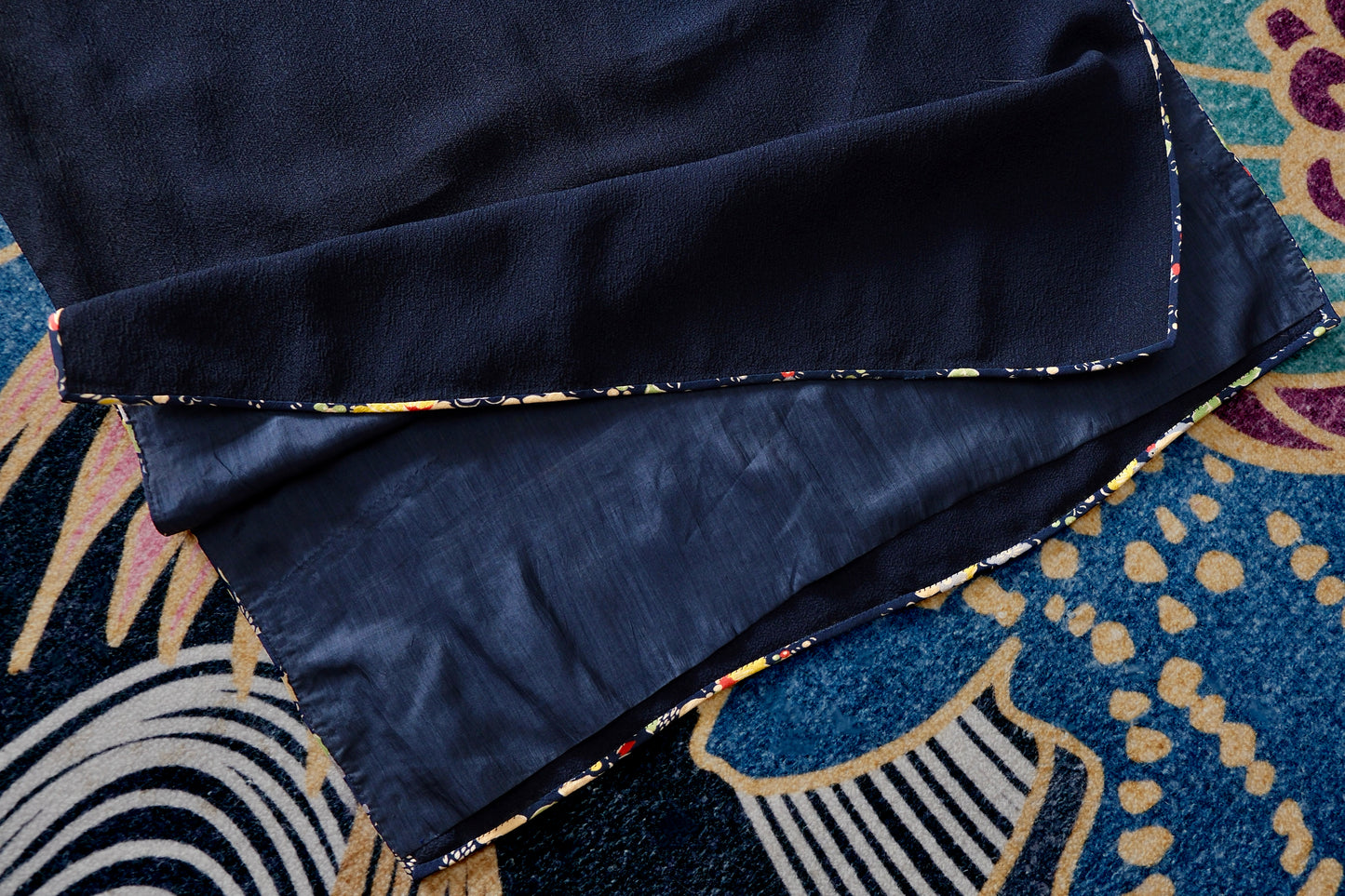
民国风华·墨底繁花旗袍套装
一、衣上丹青:墨底繁花里的春日诗篇
这套四十年代旗袍套装,以素雅藏青为底色,恰似夜幕初垂时的静谧天幕,而短外套上泼洒的百花图景,则如繁星坠入人间。细观其纹,并非工笔勾勒的规整花谱,而是以写意笔法晕染出的“百花齐放”——明黄如金盏绽蕊,绛红似海棠含露,靛蓝若鸢尾临风,更有浅粉、鹅黄、墨绿点缀其间,似将江南春日的姹紫嫣红,悉数凝于方寸织物。
这种“满地碎花”的纹样设计,暗合民国时期“中西合璧”的审美转向:既承袭传统“百子图”“百花图”的吉祥寓意,又融入西方印象派对色彩与光影的捕捉。花瓣边缘的晕染效果,宛如莫奈笔下的睡莲,在墨色底布上漾开朦胧光晕;而花朵的错落排布,又似宋代院体画的“折枝构图”,疏密有致,动静相宜。更难得的是,衣领袖口处暗藏玄机——旗袍滚边采用外套同色系丝线,与繁花形成“藏”与“露”的对话,恰如《园冶》所言:“虽由人作,宛自天开”,于繁华中见雅致,于规整中藏灵动。
二、旧衣新语:战火纷飞里的风雅坚守
这套旗袍诞生于1940年代的上海,彼时正值抗战后期,物资匮乏却难掩都市女性的风雅追求。据《上海服饰史》记载,四十年代旗袍因布料管制,逐渐从三十年代的大开衩、长下摆转向“简洁实用”,但爱美之心未泯,遂有“旧衣新做”“拼接设计”之风。这套套装,正是这一时代的产物:其外套剪裁借鉴西式短夹克的利落廓形,藏青旗袍的素净,既是对战时物资的妥协,亦是对“素以为绚”东方美学的回归。
三、稀世之珍:时光淬炼的艺术孤品
在古董衣收藏界,四十年代旗袍本就稀缺,而“旗袍+短外套”的套装形式更是凤毛麟角。其一,因战乱与年代久远,完整保存的套装不足存世量的5%;其二,这套旗袍的面料工艺堪称绝响——外套的百花纹样采用“拔染印花”技术,需先在藏青底布上染色,再以化学药剂“拔”出花纹,工艺复杂且易褪色,能历经八十余载仍色彩明艳者,实属罕见。
其艺术价值,更在于它是民国服饰“中西融合”的活化石。立领、盘扣、滚边是传统的“形”,西式短外套的廓形是现代的“神”;藏青的素净是东方的“韵”,百花的绚烂是西方的“彩”。这种“形神兼备、韵彩交融”的设计,恰如民国才女林徽因所言:“建筑是凝固的音乐,服饰是流动的建筑。”这套旗袍,便是流动的民国风华,是战火中绽放的优雅,是时光带不走的艺术孤品。
四、结语:穿在身上的民国史诗
当指尖抚过藏青裙摆的细腻纹理,仿佛触到了1940年代上海滩的晨雾;当目光掠过外套上的百花,似见穿着它的女子,踩着高跟鞋走过外滩的石库门,裙摆摇曳间,是战火中的从容,是乱世里的风雅。这套旗袍,不仅是衣物,更是一部穿在身上的民国史诗——它记录着一个时代的审美转向,承载着一代女性的坚韧与浪漫,更以稀世之姿,诉说着“衣以载道”的永恒魅力。
若说古董衣的灵魂在于“故事”,那么这套旗袍的故事,便是“于废墟中开花,于苦难中绽放”——这,或许正是它穿越时空,依然动人的原因。
The Grace of the Republic: A 1940s Floral-on-Ink Qipao Suit Set
I. Painting on Silk: A Spring Poem Amidst Ink-Black Blooms
This 1940s qipao suit set uses an elegant navy ink as its base, resembling the tranquil canopy of early nightfall, while the profusion of flowers splashed across the short jacket looks like a cluster of stars falling into the mortal world. Upon close inspection, the patterns are not a rigid botanical chart of fine-brush lines, but rather a "hundred flowers in bloom" rendered with expressive, freehand washes—bright yellows like blooming goldcups, vermilion reds like dew-laden crabapples, and indigo blues like irises in the wind, interspersed with light pink, primrose, and forest green. It is as if the entire brilliant spring of Jiangnan has been condensed onto this limited fabric.
This "all-over ditsy floral" design aligns with the "East-meets-West" aesthetic shift of the Republican era: it inherits the auspicious symbolism of traditional "Hundred Children" or "Hundred Flowers" motifs while integrating the Western Impressionist capture of color and light. The bleeding effect at the petal edges evokes Monet’s water lilies, rippling with a hazy halo against the ink-dark cloth; meanwhile, the staggered arrangement of the flowers mirrors the "broken branch composition" of Song Dynasty academy paintings—orderly yet rhythmic, balancing motion and stillness. More remarkably, a hidden detail lies within the collar and cuffs—the qipao’s piping uses silk thread matching the jacket’s tones, creating a dialogue of "concealment" and "revelation." As noted in Yuanye (The Craft of Gardens): "Though fashioned by human hands, it appears as if wrought by Heaven," finding elegance within complexity and vitality within structure.
II. New Whispers from Old Garments: Aesthetic Persistence Amidst the Flames of War
This qipao suit was born in 1940s Shanghai, during the late stages of the War of Resistance. Resources were scarce, yet the aesthetic pursuits of urban women remained undiminished. According to the History of Shanghai Costume, 1940s qipaos shifted from the high slits and long hems of the 1930s toward "simplicity and practicality" due to fabric rationing. However, the love for beauty persisted, leading to trends of "remodeling old clothes" and "patchwork designs." This suit is a product of that era: the jacket’s tailoring draws from the clean silhouette of a Western short jacket, while the plainness of the navy qipao represents both a compromise with wartime scarcity and a return to the Oriental aesthetic of "plainness as the ultimate brilliance."
III. A Rare Treasure: An Artistic Unique Specimen Tempered by Time
In the world of antique garment collecting, 1940s qipaos are inherently scarce, and the "qipao + short jacket" suit format is exceptionally rare. Firstly, due to war and the passage of time, complete sets account for less than 5% of surviving pieces. Secondly, the fabric craftsmanship of this set is a lost art—the floral patterns on the jacket utilize "discharge printing" technology, which requires dyeing the navy base first and then using chemical agents to "discharge" the floral patterns. This process is complex and prone to fading; that the colors remain vivid after over eighty years is truly extraordinary.
Its artistic value lies in its status as a "living fossil" of Republican-era fusion. The standing collar, pankou buttons, and piping are the traditional "form," while the silhouette of the Western short jacket is the modern "spirit." The navy’s purity is the Oriental "rhyme," and the floral brilliance is the Western "color." This design, possessing both "form and spirit, rhyme and color," echoes the words of the Republican talent Lin Huiyin: "Architecture is solidified music; clothing is fluid architecture." This qipao set is the flowing grace of the Republic, an elegance blooming amidst war—an artistic unique specimen that time cannot take away.
IV. Conclusion: A Republican Epic Worn on the Body
As your fingertips brush the delicate texture of the navy hem, it feels as if you are touching the morning mist of 1940s Shanghai. As your gaze sweeps over the flowers on the jacket, you seem to see the woman who wore it, walking past the Shikumen gates of the Bund in high heels, her swaying hem embodying composure amidst fire and elegance in a chaotic world. This qipao set is not merely clothing; it is a Republican epic worn on the body—it records an era’s aesthetic shift, carries the resilience and romance of a generation of women, and tells the eternal charm of "garments as vessels of the Way" with its rare presence.
If the soul of an antique garment lies in its "story," then the story of this suit is "blooming amidst ruins and flourishing amidst suffering"—this is perhaps why it remains so moving, even as it travels through time and space.