深圳溯源
无法加载取货服务可用情况
衣服尺寸:
胸围/腰围/臀围:82/68/92 厘米
衣长:104 厘米
细节描述:
一、图案描述
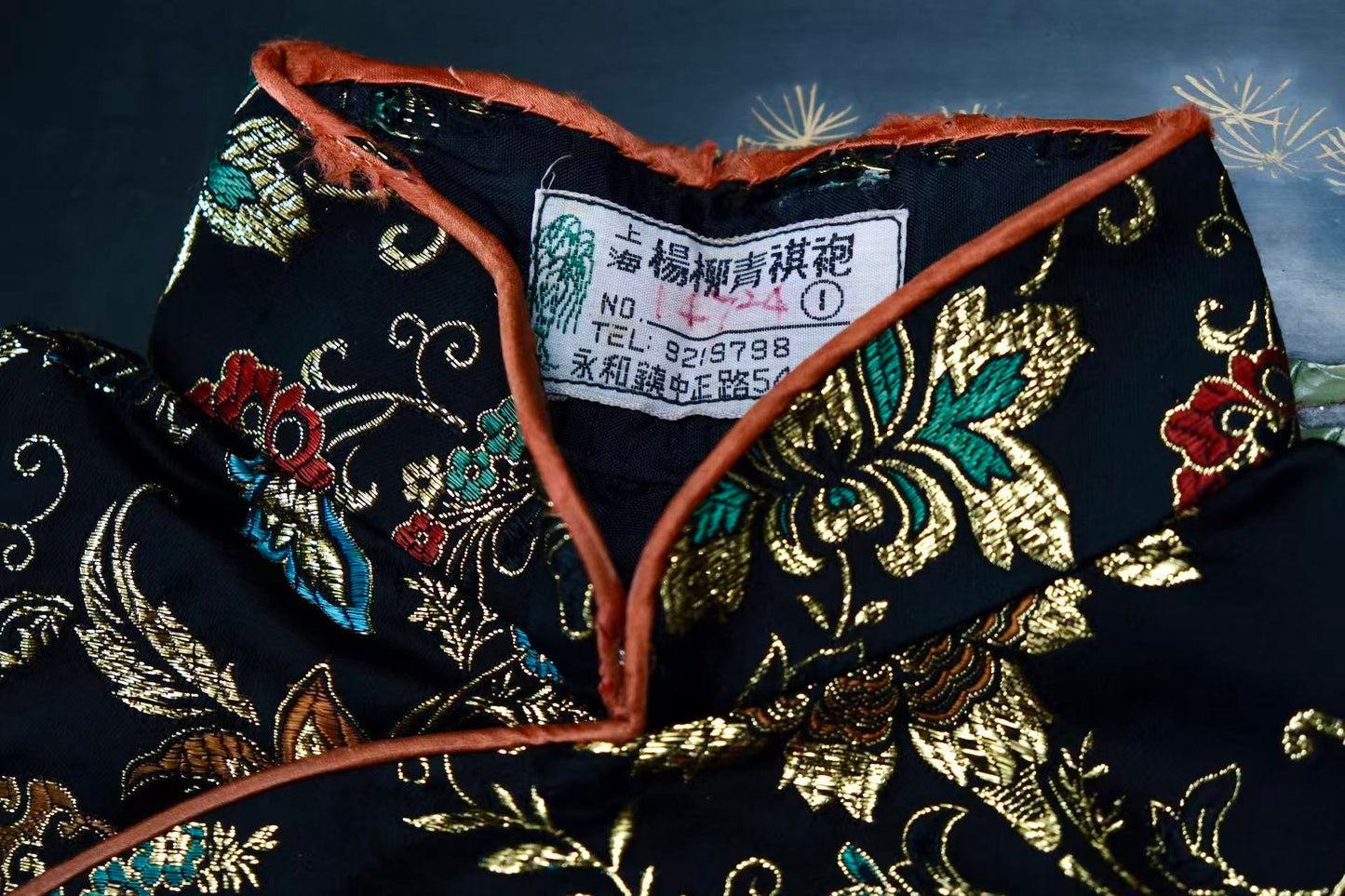
这件旗袍的衣身,宛如一幅流动的锦绣画卷。它以深邃的墨色为底,其上以金线为骨,织就出繁复而典雅的缠枝花卉纹样。这些纹样并非简单的平面印花,而是采用提花织锦缎工艺,使得图案在光线下呈现出立体的浮雕感与金属般的光泽。
- 主体纹样:主体为缠枝莲与缠枝牡丹的变体。莲花出淤泥而不染,牡丹为花中之王,二者皆为传统吉祥图案,象征着高洁与富贵。花头饱满,花瓣层叠,以红、蓝、橙等彩色丝线点缀其间,色彩虽经岁月洗礼,依然明丽动人。
- 构图与工艺:图案采用满地铺陈的构图方式,疏密有致,连绵不绝,寓意着福寿绵长、富贵不断。织金工艺的运用,使得金线在深色底料上熠熠生辉,尽显华贵。领口、门襟与袖口处,以一道橘红色的细滚边勾勒轮廓,如同画框,将这幅锦绣画卷完美地框定,更添一份精致与灵动。
二、古董衣的故事
这件旗袍的身世,藏于领口内那枚小小的白色标签之中——“上海杨柳青旗袍”。这五个字,如同一把钥匙,开启了一段跨越海峡的流金岁月。
“上海”,一个代表着近代中国时尚与繁华的符号。二十世纪三四十年代,上海旗袍风靡全国,成为东方女性美的象征。而“杨柳青”,则是当时上海众多旗袍名店中的一家,其名字取自天津著名的年画产地,本身就带有一种民间艺术的雅致与喜庆。
然而,这件旗袍的诞生地,却并非上海,而是台湾。标签上的“永和镇中正路”揭示了它的最终归宿。这背后,是1949年那场巨大的历史迁徙。无数大陆居民,包括许多技艺精湛的裁缝与商家,随国民政府迁往台湾,将上海的时尚与技艺一同带到了宝岛。
因此,这件旗袍便成为了一段“文化移植”的见证。它由来自上海的师傅,在台湾的土地上,用着可能来自不同产地的织锦缎,为同样背井离乡的顾客量身定做。它既保留了上海旗袍的经典韵味与精湛工艺,又融入了迁台后对故土的思念与对未来的期许。它不仅仅是一件衣服,更是一段家族史、一部微缩的两岸交流史。
三、艺术风格与稀缺性
从艺术风格上看,这件旗袍完美地融合了传统与现代。其图案的繁复与吉祥寓意,是典型的中国传统审美;而其修身的剪裁、流畅的线条,则体现了海派文化对西方时尚的吸收与改造。它是一件“穿在身上的艺术品”,将织锦、刺绣、剪裁等多种工艺集于一身。
其稀缺性,主要体现在以下几点:
- 工艺稀缺:织金提花织锦缎工艺复杂,成本高昂,在物资相对匮乏的上世纪六十年代,能拥有这样一件旗袍的主人,绝非寻常人家。如今,这种传统工艺更是日渐式微,能保存完好的古董衣更是凤毛麟角。
- 历史稀缺:作为“上海老字号,台湾制造”的产物,它承载了特殊历史时期的文化记忆。它不是简单的复刻,而是历史变迁的活化石,其背后的故事赋予了它独一无二的价值。
- 品相稀缺:从图片上看,这件旗袍保存状况极佳,金线光泽依旧,色彩未褪,实属难得。古董衣的价值,很大程度上取决于其品相,如此完好的状态,使其更具收藏价值。
“劝君莫惜金缕衣,劝君惜取少年时。”唐人杜秋娘的诗句,道尽了金缕衣的珍贵与时光的易逝。这件上海杨柳青旗袍,恰如一件现代的“金缕衣”,它以金丝为线,以岁月为梭,织就的不仅是一件华服,更是一段无法复制的历史与一段永恒的东方美学。它静默地诉说着过去,也等待着懂得欣赏它的人,续写新的故事。
Measurements / Size Guide:
Bust / Waist / Hips: 82/68/92 cm
Total Length: 104 cm
Detailed Description:
The body of this cheongsam (qipao) resembles a flowing scroll of magnificent embroidery. Against a deep, ink-black base, golden threads serve as the skeletal framework, weaving complex and elegant motifs of intertwining flowers. These are not simple flat prints but are crafted using a jacquard brocade technique, giving the patterns a three-dimensional relief effect and a metallic luster under the light.
Primary Motifs: The main patterns are variations of intertwining lotus and peony. The lotus, "rising unsullied from the mud," and the peony, the "king of flowers," are both traditional auspicious symbols representing purity and nobility. The flower heads are full and the petals layered, punctuated with vibrant silk threads of red, blue, and orange that remain vivid despite the passage of time.
Composition and Craftsmanship: The pattern employs an all-over (Mandi) composition, dense yet orderly, symbolizing endless fortune and longevity. The use of gold-weaving (Zhijin) makes the golden threads shimmer against the dark fabric, exuding opulence. The collar, lapel, and cuffs are traced with a slender tangerine-red piping, acting like a picture frame that perfectly defines this embroidered scroll while adding a touch of exquisite vitality.
The origin of this cheongsam is hidden within the small white label inside the collar: "Shanghai Yangliuqing Cheongsam." These words act as a key, unlocking a period of golden years that spanned the Strait.
"Shanghai" is a symbol of modern Chinese fashion and prosperity. In the 1930s and 40s, the Shanghainese qipao took the nation by storm, becoming the emblem of Oriental feminine beauty. "Yangliuqing," named after the famous New Year woodblock print center in Tianjin, carried an inherent grace and festivity of folk art.
However, the birthplace of this specific garment was not Shanghai, but Taiwan. The address on the label—"Zhongzheng Road, Yonghe Town"—reveals its final destination. Behind this lies the massive historical migration of 1949. Countless mainlanders, including master tailors and merchants, moved to Taiwan, bringing Shanghainese fashion and techniques to the island.
Thus, this cheongsam stands as a witness to "cultural transplantation." It was custom-made by a master from Shanghai on Taiwanese soil, using brocade perhaps sourced from various origins, for a customer who was likewise far from home. It preserves the classic charm and craftsmanship of Shanghai while infusing the nostalgia and hope for the future found in post-migration Taiwan. It is more than a dress; it is a family history and a miniature history of cross-strait exchange.
Artistically, this cheongsam perfectly fuses tradition and modernity. The complexity and auspicious symbolism of its patterns are classic Chinese aesthetics, while its slim-fit tailoring and fluid lines reflect the Shanghainese absorption and transformation of Western fashion. It is a "work of art worn on the body," integrating brocade-weaving, embroidery, and precision tailoring.
Its scarcity is manifested in several points:
Technical Scarcity: The gold-woven jacquard brocade process is complex and costly. In the 1960s, an era of relative material scarcity, the owner of such a garment was certainly from no ordinary family. Today, this traditional craft is declining, making well-preserved antique pieces exceedingly rare.
Historical Scarcity: As a product of a "Shanghai Heritage Brand, Made in Taiwan," it carries the cultural memory of a unique historical period. It is not a simple replica but a "living fossil" of historical change, possessing a value bestowed by its narrative.
Condition Scarcity: The cheongsam is in excellent condition; the gold threads retain their luster and the colors have not faded. In the world of antique clothing, value is heavily dictated by condition, and such a pristine state makes it a premier collector's item.
"I urge you not to cherish your robe of gold threads, but to cherish the time of your youth." The Tang dynasty poem by Du Qiuniang speaks to the preciousness of such garments and the transience of time. This "Shanghai Yangliuqing" cheongsam is a modern "Gilded Robe"—woven with gold as thread and years as the shuttle—weaving together not just a magnificent garment, but an unrepeatable history and an eternal Oriental aesthetic.