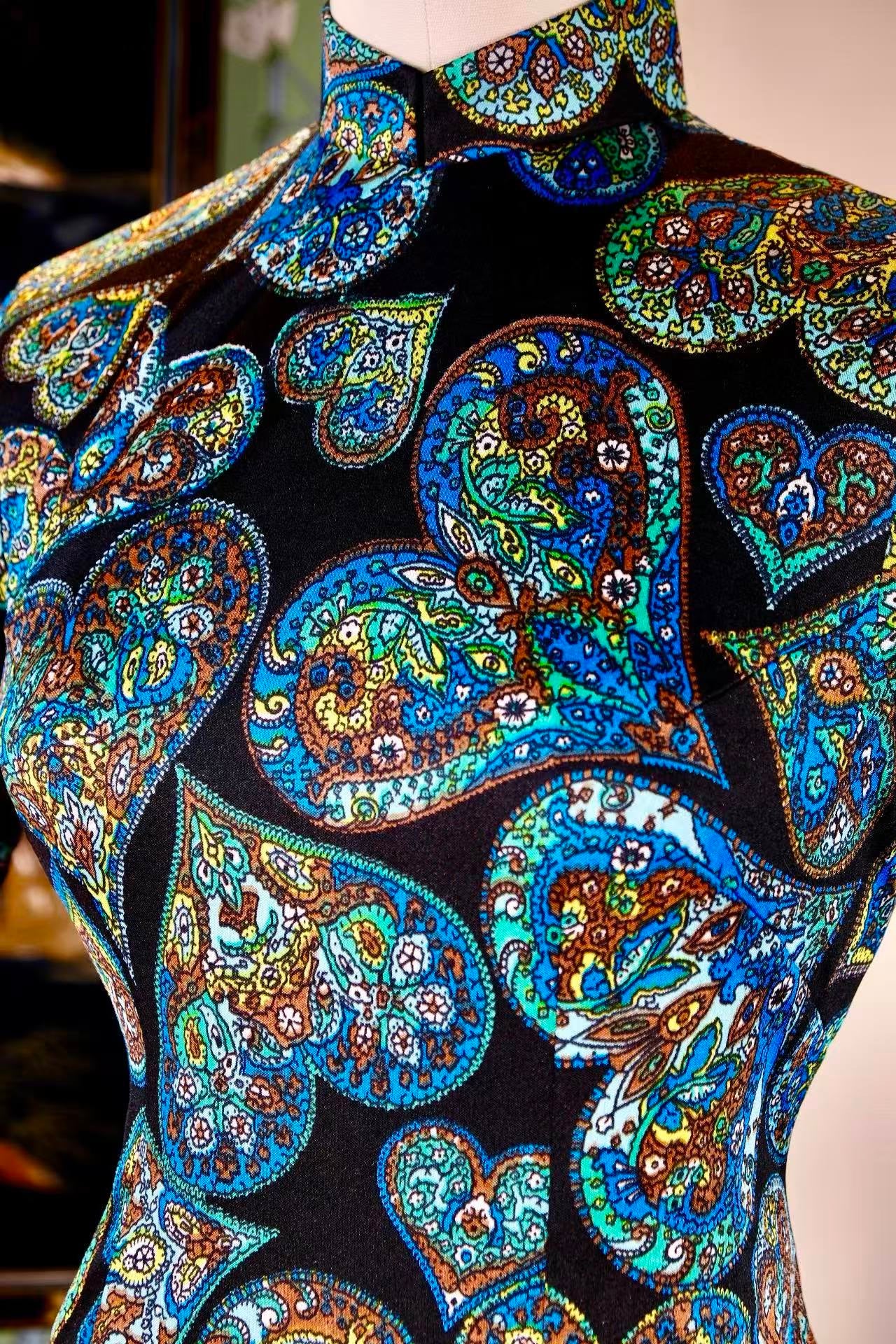
香江绮梦:手绘佩斯利纹古董旗袍
这件诞生于上世纪六十年代早期的香港手绘旗袍,以佩斯利纹为骨,水墨意趣为魂。佩斯利纹(Paisley),源自古波斯的“生命之树”图腾,后经印度莫卧儿王朝的织造工坊臻于完善,十九世纪随大英帝国的印花棉布风靡欧美。而这件旗袍的匠人,却将这一西洋装饰纹样“东渡”重生——以中国传统工笔重彩之法,在黑色底料上手绘出层层叠叠的涡旋纹,每一处曲线都如书法般顿挫生姿,蓝绿晕染间暗藏青花瓷的清雅,棕黄勾勒处又见广彩瓷的热烈。
据《香港纺织史》记载,六十年代初的香港旗袍工坊仍保留着“画师绘稿、绣娘补金”的传统,而这件旗袍尤为珍贵之处,在于其纹样全由老匠人以植物颜料手绘而成。不同于同期机制印花的呆板重复,手绘纹样的每一笔都带着微妙的浓淡变化。这种“一笔一染”的工艺,需画师兼具绘画功底与耐心,一件旗袍的纹样绘制往往耗时月余,存世量不足同期机制旗袍的百分之五,堪称“穿在身上的活化石”。
佩斯利纹的大面积运用,藏着一段香江往事:彼时香港作为转口贸易港,大量进口印度棉布与英国印花布,本地裁缝将异域纹样与中国传统色彩调和,创造出这种“不中不西、亦中亦西”的独特风格,恰如作家刘以鬯在《酒徒》中描写的六十年代香港:“新旧杂陈,中西碰撞,每一寸布料都浸着时代的汗与梦。”
当你触摸这件旗袍,指尖划过的是六十年前香江画师的笔触,眼中映见的是佩斯利纹在东方土壤里的涅槃重生。它不止是一件衣裳,更是一份消逝的手工艺的见证,一个时代的美学切片,以及一位无名匠人留给世界的温柔密码——正如《诗经》所言“衣锦褧衣,裳锦褧裳”,华服之美,终在时光中沉淀为不朽的诗。
A Fragrant River Dream: Hand-Painted Paisley Antique Qipao
The Metamorphosis of the "Tree of Life" Born in the early 1960s in Hong Kong, this hand-painted qipao uses the Paisley motif as its bone and the spirit of ink-wash as its soul. The Paisley pattern, originating from the ancient Persian "Tree of Life" totem and perfected in the weaving workshops of India’s Mughal Empire, swept through Europe and America via British printed cottons in the 19th century. Yet, the artisan of this qipao facilitated a "rebirth" of this Western decorative motif in the East—using traditional Chinese fine-brush heavy-color (Gongbi Zhongcai) techniques to hand-paint cascading swirling patterns onto a black base. Every curve possesses the rhythmic pauses of calligraphy; the indigo and emerald washes hide the elegance of blue-and-white porcelain, while the brown and ochre outlines echo the vibrancy of Canton Enamel (Guangcai).
The Vanishing Craft of the "Scholar-Artisan" According to the History of Hong Kong Textiles, workshops in the early 1960s still maintained the tradition of "artists sketching and embroiderers gilding." The particular value of this piece lies in the fact that its patterns were entirely hand-painted by an old master using botanical pigments. Unlike the rigid repetition of contemporary machine prints, every stroke here bears subtle variations in intensity. This "one stroke, one dye" process required the artist to possess both painterly skill and immense patience; a single gown’s pattern often took over a month to complete. Surviving hand-painted pieces account for less than 5% of the machine-printed qipaos from the same era, making this a true "living fossil."
A Microcosm of the "Orphan Island" Port The extensive use of Paisley motifs hides a story of old Hong Kong. As a bustling entrepôt, Hong Kong imported vast quantities of Indian cotton and British prints. Local tailors harmonized these exotic patterns with traditional Chinese colors, creating a unique style that was "neither East nor West, yet both"—much like the 1960s Hong Kong described by Liu Yichang in The Drunkard: "A jumble of old and new, a collision of East and West; every inch of fabric is soaked in the sweat and dreams of the era."
The Eternal Code of the Nameless Artisan To touch this qipao is to feel the brushstrokes of a Hong Kong artist from sixty years ago; to see the Nirvana of the Paisley motif on Oriental soil. It is more than a garment; it is a witness to a vanished craft, an aesthetic slice of an era, and a gentle code left to the world by a nameless artisan. As the Book of Songs declares: "With brocade robes and embroidered skirts," the beauty of fine raiment eventually settles into the immortal poetry of time.