深圳溯源
无法加载取货服务可用情况
衣服尺寸:
胸围/腰围/臀围:86/70/90 厘米
衣长:107 厘米
细节描述:
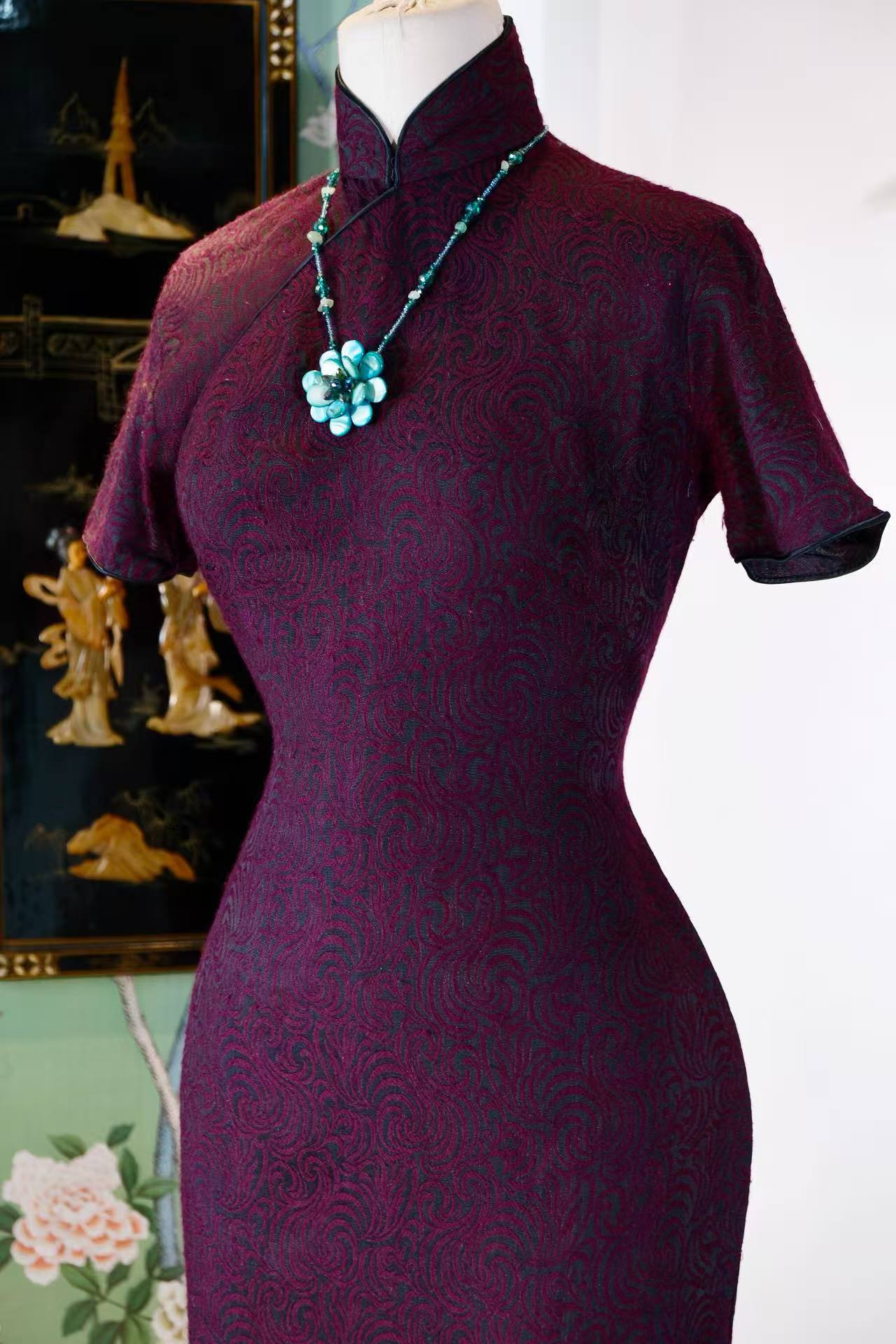
当指尖抚过这件酒红割绒旗袍,仿佛触到了1950年代香港的体温。彼时香江之畔,东西方文化在旗袍的经纬间碰撞——西式立体剪裁勾勒女性曲线,东方传统纹样暗藏千年风雅。这件旗袍的珍贵,不仅在于其“线香绲边”的极致工艺,更在于它凝结了一个时代的审美密码:酒红底色如陈年佳酿,割绒工艺让云纹在光影中流转,宛如“云想衣裳花想容”的诗意具象,每一道绒线都是匠人指尖的温度,每一寸绲边都是时光的刻度。
旗袍上的云纹,是中华服饰纹样中最具哲学意味的符号。《考工记》有言“天有时,地有气,材有美,工有巧”,这件旗袍的云纹以割绒工艺呈现,绒面凹凸间形成“行云流水”的视觉效果,既非宫廷龙袍的威严,也非民间刺绣的繁复,而是带着文人画般的写意——云纹线条婉转流畅,似山间云气,又如海浪波涛,暗合“天人合一”的东方美学。更难得的是,这种割绒云纹在五十年代香港旗袍中极为罕见,多为上海老铺传承的手艺,随着时代变迁,如今能完整保留此工艺的旗袍已不足百件,堪称“行走的文物”。
这件旗袍的“线香绲边”更是点睛之笔。所谓“线香绲”,是指用极细的丝线在衣缘处滚出如线香般纤细的边,需匠人以“一针一线”的耐心完成,稍有偏差便会破坏整体美感。五十年代香港旗袍匠人将这种工艺与西式剪裁结合,让旗袍既保留“立领斜襟”的东方韵味,又贴合女性身体曲线,正如张爱玲笔下“旗袍是女子最贴身的知己”,这件旗袍的剪裁,恰似为穿着者量身定制的“第二层肌肤”,腰线的收束、裙摆的开衩,每一处细节都在诉说着那个年代对“优雅”的定义。
如今,当我们凝视这件旗袍,看到的不仅是酒红割绒的华美,更是一个时代的缩影——它是五十年代香港女性走向独立的见证,是东西方文化交融的产物,更是传统工艺在时光中沉淀的结晶。正如《长物志》所言“物有本末,事有终始”,这件旗袍的稀缺性,正在于它承载的“本”与“始”:传统工艺的坚守、时代审美的变迁、女性意识的觉醒。它不是博物馆里的陈列品,而是可以触摸的历史,是可以穿着的文化,是连接过去与现在的“时光信使”。
或许,这便是古董旗袍的魅力——它让时光有了形状,让文化有了温度。当你穿上它,仿佛能听见五十年代香港的街声,看见匠人指尖的绒线在光影中流转,感受到那份跨越半个世纪的优雅与从容。这,便是“云纹割绒”的故事,也是属于每个穿着者的“时光密码”。
Measurements / Size Guide:
Bust / Waist / Hips: 86/70/90 cm
Total Length: 107 cm
Detailed Description:
When your fingertips brush across this burgundy cut-velvet cheongsam (qipao), it feels as though you are touching the very pulse of 1950s Hong Kong. Back then, by the shores of the Fragrant River, East and West collided within the warp and weft of the fabric—Western 3D tailoring traced the feminine silhouette, while traditional Eastern motifs concealed a millennium of elegance. The preciousness of this garment lies not only in the exquisite craftsmanship of its "incense-stick piping" (xianxiang gunbian), but also in how it condenses the aesthetic codes of an era. The burgundy base is like a vintage wine; the cut-velvet technique allows the cloud patterns to flow through light and shadow, becoming a poetic manifestation of "clouds remind one of her clothes, and flowers of her face." Every thread of velvet carries the warmth of the artisan's touch, and every inch of piping serves as a notch on the scale of time.
The cloud patterns on the cheongsam are the most philosophically profound symbols in Chinese vestiary motifs. As stated in The Artificers' Record (Kao Gong Ji), "Heaven has its seasons, Earth has its energy, materials have their beauty, and craftsmanship has its skill." The cloud patterns here, presented through cut velvet, create a "flowing water and moving clouds" visual effect through the undulating texture of the pile. It possesses neither the austerity of imperial dragon robes nor the complexity of folk embroidery; instead, it carries the freehand spirit of literati painting. The lines are supple and smooth, resembling mountain mists or ocean waves, subtly echoing the Eastern aesthetic of "harmony between humanity and nature." Furthermore, such cut-velvet cloud patterns were extremely rare in 1950s Hong Kong cheongsams, mostly representing skills passed down from old Shanghainese workshops. As times changed, fewer than a hundred cheongsams preserving this complete craftsmanship remain today, making it truly a "walking cultural relic."
The "incense-stick piping" is the crowning touch. This technique involves using extremely fine silk threads to create edges as slender as incense sticks along the garment's borders. It requires the artisan's "one stitch, one thread" patience; the slightest deviation would ruin the overall aesthetic. In the 1950s, Hong Kong tailors combined this technique with Western tailoring, allowing the cheongsam to retain its Eastern charm of "standing collars and diagonal toggles" while hugging the female form. Just as Eileen Chang wrote, "The cheongsam is a woman’s closest confidant," the cut of this garment acts like a "second skin" tailored for the wearer. The cinched waist and the slit of the skirt—every detail speaks of the era’s definition of "elegance."
Today, when we gaze upon this cheongsam, we see more than just the splendor of burgundy cut velvet; we see a microcosm of an era. It is a witness to the burgeoning independence of Hong Kong women in the fifties, a product of the fusion between East and West, and the crystallization of traditional crafts precipitated over time. As Treatise on Superfluous Things (Zhang Wu Zhi) says, "All things have their roots and branches; all affairs have their beginning and end." The scarcity of this piece lies in the "roots" and "beginnings" it carries: the persistence of traditional craft, the evolution of period aesthetics, and the awakening of female consciousness. It is not a mere museum display, but touchable history, wearable culture, and a "time messenger" connecting past and present.
Perhaps this is the charm of vintage cheongsams—they give shape to time and warmth to culture. When you put it on, it is as if you can hear the street sounds of 1950s Hong Kong, see the artisan’s velvet threads shimmering in the light, and feel that grace and composure that has spanned half a century. This is the story of "Cloud-Patterned Cut Velvet," and the "Time Code" belonging to every wearer.