五十年代台湾制月黄刺绣旗袍:针线间的风雅颂
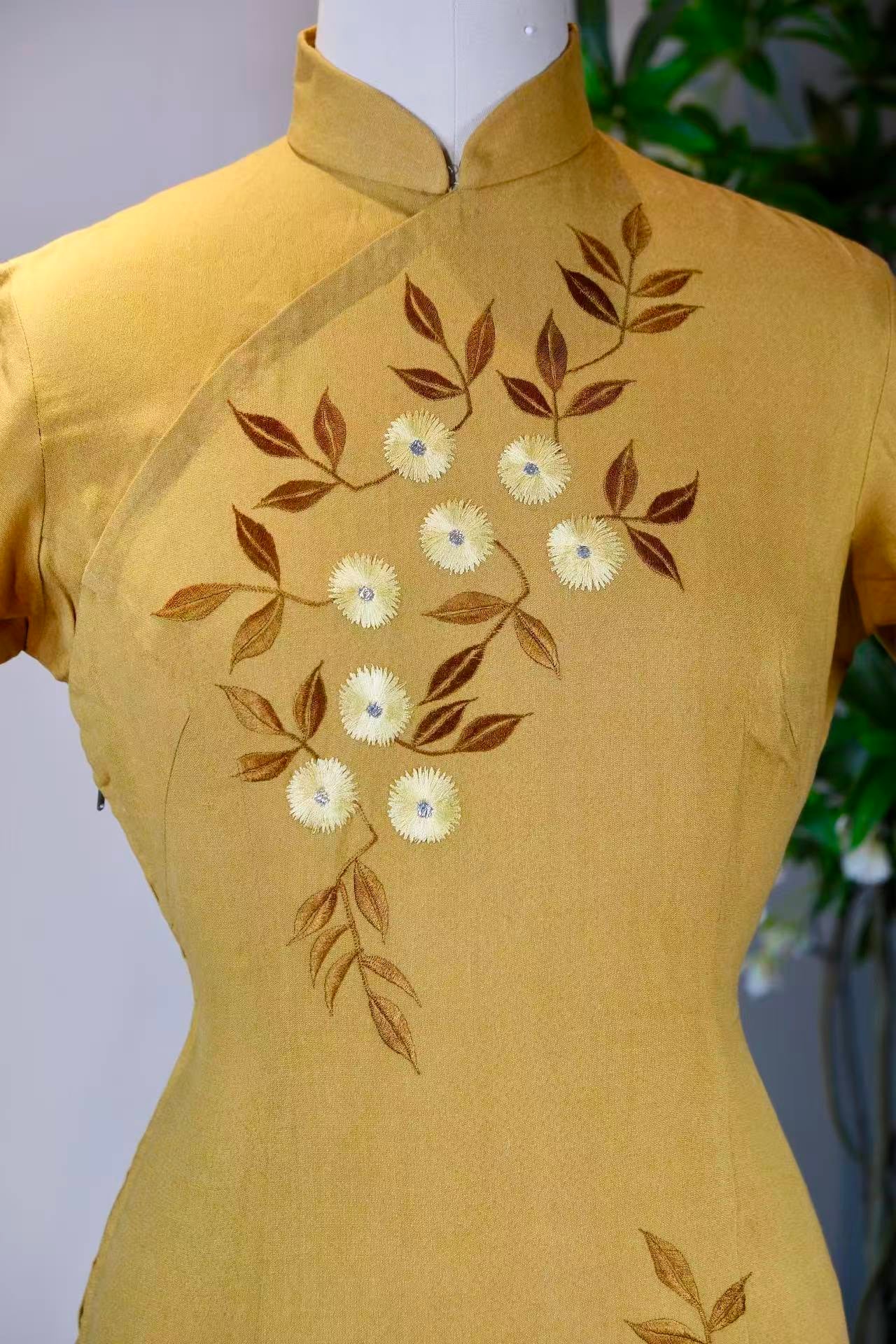
此件五十年代台湾制古董旗袍,以月黄面料为底,色调温雅如秋日银杏,恰合《诗经》“君子之服,如金如锡”之贵气。斜襟处绣枝蔓蜿蜒,米白绒花簇拥绽放,花心缀以浅蓝细珠,似《楚辞》“扈江离与辟芷兮,纫秋兰以为佩”之芳草意象,又暗含台湾本土植物纹样特征,兼具文人画的写意与民间工艺的细腻。
针法上,叶片以套针绣出渐变层次,仿若工笔晕染;花朵则用乱针绣堆叠立体肌理,触之如闻暗香。这种“画绣结合”的技法,在五十年代台湾刺绣中极为罕见——彼时正处传统苏绣技艺与本土美学交融的关键期,能保存如此完整的原绣旗袍,堪称“活化石”级藏品。
旗袍版型更显时代匠心:高立领与短袖的利落线条,暗合五十年代西风东渐的摩登气息;而收腰剪裁与侧摆开衩的弧度,却仍恪守“婉约含蓄”的东方美学,正如《礼记》所言“衣服在躬,而不知其名为奥”,将风雅藏于一针一线间。
其稀缺性更在于历史语境:五十年代台湾刺绣产业正值转型,此件旗袍既保留了传统宫廷刺绣的规制,又融入了战后新中式美学的探索,每一道针脚都承载着特殊年代的文化密码。今观此袍,恰如触摸到半世纪前东方美学的脉搏,其艺术价值与历史重量,已超越衣物本身,成为可穿行于时空的“立体诗篇”。
1950s Taiwanese Embroidered Citrine Qipao: An Ode to Elegance in Every Stitch
"Citrine fabric as smooth as autumn gingko, echoing the noble grace described in The Classic of Poetry: 'A gentleman’s attire, refined as gold and tin.'"
This 1950s antique Qipao from Taiwan features a Lunar Yellow (Citrine) base, a hue as temperate and elegant as autumn leaves. Along the diagonal closure, winding vines and clusters of cream-white blossoms unfold. The flower centers are embellished with light blue micro-beads, evoking the fragrant herb imagery of The Songs of Chu: "I knit autumn orchids to make a garland." The pattern subtly integrates native Taiwanese botanical motifs, balancing the freehand spirit of literati painting with the delicate intricacy of folk craft.
In terms of technique, the leaves are rendered in Satin Stitch (Tao Zhen) to create a gradient effect akin to fine-brush ink washing. The blossoms utilize Random Stitch (Luan Zhen) to build a three-dimensional texture that feels as if it carries a hidden fragrance. This fusion of "painting and embroidery" was exceptionally rare in 1950s Taiwan—a pivotal era where traditional Suzhou embroidery merged with local island aesthetics. A perfectly preserved piece of original embroidery from this period is a "living fossil" in the world of textile collection.
The silhouette reflects the ingenuity of its time: the sharp lines of the high standing collar and short sleeves align with the modernist influence of the 1950s. Meanwhile, the cinched waist and the curve of the side slits strictly adhere to the "subtle and reserved" Oriental aesthetic. As stated in the Book of Rites: "One wears the clothing, yet knows not its profound mystery," hiding elegance within every single thread.
Its scarcity is rooted in its historical context: as Taiwan’s embroidery industry underwent a post-war transformation, this Qipao preserved the regulations of imperial embroidery while exploring a New Chinese Aesthetic. Every stitch carries a cultural cipher from a unique era. Beholding this robe today is like touching the pulse of Oriental aesthetics from half a century ago; its artistic and historical weight transcends the garment itself, becoming a "three-dimensional poem" that traverses time and space.