深圳溯源
无法加载取货服务可用情况
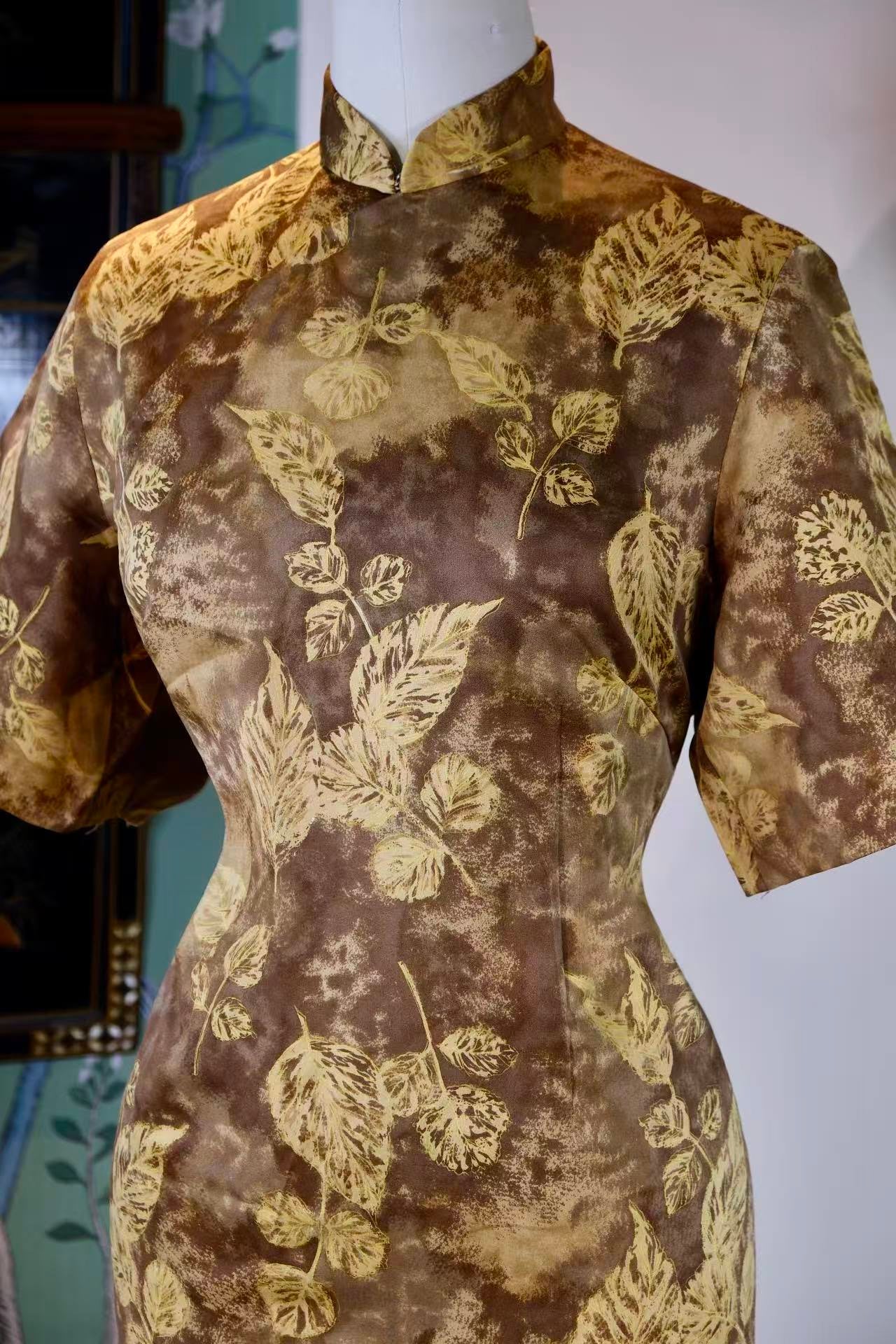
五十年代台湾金叶旗袍:丝绸上的秋日诗篇
“庭前落尽梧桐,水边开彻芙蓉。”——宋·朱庭玉《天净沙·秋》
当一片金叶飘落在赭褐色的天光里,
“云破月来花弄影,绸缪枫叶荻花秋。”——唐·白居易《琵琶行》
旗袍的剪裁暗合五十年代台湾改良旗袍的风韵:
这件旗袍的织造者,或许是某位从苏州迁台的老裁缝,
“此情可待成追忆,只是当时已惘然。”——唐·李商隐《锦瑟》
七十年后,当我们的目光掠过这片金叶,触摸的不仅是丝绸的肌理,
"The sycamores before the courtyard shed their leaves; the lotus blossoms by the water have bloomed their last." — Zhu Tingyu, Tian Jing Sha: Autumn (Song Dynasty)
When a single golden leaf drifts into the amber glow of twilight, time freezes into the patterns of this 1950s Taiwanese antique Qipao. The brownish-yellow base resembles autumn earth, carrying a matte texture refined by decades of history. Hand-printed leaf motifs wind gracefully from the collar to the hem, capturing the Zen philosophy of "knowing autumn by the fall of a single leaf." Traced with fine gold-painted veins, some leaves unfurl like fans while others curl like butterflies. The spacing between the vines balances realism with the effortless brushstrokes of a literati painting.
"The clouds break, the moon emerges, and flowers dance in shadows..." — Inspired by Bai Juyi’s Pipa Xing (Tang Dynasty)
The tailoring captures the distinct charm of modified Taiwanese Qipaos from the 1950s: high collars and narrow sleeves are paired with a slight outward expansion at the shoulder line, blending traditional modesty with Western-style sculptural silhouettes. The waistline sits slightly lower than in the earlier Republican era, contouring the body without restriction. As the wearer moves, the hem sways like wind through the treetops, bringing the golden leaf patterns to life in a play of light and shadow. This "measured elegance" epitomizes the "New Chinese" sartorial philosophy of Taiwanese ladies at the time—finding a calm, Oriental composure amidst the collision of tradition and modernity.
The creator of this Qipao might have been an old tailor from Suzhou who migrated to Taiwan, sewing memories of Jiangnan's sycamores into every stitch. Or perhaps it was a local Taiwanese seamstress inspired by the acacia leaves of the tropical island, reinterpreting the auspicious "Golden Leaf" motif. Regardless of its origin, this garment is a living fossil of the shared textile and printing heritage across the Strait. Each golden leaf whispers a truth: though mountains and rivers may separate us, the roots of culture remain intertwined in the warp and weft of the silk.
"This feeling might have become a memory to be cherished, but even then, it felt like a sense of loss." — Li Shangyin, The Ornamented Zither (Tang Dynasty)
Seventy years later, as we gaze upon these golden leaves, we touch more than just the texture of silk; we feel the breath of an era. This Qipao may have witnessed the rising steam in a Taiwanese teahouse or accompanied a lady on a sunset stroll through the old town of Lukang. Today, as fast fashion turns "National Tide" (Guochao) into a factory-line symbol, this Golden Leaf Qipao stands as a reminder through its weathered gold foil and warm patina: true Oriental aesthetics are not a mere stacking of elements, but the weaving of nature, history, and humanity into a garment of "harmony between Heaven and Man."