深圳溯源
无法加载取货服务可用情况
衣服尺寸:
胸围/腰围/臀围:84/70/90 厘米
衣长:103 厘米
细节描述:
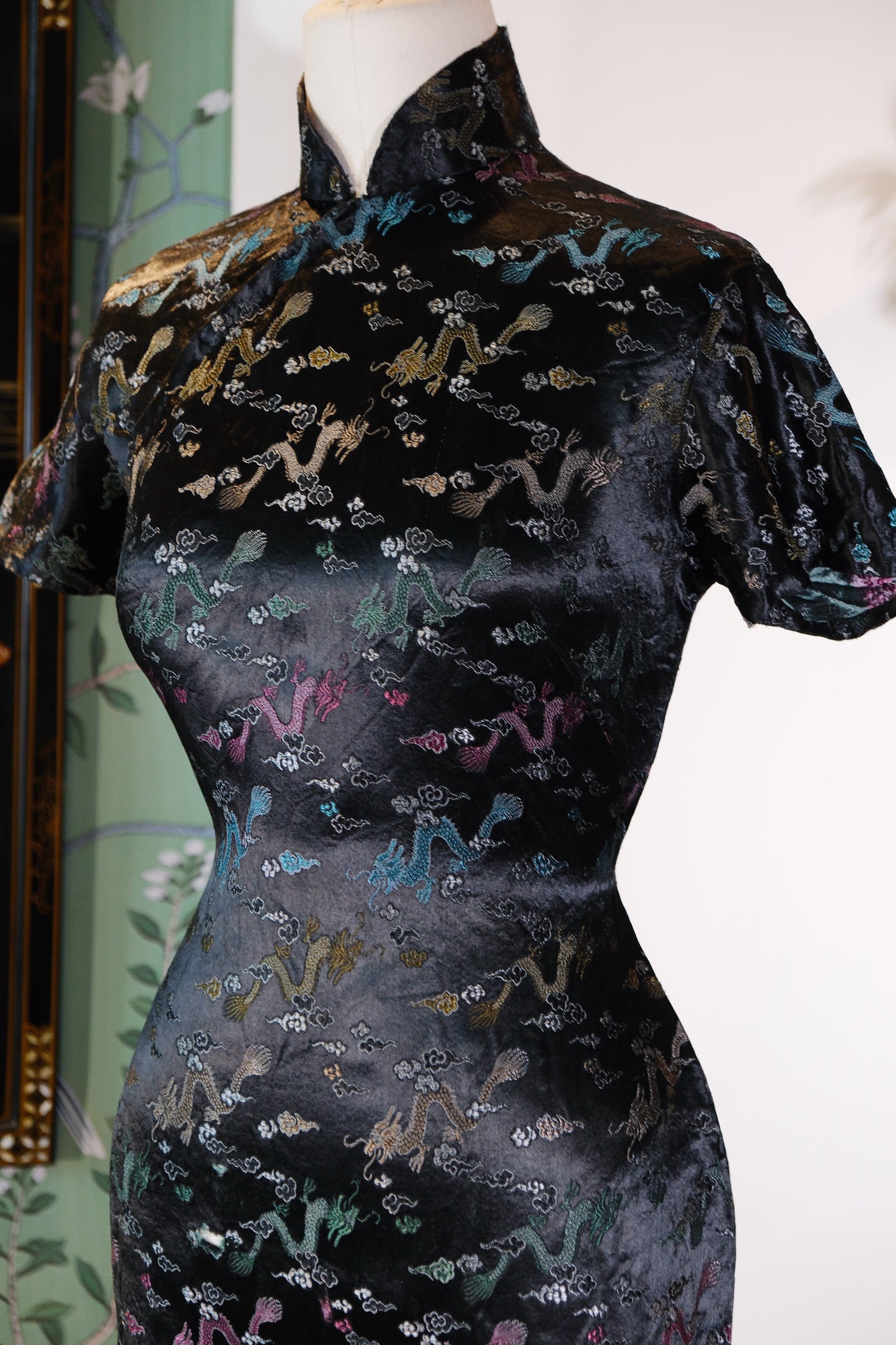
当墨色丝绒浸染了香江的月色,祥云龙纹便在经纬间苏醒。这件诞生于上世纪五十年代香港的织锦缎旗袍,以金丝为骨、彩线为魂,将东方的云水气象与西方的立体剪裁熔于一炉,成为东西方文明碰撞的缩影。
旗袍面料采用传统“满地金”织造工艺,墨黑底色上,数十条祥龙以“S”形游走于云海之间——朱砂红的龙睛如星火闪烁,靛青的龙鳞泛着幽光,金线勾勒的龙须与云纹交织成流动的韵律。云纹并非呆板的重复,而是借鉴了宋代《营造法式》中的“如意云”造型,既有汉代瓦当的古朴,又含明代缂丝的灵动。每一寸织锦都需匠人耗时数月,以“通经断纬”技法织就,龙纹的立体感与云纹的层次感,在光线流转间如活物般呼吸。
1950年代的香港,是旗袍艺术的“黄金孤岛”。彼时上海裁缝南下,将海派旗袍的精致与岭南文化的务实结合,催生出独特的“港式旗袍”风格。这件旗袍的立领高度、斜襟弧度,皆遵循传统规制,却在腰身处暗藏西式省道设计,既保留东方女性的含蓄,又凸显现代曲线美。据考,彼时香港织锦缎多从苏州进口,而龙纹图案因涉及“皇家规制”,民间极少使用,这件旗袍或为某位名门闺秀的定制嫁衣,龙纹象征“龙凤呈祥”,云纹寓意“青云直上”,一针一线皆是时代的眼泪与希冀。
从艺术史视角看,这件旗袍堪称“活态文物”。其织锦缎的纹样布局,暗合《考工记》“天有时,地有气,材有美,工有巧”的造物哲学;而旗袍的剪裁,则是“中西合璧”的典范——立领、斜襟坚守传统,修身廓形却借鉴了西方女装的立体裁剪,堪称“东方的身体,西方的骨架”。更难得的是,五十年代香港织锦缎旗袍存世极少,因彼时工业化浪潮初起,手工织锦逐渐被机制面料取代,这件旗袍的“满地金”工艺与完整龙纹图案,在现存实物中不足百件,堪称“可穿着的博物馆藏品”。
《诗经》有云:“君子至止,锦衣狐裘。”这件旗袍不仅是服饰,更是一部穿在身上的文化史。当指尖抚过龙纹的凸起,仿佛触碰到半个世纪前香江的晚风,以及那个时代女性对美的执着与坚守。它等待着新的主人,续写属于东方的优雅传奇。
Measurements / Size Guide:
Bust / Waist / Hips: 84/70/90 cm
Total Length: 103 cm
Detailed Description:
When the ink-black velvet is steeped in the moonlight of old Hong Kong, the auspicious clouds and dragon motifs awaken within the warp and weft. Born in 1950s Hong Kong, this brocade qipao uses gold thread as its bone and colored silk as its soul. It melts Oriental elemental aesthetics with Western 3D tailoring, serving as a microcosm of the collision between Eastern and Western civilizations.
Crafted with the traditional "Man Di Jin" (Full-Ground Gold) weaving technique, dozens of auspicious dragons wander in an "S" shape through a sea of clouds across the ink-black ground. The cinnabar-red eyes of the dragons flicker like sparks, their indigo scales shimmer with a faint luminescence, and the gold-traced whiskers intertwine with cloud patterns in a flowing rhythm. These cloud motifs are not mere repetitions; they draw inspiration from the "Ruyi Clouds" found in the Song Dynasty’s Yingzao Fashi (Treatise on Architectural Methods), possessing both the primitive simplicity of Han Dynasty roof tiles and the ethereal grace of Ming Dynasty tapestry (Kesi). Every inch of the brocade took craftsmen months to complete using the "discontinuous weft" technique, allowing the three-dimensionality of the dragons and the layering of the clouds to breathe like living creatures under shifting light.
Hong Kong in the 1950s was a "Golden Island" for qipao artistry. During this era, Shanghainese tailors migrated south, blending the exquisite refinement of Haipai (Shanghai-style) qipao with the pragmatism of Lingnan culture, giving birth to the unique "Hong Kong-style" qipao. While the collar height and diagonal bodice follow traditional regulations, the waist conceals Western-style darts—preserving the modesty of the Oriental woman while accentuating a modern, curvaceous silhouette. Records suggest that much of the brocade in Hong Kong at that time was imported from Suzhou. Because dragon motifs were historically tied to "Imperial Regulations" and rarely used by the public, this piece may have been a custom bridal gown for a prominent family. The dragon symbolizes "prosperity brought by the dragon and phoenix," and the clouds signify "rising to the blue sky"—every stitch carries the tears and hopes of an era.
From an art history perspective, this qipao is a "living cultural relic." The layout of its brocade patterns aligns with the philosophy from Kao Gong Ji (The Artificers' Record): "Heaven has its seasons, Earth has its Qi, materials have their beauty, and craftsmanship has its skill." Its tailoring is a masterpiece of "East meets West"—the high collar and diagonal closure uphold tradition, while the fitted silhouette draws from Western 3D draping, embodying "an Oriental body with a Western skeleton." Furthermore, 1950s Hong Kong brocade qipaos are exceedingly rare. As the tide of industrialization rose, hand-woven brocade was gradually replaced by machine-made fabrics. With its "Full-Ground Gold" craftsmanship and complete dragon patterns, fewer than a hundred such pieces are estimated to exist today, making it a "wearable museum collectible."
As The Classic of Poetry (Shijing) says: "When the gentleman arrives, he is clothed in embroidered silk and fox fur." This qipao is more than a garment; it is a wearable history of culture. When fingertips brush over the raised dragon scales, it feels like touching the evening breeze of Hong Kong half a century ago and the unwavering devotion to beauty held by women of that time. It awaits a new owner to continue the legend of Oriental elegance.