深圳溯源
无法加载取货服务可用情况
五十年代香港提花蕾丝旗袍:织光镂影的浮世美学
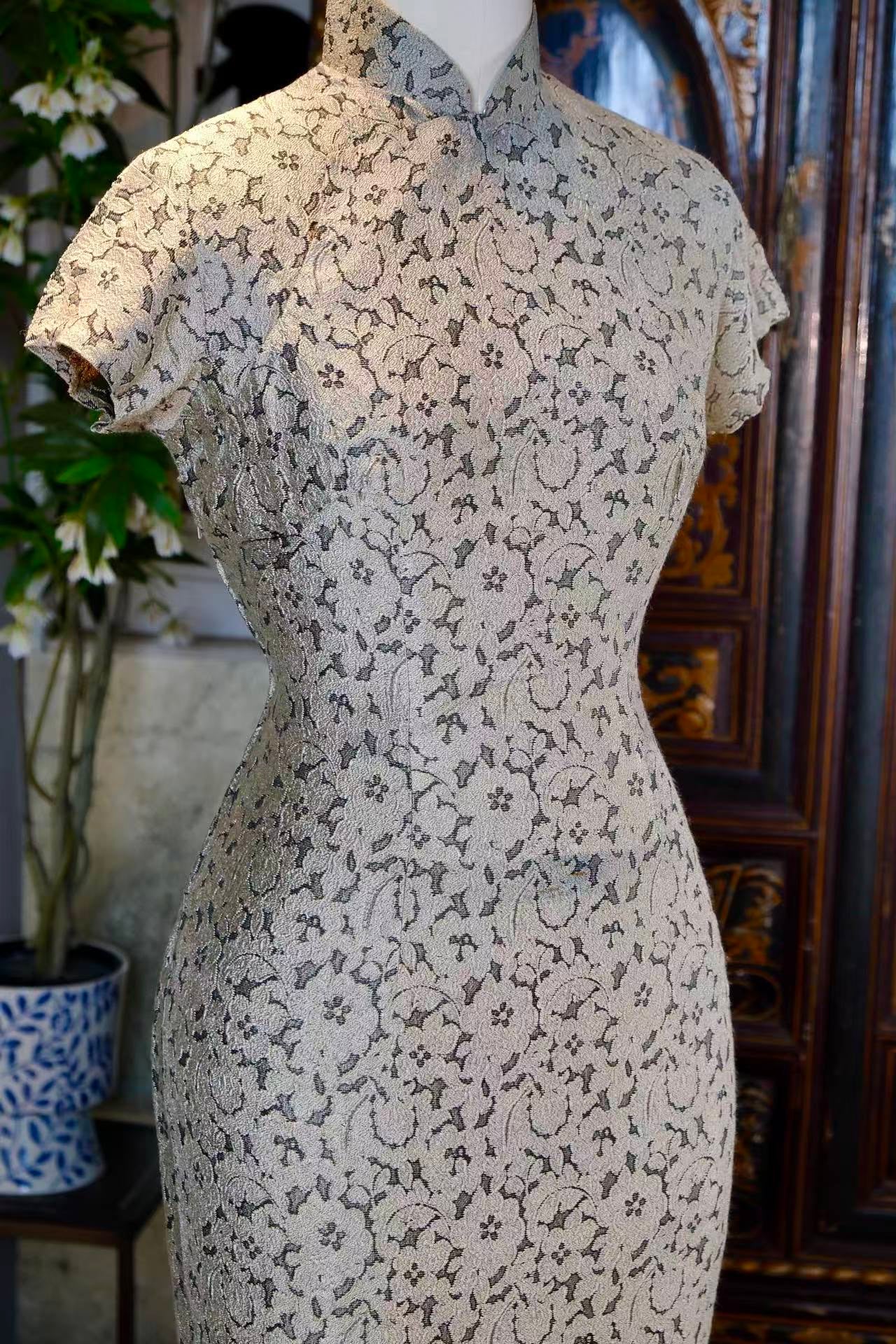
银灰底子上,暗纹如星子浮沉。提花工艺织就的蕾丝纹样,
衣身紧致合体,立领高挺如孤峰耸峙,短袖微喇似兰芽破晓。
此袍存世不过半世纪,却已成香港制衣史的“活化石”。
抚之如触时光肌理,观之若见旧梦依稀——此袍之稀,
"Upon a silver-grey base, hidden patterns drift like stars in a shifting tide."
The jacquard lace patterns of this garment are a crystallization of the mid-century collision between Oriental aesthetics and Western techniques. A closer look at the variations of "Intertwining Lotus" (Chanzhi Lian) and "Scrolling Grass" (Juan Cao) motifs reveals a structure that inherits the precision of "Lock Patterns" and "Linked Beads" from Yingzao Fashi (Treatise on Architectural Methods), while echoing the refined elegance of "simplicity over complexity" advocated in Zhang Wu Zhi (Treatise on Superfluous Things). Every strand of warp and weft tells the story of the Hong Kong garment industry’s golden age: in the workshops of the Kowloon Walled City, master tailors still used traditional Cantonese "Drawlooms" (Hua Lou Ji) to hand-weave patterns, infusing Western-imported lace techniques with an Oriental soul.
The silhouette is tight and form-fitting, with a high standing collar as resolute as a lonely peak and short sleeves flaring slightly like budding orchids at dawn. Under the light, the jacquard lace radiates a texture of "mysterious allure," much like Eileen Chang’s famous metaphor: "Life is a gorgeous robe, crawling with fleas." The dense scrolling grass entwine with the lotuses, concealing the Lingnan aspiration for "ever-blooming fortune" while exhaling the modern breath of a colonial metropolis. The patterns fan out radially at the neckline and gradually unfurl below the waist, harmonizing with the philosophy of Kao Gong Ji: "The season of Heaven, the breath of Earth, the beauty of Material, and the skill of Craft." Every inch conforms perfectly to the grace of the human curve.
Though this robe has existed for barely half a century, it has become a "living fossil" of Hong Kong’s sartorial history. The 1950s were the "Golden Decade" for the Hong Kong Qipao industry, a time when tailors from across China converged there, melting the silhouettes of the Shanghai school and the delicacy of Cantonese embroidery into a single furnace. Jacquard lace fabric, requiring manual picking and weaving, was extremely labor-intensive and reserved only for bespoke creations in top-tier ateliers. Beholding this antique Qipao today, the hidden patterns on the silver-grey base transcend the garment itself: they represent the stubborn growth of Oriental aesthetics within a colonial context, the elegant persistence of hand-craft against the industrial tide, and an irreplaceable silhouette of the "Fleeting World" in a century of fashion history.
To touch it is to feel the texture of time; to view it is to see a faint, lingering dream. The rarity of this robe lies in the civilizational dialogue within its threads; the elegance of its pattern lies in the chronicle of an era hidden within its vines.