深圳溯源
无法加载取货服务可用情况
衣服尺寸:
胸围/腰围/臀围:86/70/86 厘米
衣长:90 厘米
细节描述:
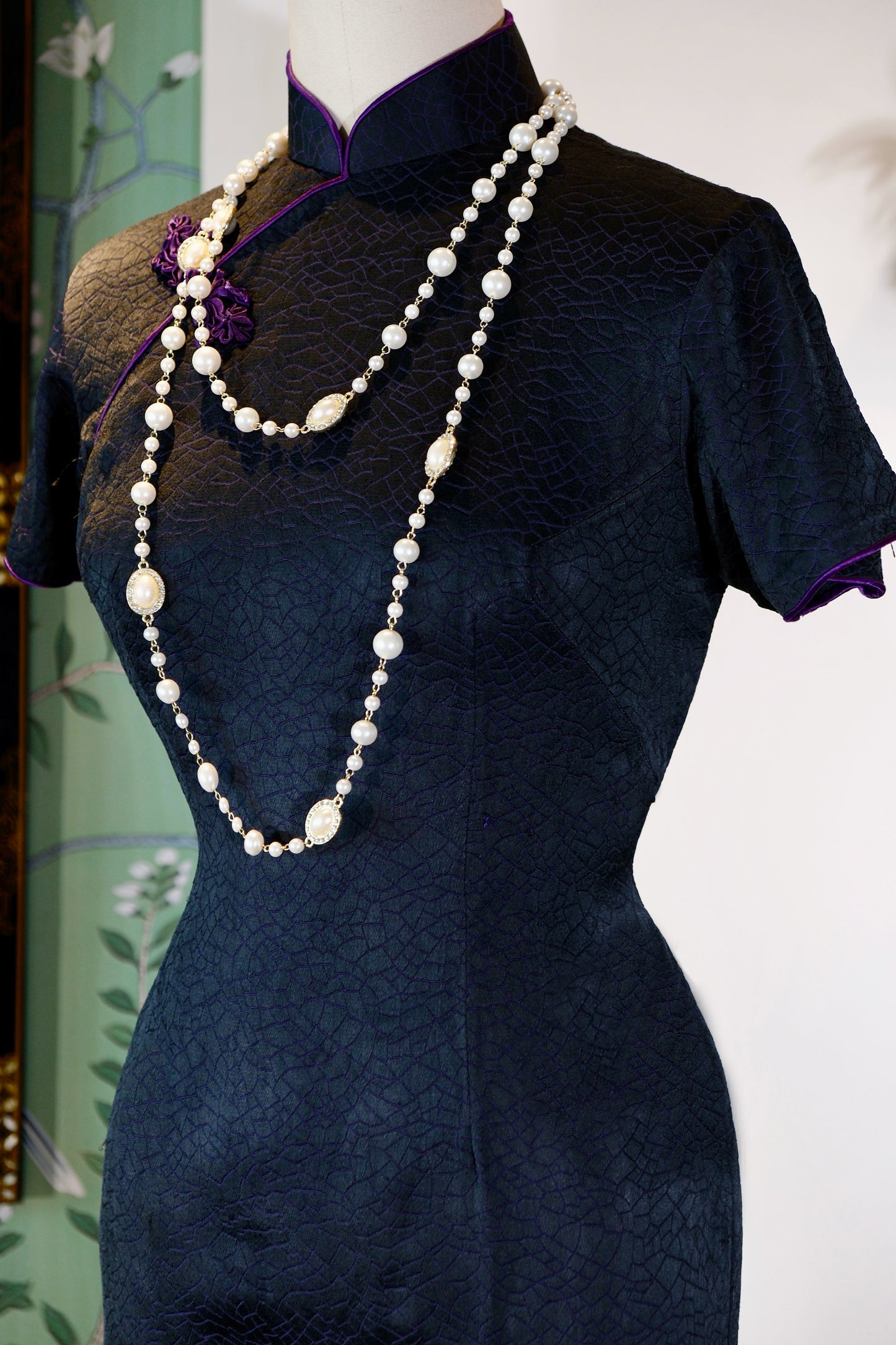
当目光触及这件五十年代香港产旗袍时,仿佛推开了一扇通往旧时光的雕花木窗。深黑色的底料上,冰裂纹提花如碎玉般铺陈开来,每一道纹路都似被时光之手细细摩挲过,泛着温润的光泽。这种冰裂纹,原是中国传统瓷器中“开片”工艺的延伸,在纺织领域却极为罕见——它并非简单的印花,而是通过提花织机以经纬交织的方式,将冰面龟裂的自然肌理凝固于丝线之间,远观如月下寒潭的冰面,近看则见细密的纹路中藏着微妙的明暗变化,仿佛能听见冰层下暗流涌动的声响。
旗袍的领口与斜襟处,紫色线香绲边如一条精致的丝带,勾勒出流畅的轮廓。所谓“线香绲”,是将极细的棉线或丝线裹入绲边之中,使边缘挺括如线香,既显利落又不失柔美。而硬花扣则更见匠心,两枚紫色的盘扣被塑造成含苞待放的花形,扣结紧实却不失灵秀,仿佛是匠人用指尖的温度将布料“捏”出了生命。这种硬花扣工艺在五十年代的香港旗袍中已属精细,彼时香港作为中西文化交汇的港口,旗袍设计既保留了传统苏绣盘扣的雅致,又融入了西方立体剪裁的考量,而这枚花扣,正是这种交融的无声见证。
说起这件旗袍的来历,总让人想起五十年代港岛的旗袍店——皇后大道中的“鸿翔”、中环的“龙凤”,那些临街的铺面里,裁缝们踩着缝纫机,将上海传来的旗袍版型与本地面料结合,创造出独属于香港的“海派遗风”。这件旗袍的面料据传来自当时香港本地纺织厂的定制提花布,彼时战后物资虽不丰裕,但港人对美的追求却从未停歇。冰裂纹的提花设计,或许正暗合了当时人们对“破碎后重生”的隐喻——如同冰面下的春水,看似沉寂,实则暗藏生机。
在艺术风格上,这件旗袍堪称“传统与现代的协奏曲”。冰裂纹的抽象图案打破了传统旗袍常见的花卉、云纹等具象纹样,以极简的几何线条传递出东方的禅意美学,正如宋代汝窑瓷器以“雨过天青”之色与冰裂纹片闻名,这件旗袍也将“残缺之美”升华为一种高级的审美趣味。而深紫色的绲边,在中国传统色彩体系中象征着“紫气东来”,既显贵气又不失内敛,与白色珍珠项链相配,恰如《红楼梦》中“白玉为堂金作马”的富贵气象,却又多了几分港岛特有的市井烟火气。
稀缺性则藏于细节之中。五十年代的香港旗袍虽有一定存世量,但冰裂纹提花面料的旗袍却凤毛麟角——这种面料对织造工艺要求极高,需精准控制经纬线的张力,稍有偏差便无法形成均匀的裂纹效果。加之历经七十余载光阴,能保存至今且纹路清晰、色泽如新的,更是百里挑一。正如艺术史家巫鸿所言:“古董衣的价值,不仅在于其物质形态,更在于它所承载的时代记忆与工艺密码。”这件旗袍上的每一道冰裂纹,都是五十年代港岛女性追求精致生活的注脚;每一针线香绲边,都是传统手工艺在工业浪潮中坚守的印记。
如今,当它静静陈列于展柜中,深紫色的面料在灯光下泛着幽光,冰裂纹仿佛在轻轻呼吸。它不再只是一件衣服,而是一部穿在身上的历史——讲述着五十年代港岛的繁华与沧桑,讲述着匠人对美的执着,更讲述着东方美学中“以简驭繁”的永恒智慧。或许,这正是古董旗袍最动人的地方:它让时光有了形状,让记忆有了温度,让每一个凝视它的人,都能在那片冰裂纹中,看见自己心中的那片“旧时月色”。
Measurements / Size Guide:
Bust / Waist / Hips: 86/70/86 cm
Total Length: 90 cm
Detailed Description:
When your gaze meets this 1950s Hong Kong-made cheongsam (qipao), it feels as though you are pushing open a carved wooden window into the past. On the deep black base fabric, ice-crack jacquard patterns are spread out like shattered jade, each line appearing as if finely burnished by the hand of time, radiating a mellow luster. This "ice-crack" pattern is originally an extension of the kaipian (crazing) technique found in traditional Chinese ceramics, yet it is extremely rare in the textile field. It is not a simple print; rather, it is created using a jacquard loom to interweave warp and weft threads, freezing the natural texture of cracked ice between the silks. From afar, it resembles an icy pond under the moonlight; up close, subtle shifts of light and shadow hide within the dense lines, as if one could hear the undercurrents surging beneath the ice.
At the collar and the diagonal bodice, purple "incense-stick" piping (xianxiang gun) acts like an exquisite silk ribbon, tracing a fluid silhouette. This technique involves wrapping an extremely fine cotton or silk thread within the piping to make the edges as stiff and upright as an incense stick—neat yet graceful. The "hard floral toggles" (ying huakou) show even greater ingenuity: two purple knotted buttons are shaped like flower buds about to bloom. The knots are tight yet nimble, as if the artisan used the warmth of their fingertips to "knead" life into the fabric. This craftsmanship was already considered highly refined in 1950s Hong Kong. At that time, as a port where Eastern and Western cultures converged, Hong Kong’s cheongsam designs retained the elegance of traditional Suzhou-style embroidery toggles while incorporating Western 3D tailoring. These floral buttons serve as a silent witness to this fusion.
The origins of such a cheongsam inevitably bring to mind the qipao shops of 1950s Hong Kong—"Hong Kong Hong Xiang" on Queen’s Road Central or "Loong Fung" in Central. In those street-side shops, tailors worked at their sewing machines, combining the qipao silhouettes brought from Shanghai with local fabrics to create a "Shanghai-style legacy" unique to Hong Kong. The fabric of this piece is said to have come from a custom jacquard order from a local Hong Kong textile mill. Although resources were not abundant after the war, the pursuit of beauty by Hong Kong people never ceased. The ice-crack jacquard design might have subtly echoed a metaphor for "rebirth after breaking"—like spring water beneath the ice, seemingly silent but harboring hidden vitality.
In terms of artistic style, this cheongsam is a "concerto of tradition and modernity." The abstract ice-crack pattern breaks away from the concrete motifs like flowers or clouds common in traditional qipaos, conveying an Eastern Zen aesthetic through minimalist geometric lines. Just as the Ru kiln ceramics of the Song Dynasty were famous for their "sky-blue after the rain" color and ice-crack crazing, this garment elevates the "beauty of imperfection" into a high-level aesthetic taste. The deep purple piping, symbolizing "purple air coming from the east" in the traditional Chinese color system, is noble yet restrained. Paired with a white pearl necklace, it mirrors the opulence described in Dream of the Red Chamber as "white jade for halls and gold for horses," yet adds a touch of the unique, bustling daily life of Hong Kong.
Scarcity is hidden within the details. While a certain number of 1950s Hong Kong cheongsams still exist, those featuring ice-crack jacquard fabric are few and far between. This fabric requires extremely high weaving skills, needing precise control over the tension of warp and weft threads; the slightest error would fail to form a uniform crackle effect. Furthermore, having survived seventy years of time, finding a piece where the patterns remain clear and the colors look as good as new is choosing one in a hundred. As art historian Wu Hung noted: "The value of antique clothing lies not only in its physical form but also in the era's memory and the craftsmanship codes it carries." Every ice-crack line on this cheongsam is a footnote to the refined life pursued by 1950s Hong Kong women; every stitch of the incense-stick piping is a mark of traditional handcraft persisting amidst the industrial wave.
Today, as it stands quietly in a display case, the deep purple fabric glows faintly under the lights, and the ice-crack patterns seem to breathe softly. It is no longer just a piece of clothing but a wearable history—telling of the prosperity and vicissitudes of 1950s Hong Kong, the obsession with beauty by artisans, and the eternal wisdom of "controlling complexity with simplicity" in Eastern aesthetics. Perhaps this is the most moving part of antique cheongsams: they give shape to time and warmth to memory, allowing everyone who gazes upon them to see the "moonlight of old days" within those icy cracks.