深圳溯源
无法加载取货服务可用情况
一、面料:现代主义的墨色交响
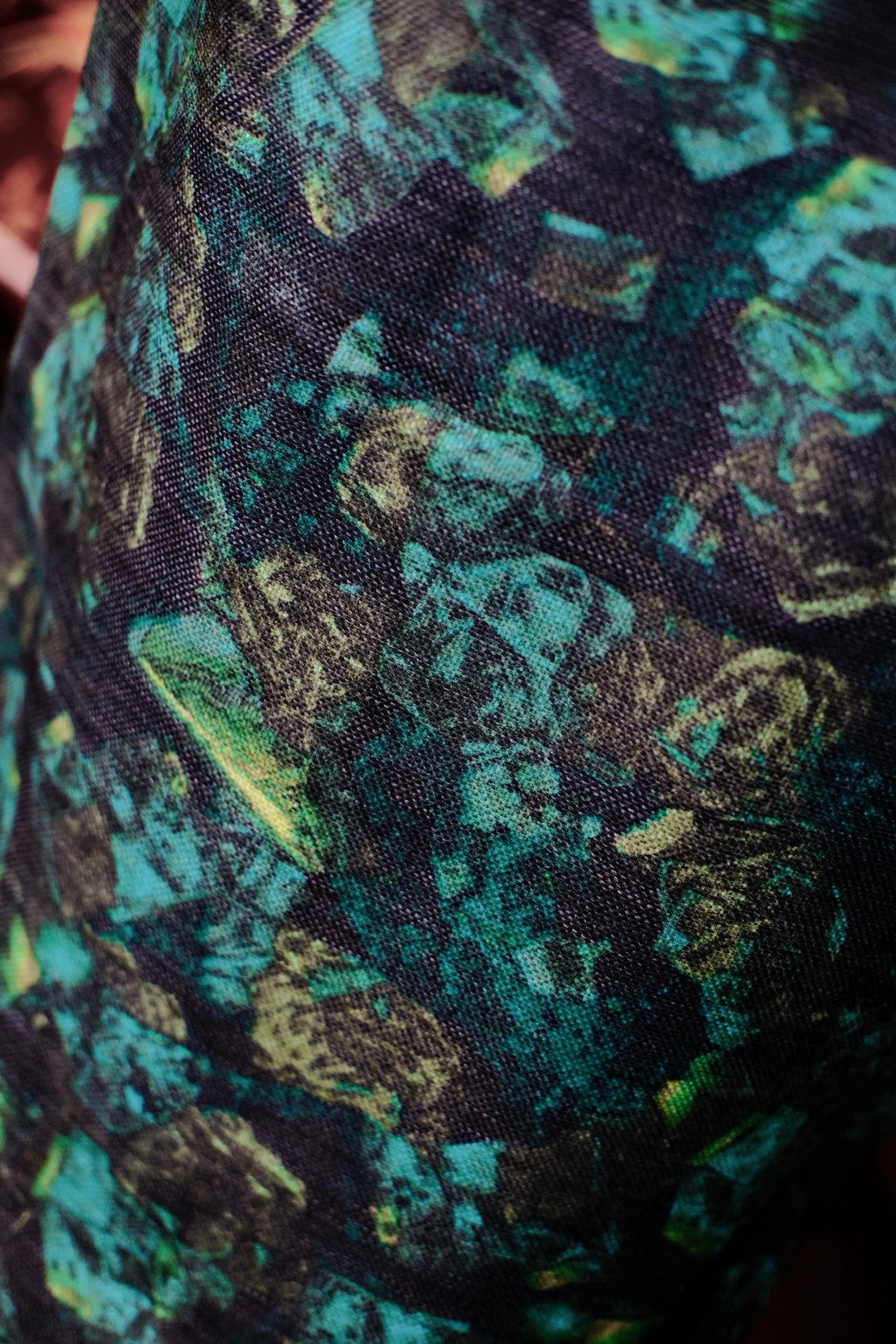
这套套装的面料,是上世纪五十年代意大利进口的抽象印花羊毛。
- 图案:面料上的印花仿佛打碎的墨玉或深邃的矿石切面,深蓝、
- 质感:羊毛的质地赋予了面料厚实的骨架感与温润的触感,
二、形制:十字袖与西装外套的“新旧融合”
套装由十字袖旗袍与同面料西装外套组成,是五十年代香港“
- 内搭旗袍:采用经典的十字袖设计,
- 外搭外套:同面料的西装外套采用简洁的直身廓形,
三、故事:Woo女士的“双城记”
这套衣服的主人Woo女士,是加拿大Super Store的老板之一,亦是五十年代“全球买手”的先驱。
- 在五十年代,像Woo女士这样的海外华商,每年必赴欧洲(
- 这套衣服就是这种生活方式的见证:
四、稀缺性:消逝的“港产高定”生态
如今这套套装的珍贵,不仅在于面料与工艺,
- 五十年代的香港,曾有数百家旗袍工坊,师傅们以“一人一版”
- 随着成衣工业的崛起,这种“欧洲面料+香港工艺”
The structural foundation of this ensemble resides in a premium, abstract-print wool fabric imported from Italy during the 1950s. Deliberately breaking away from the conventional motifs of traditional qipaos—such as botanical florals and avian plumage—this textile presents a bold, geometric abstract aesthetic rooted firmly in mid-century modernism:
The Avant-Garde Pattern: The printed motif mimics fractured dark jade or the complex, multi-faceted planes of deep subterranean minerals. Deep sapphire, ink green, crisp emerald, and vibrant lemon yellow interlace to form irregular, interlocking color blocks. This design tracks a distinct European modern art influence—evoking the fluid movement of a Piet Mondrian composition across a woven canvas, achieving a visual presence that is simultaneously cool, structured, and packed with graphic tension.
The Textural Frame: The organic composition of the wool imbues the textile with a dense, substantial structural skeleton and a comforting, warm hand-feel. It effortlessly balances a proud, crisp silhouette with an elegant, heavy drape. Sourcing this material in 1950s Europe was remarkably rare, with volumes typically reserved for exclusive Western haute couture; repurposing such an avant-garde canvas for a custom qipao speaks directly to the wearer's exceptional eye for design.
The two-piece ensemble comprises an integrated, continuous-sleeve (Shizixiu) qipao and a matching structured tailored jacket, standing as a textbook manifestation of mid-century Hong Kong’s cross-cultural sartorial engineering:
The Foundation Qipao: The interior gown utilizes historical continuous-sleeve tailoring, a traditional cutting method that preserves the organic, continuous fluid composure of Eastern flat patterning. The contours of the standing mandarin collar, front opening, and sleeve cuffs are framed by micro-scale, ultra-fine corded piping (Xianxianggun). The hair-thin refinement of this edge-work establishes a brilliant aesthetic contrast against the heavy, raw texture of the wool—resembling an intricate design engraved upon a rugged stone canvas, perfectly balancing traditional Eastern restraint with absolute modern definition.
The Coordinating Jacket: Cut from the identical Italian wool canvas, the outerwear piece adopts a clean, straight-cut structural framework. Its tailored lapels establish a sophisticated geometric dialogue with the high standing collar of the qipao beneath, multiplying the ensemble's cold-weather utility while solidifying its contemporary edge. This specific "qipao plus jacket" formula became exceptionally popular among intellectual women in 1950s Hong Kong, serving as a definitive sartorial symbol of independence, professionalism, and forward-thinking style.
The custodian of this artifact, Ms. Woo, operated as a co-director of a major Canadian enterprise, standing as a definitive visionary within the early network of global luxury textile procurement:
During the 1950s, elite international Chinese merchants made regular, calculated sourcing journeys across Europe—specifically targeting the premier heritage mills of Italy and France—to secure advanced, trend-setting fabric volumes. These precious materials were subsequently routed back to Hong Kong, where master tailors transformed the raw textiles into bespoke, one-of-a-kind garments.
This specific ensemble stands as an absolute historical marker of that exact transoceanic lifestyle: the abstract Italian wool records the pinnacle of European material taste; the precision-engineered continuous sleeves and custom edge-work track the absolute mastery of Hong Kong's artisan tailoring traditions; and its ultimate presentation within the executive landscapes of Canada highlights a profound narrative of self-directed identity. As the fashion historian Anne Hollander noted, "Dress is an extension of the body." Ms. Woo’s selection functions beautifully as a material expression of personal refinement and a concrete manifestation of cultural authority on the global stage.
The modern rarity of this two-piece set extends far beyond its raw material worth or its unique mineral aesthetics; it stands as a pristine archive of a highly specialized, completely vanished sartorial ecosystem:
During the 1950s, Hong Kong’s custom apparel trade thrived across hundreds of master ateliers who engineered garments based on a strict "one person, one pattern" blueprint philosophy, where senior artisans meticulously draped rare European imported fabrics to match individual anatomical requirements down to the millimeter.
With the subsequent global ascension of mechanized, mass-market industrial production scales, this resource-heavy, time-intensive synthesis of European textile technology and custom Hong Kong craftsmanship permanently dissolved. Finding a fully intact, meticulously preserved 1950s matching set of this calibre represents an exceptionally rare historical discovery. It survives as a peerless, one-of-a-kind monument—a living fragment of fashion history, recording the romance, industry, and uncompromising artistry of a golden era.