深圳溯源
无法加载取货服务可用情况
衣服尺寸:
胸围/腰围/臀围:96/74/100 厘米
衣长:102 厘米
细节描述:
图案描述:墨白间的草木诗学
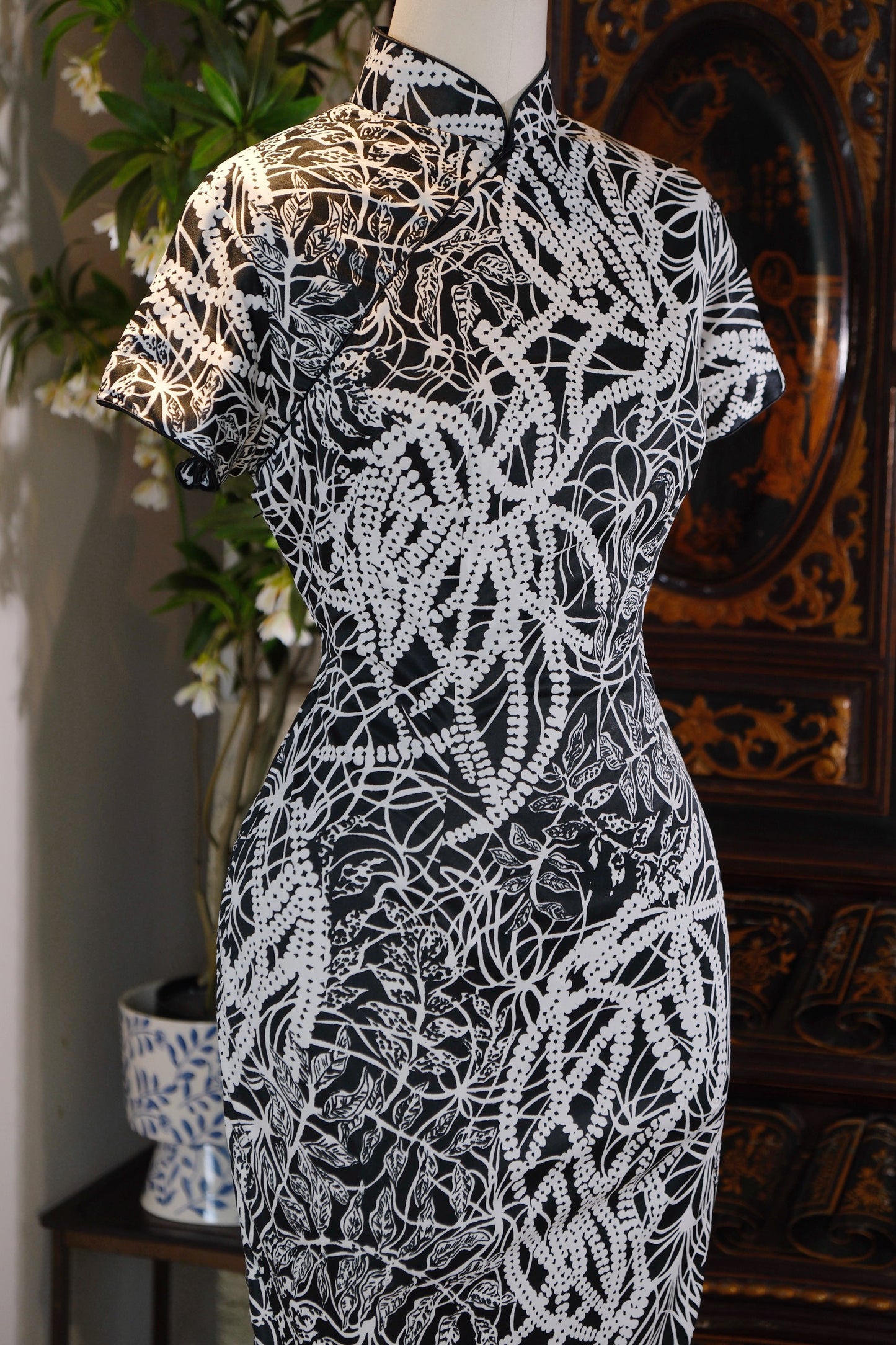
这件旗袍的印花图案以黑白为骨,草木为魂。黑底如夜,白纹似月,交织出藤蔓缠绕、花叶纷披的意象——细看之下,既有蕨类植物的羽状复叶舒展如扇,又有串珠状花序垂落如瀑,更有抽象化的几何线条穿插其间,似水墨写意,又带现代构成感。这种“中西合璧”的图案设计,恰是五十年代香港纺织业“拿来主义”与本土审美碰撞的产物:既承袭了中国传统花鸟画的“折枝”构图,又融入了西方现代艺术的“装饰艺术运动”风格,黑白对比强烈却不失雅致,繁密纹样中暗藏呼吸感,穿在身上,仿佛将一座微型的“纸上园林”穿在了身上。
古董故事:香江衣香鬓影里的时代切片
上世纪五十年代的香港,是东西方文化交汇的“东方之珠”。彼时上海裁缝南迁,将海派旗袍的精致剪裁带到香江,又与本地的务实精神结合,催生出“港式旗袍”——收腰更利落,开衩更含蓄,面料更轻便。这件旗袍的剪裁便是典型:立领挺括如君子之风,短袖利落显女性干练,腰臀曲线贴合如第二层肌肤,下摆微收至膝下,既保留了传统旗袍的“含蓄之美”,又暗合了战后女性参与社会生活的“行动之需”。
它的稀缺性,更藏于历史的褶皱里。五十年代的香港,纺织业虽兴,但高档印花面料仍多依赖进口,如此大面积、高精度的黑白植物纹样,需经过“设计-制版-印花-固色”多道工序,成本不菲。能穿着这样一件旗袍的女子,必是当时的“新女性”——或许是中环写字楼里的文员,或许是湾仔商铺的老板娘,她们用这件衣裳宣告:传统不必守旧,时尚亦可优雅。
引经据典:从《长物志》到“装饰艺术”
明代文震亨在《长物志》中说:“衣以章身,贵乎称体。”这件旗袍的剪裁,正是“称体”的典范——它不追求夸张的廓形,而是以精准的省道和归拔工艺,让布料“长”在身体上,行走时衣袂轻摆,如“风过疏竹,雁渡寒潭”,留白处皆是韵味。
而它的图案,又让人想起二十年代欧洲的“装饰艺术运动”——那种对几何线条的迷恋,对自然形态的抽象化处理,在这件旗袍上得到了东方化的转译。黑白两色,看似极简,实则包罗万象:黑是“玄”,《易经》有云“天玄地黄”,黑为天色,是万物之始;白是“素”,《道德经》言“见素抱朴”,白为本色,是返璞归真。以黑白绘草木,恰是“大道至简”的东方哲学在服饰上的体现。
结语:穿在身上的“流动艺术”
这件五十年代的港产旗袍,早已超越了“衣服”的范畴——它是战后香港社会变迁的“物证”,是中西文化交融的“标本”,更是东方女性身体美学的“宣言”。如今,当我们凝视这件衣裳,仿佛能看见那个年代的女子,穿着它在石澳的海边漫步,在兰桂坊的咖啡馆小坐,在维多利亚港的夜色中转身——黑白纹样随身体起伏,如墨色在水中晕染,开出一朵永不凋零的“时光之花”。
Measurements / Size Guide:
Bust / Waist / Hips: 96/74/100 cm
Total Length: 102 cm
Detailed Description:
Pattern Description: The Poetics of Flora in Monochrome The print of this Qipao uses black and white as its bone and botanical elements as its soul. The black base is like the night, while the white patterns resemble moonlight, weaving an imagery of twining vines and cascading blossoms. Upon closer inspection, one sees pinnate compound leaves of ferns spreading like fans, bead-like inflorescences falling like waterfalls, and abstract geometric lines interspersed throughout. It possesses the freehand spirit of ink-wash painting yet carries a sense of modern composition. This "East-meets-West" design is a direct product of the collision between the "eclecticism" of Hong Kong's 1950s textile industry and local aesthetics: it inherits the "broken branch" (zhezhi) composition of traditional Chinese bird-and-flower painting while integrating the Art Deco style of Western modern art. The contrast between black and white is striking yet elegant; a sense of "breathability" is hidden within the dense patterns. Wearing it is like donning a miniature "garden on paper."
Antique Story: A Slice of Time from Hong Kong’s Golden Era In the 1950s, Hong Kong was the "Pearl of the Orient," a crossroads of Eastern and Western cultures. At that time, Shanghainese tailors migrated south, bringing the exquisite craftsmanship of Haipai (Shanghai-style) Qipao to Hong Kong. Combined with the local pragmatic spirit, this gave birth to the "Hong Kong-style Qipao"—cleaner waistlines, more subtle side slits, and more practical fabrics. The cut of this piece is typical: the standing collar is as upright as a gentleman’s character, the short sleeves are crisp and capable, and the curves at the waist and hips fit like a second skin. The hem tapers slightly below the knee, preserving the "reserved beauty" of the traditional Qipao while meeting the "functional needs" of post-war women entering social life.
Its rarity is hidden within the folds of history. While the textile industry flourished in 1950s Hong Kong, high-end printed fabrics still relied heavily on imports. A large-scale, high-precision monochrome botanical print like this required a complex process of design, plate-making, printing, and color-fixing, incurring significant costs. The woman wearing such a Qipao must have been a "New Woman" of the era—perhaps a clerk in a Central office building or the proprietress of a Wan Chai shop. Through this garment, they declared: tradition need not be conservative, and fashion can remain elegant.
Citing Classics: From "Treatise on Superfluous Things" to Art Deco Wen Zhenheng of the Ming Dynasty wrote in Treatise on Superfluous Things: "Clothes are meant to adorn the body; it is paramount that they fit properly." The cut of this Qipao is a paragon of "fitting properly." It does not seek exaggerated silhouettes but uses precise darts and iron-shaping techniques to make the fabric "grow" onto the body. As one walks, the hem sways gently, like "wind through sparse bamboo or a wild goose crossing a cold pond"—the empty spaces are filled with charm.
Its pattern, meanwhile, recalls the Art Deco movement of 1920s Europe—that obsession with geometric lines and the abstraction of natural forms, translated here into an Oriental vernacular. Black and white may seem minimalist, but they encompass everything: Black is "Xuan" (mystic). As the I Ching says, "Heaven is Xuan and Earth is Yellow"—black is the color of the heavens, the beginning of all things. White is "Su" (plain). The Tao Te Ching speaks of "beholding plainness and embracing simplicity"—white is the original color, a return to authenticity. Painting flora in monochrome is the perfect embodiment of the Oriental philosophy "Great Truths are Simple" (Da Dao Zhi Jian) applied to attire.
Conclusion: "Fluid Art" on the Body This 1950s Hong Kong-made Qipao has long transcended the category of "clothing." It is a piece of "physical evidence" of Hong Kong’s post-war social transformation, a "specimen" of Sino-Western cultural fusion, and a "manifesto" of Oriental female body aesthetics. Today, as we gaze upon this garment, we can almost see the women of that era—walking along the beaches of Shek O, sitting in a Lan Kwai Fong café, or turning in the night mist of Victoria Harbour. The monochrome patterns rise and fall with the body, like ink smudging in water, blooming into an eternal "Flower of Time."