深圳溯源
无法加载取货服务可用情况
衣服尺寸:
胸围/腰围/臀围:98/84/104 厘米
衣长:103 厘米
细节描述:
衣上乾坤:繁复而精致的机绣玫瑰
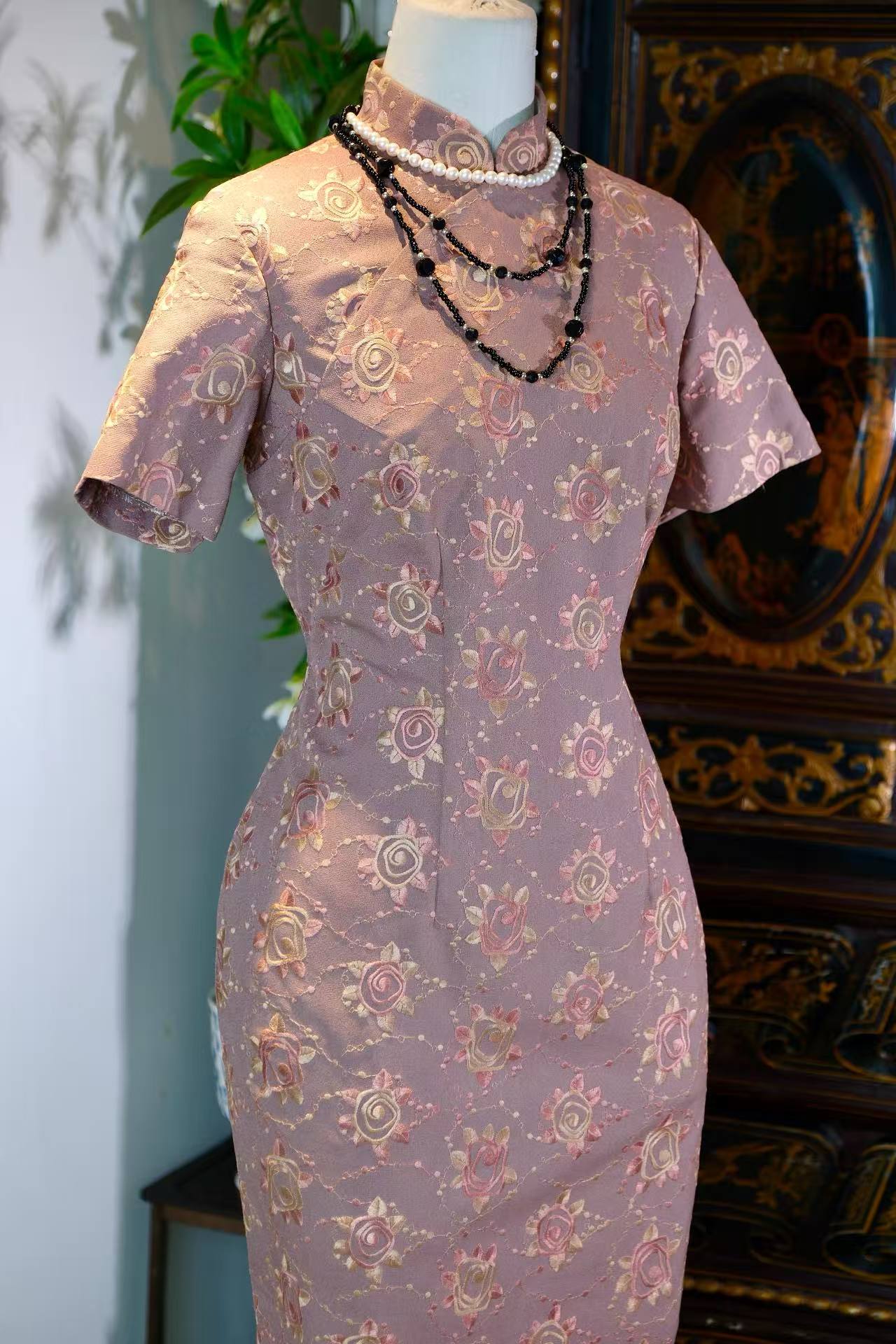
这件诞生于上世纪五十年代台湾的旗袍,其最引人注目的之处,莫过于通体覆盖的机绣玫瑰图案。这些玫瑰并非孤立绽放,而是以精巧的构图,呈规律的菱形网格状排列,彼此之间以纤细的枝蔓或点状纹样相连,形成一种既古典又富有节奏感的视觉效果。
每一朵玫瑰都经过细致的机绣工艺处理,花瓣层次分明,色彩由中心的深粉或暗红向外渐变为柔和的浅粉乃至米白,边缘则以金线或浅黄线勾勒,使其在略带灰调的藕荷色或豆沙色底料上显得立体而饱满。这种机绣技术,在当时的台湾已相当成熟,它既能模仿手绣的细腻,又能保证图案的均一与高效,是那个特定时代技术与审美结合的产物。玫瑰,作为西方舶来的“花中皇后”,在此时被巧妙地织入东方旗袍的肌理,本身就象征着一种文化的交融与时代的开放气息。
岁月留痕:衣香鬓影中的时代侧影
五十年代的台湾,对于许多迁台的大陆人士而言,是一个重建生活与记忆的时代。旗袍,作为当时女性最主要的日常与礼服,承载了她们对故土的思念与对新生活的期盼。这件旗袍,或许曾属于一位优雅的女士,她可能在台北的某个午后,穿着它赴一场茶会,或是在某个家庭的庆典上,以其端庄的姿态成为众人瞩目的焦点。
它见证了那个年代台湾社会的风貌——既有对大陆传统服饰文化的坚守,又悄然融入了新的时代元素(如更为西化的玫瑰图案)。与四十年代上海旗袍的极度修身与奢华不同,五十年代台湾的旗袍在保持曲线美的同时,也增添了一份温婉与内敛。这件旗袍的剪裁合体而不紧绷,长度及膝下,短袖设计亦符合当时亚热带气候的实用需求,是那个时代女性生活状态的真实写照。
艺术风格与稀缺性:时代的孤品
从艺术风格上看,这件旗袍体现了五十年代台湾旗袍的典型特征:
- 图案的折衷性:玫瑰图案的运用,是中西文化碰撞的体现,既有东方对花卉题材的偏爱,又引入了西方的审美符号。
- 色彩的雅致:底色的选择沉静而富有韵味,不张扬却显高贵,符合中国传统审美中对“雅”的追求。
- 工艺的过渡性:机绣的普及,标志着服饰生产从纯手工向半机械化转变,是特定历史时期的工艺见证。
其稀缺性在于:
- 时代久远:距今已近七十年,保存完好的成衣极为罕见。
- 地域特色:台湾产的古董旗袍,相较于上海或香港出品的,存世量更少,且带有独特的地域风格。
- 工艺独特性:这种特定风格的机绣玫瑰图案,是五十年代台湾纺织业的一个缩影,具有不可复制性。
引经据典:衣以载道,裳以寄情
《诗经·邶风·绿衣》有云:“绿兮衣兮,绿衣黄里。心之忧矣,曷维其已。”衣物,自古以来便是情感的载体。这件旗袍,虽非“绿衣黄里”,但其藕荷底色与粉金玫瑰的搭配,同样能唤起观者对往昔岁月的悠悠情思。它如同一个沉默的叙述者,讲述着宝岛旧梦,诉说着一个时代的优雅与坚韧。
张爱玲在《更衣记》中曾言:“回忆这东西若是有气味的话,那就是樟脑的香,甜而稳妥,像记得分明的快乐,甜而怅惘,像忘却了的忧愁。”这件旗袍,或许也曾沾染过樟脑的香气,它所承载的,正是那份甜而怅惘的回忆,是五十年代台湾女性风华的绝唱,值得我们细细品味与珍藏。
Measurements / Size Guide:
Bust / Waist / Hips: 98/84/104 cm
Total Length: 103 cm
Detailed Description:
The most striking feature of this cheongsam (qipao), born in 1950s Taiwan, is the machine-embroidered rose motifs that cover the entire garment. These roses do not bloom in isolation; instead, they are arranged in a sophisticated composition of regular diamond-shaped grids, connected by slender vines or dotted patterns, creating a visual effect that is both classical and rhythmic.
Each rose is rendered with meticulous machine-embroidery. The petals are clearly layered, with colors grading from deep pink or dark red at the center to soft pale pink and off-white at the edges, outlined with gold or pale yellow threads. This makes them appear three-dimensional and full against the slightly muted mallow or bean-paste toned base fabric. Machine-embroidery technology was quite mature in Taiwan at the time; it could mimic the delicacy of hand-embroidery while ensuring uniformity and efficiency—a product of the marriage between technology and aesthetics of that specific era. The rose, as the Western "Queen of Flowers," was cleverly woven into the texture of the Eastern qipao, symbolizing cultural fusion and the open spirit of the age.
In 1950s Taiwan, for many who had migrated from the Mainland, it was an era of rebuilding lives and memories. The qipao, as the primary daily and formal wear for women, carried their nostalgia for their homeland and their hopes for a new life. This garment may have belonged to an elegant lady who wore it to a tea party in Taipei or stood as the dignified focal point of a family celebration.
It witnessed the social landscape of Taiwan in that decade—a steadfast adherence to traditional Mainland dress culture quietly integrated with new elements, such as the more Westernized rose patterns. Unlike the extreme slim-fit and opulence of 1940s Shanghai qipaos, the Taiwanese qipaos of the 1950s maintained a curvaceous beauty while adding a sense of gentleness and restraint. The cut is well-fitted but not constricting, with a length falling below the knee and short sleeves suited for the practical demands of a subtropical climate—a true reflection of the female lifestyle of that era.
Artistically, this cheongsam embodies the typical characteristics of 1950s Taiwanese qipaos:
Eclecticism of Pattern: The use of roses reflects the collision of East and West, combining the Eastern preference for floral themes with Western aesthetic symbols.
Elegance of Palette: The choice of base colors is serene and meaningful—understated yet noble, aligning with the pursuit of "Ya" (refinement) in traditional Chinese aesthetics.
Transition of Craft: The popularity of machine-embroidery marked the shift from pure handcraft to semi-mechanization, serving as a witness to the craftsmanship of a specific historical period.
Its scarcity lies in:
Historical Distance: Nearly seventy years old, well-preserved garments from this period are exceptionally rare.
Regional Characteristics: Antique qipaos made in Taiwan are fewer in number compared to those from Shanghai or Hong Kong and possess a distinct regional style.
Uniqueness of Craft: This specific style of machine-embroidered rose pattern is a microcosm of the 1950s Taiwanese textile industry and is impossible to replicate.
As the Classic of Poetry says: "Green is the upper robe, green with a yellow lining. The sorrow of my heart, when will it ever stop?" Clothing has always been a carrier of emotion. Although this qipao is not "green with a yellow lining," its combination of a mallow-toned base and gold-pink roses evokes a deep nostalgia for the past. It acts as a silent narrator, telling dreams of the Treasure Island and speaking of an era’s elegance and resilience.
In A Chronicle of Changing Clothes, Eileen Chang once said: "If memory had a scent, it would be the fragrance of camphor—sweet and steady, like a clearly remembered joy; sweet and wistful, like a forgotten sorrow." This cheongsam may once have carried the scent of camphor. What it carries today is precisely that sweet and wistful memory—a swan song of the 1950s Taiwanese woman’s grace, worthy of our careful appreciation and preservation.