深圳溯源
无法加载取货服务可用情况
衣服尺寸:
胸围/腰围/臀围:88/68/94 厘米
衣长:116 厘米
细节描述:
一、图案:织锦上的“岁寒双清”
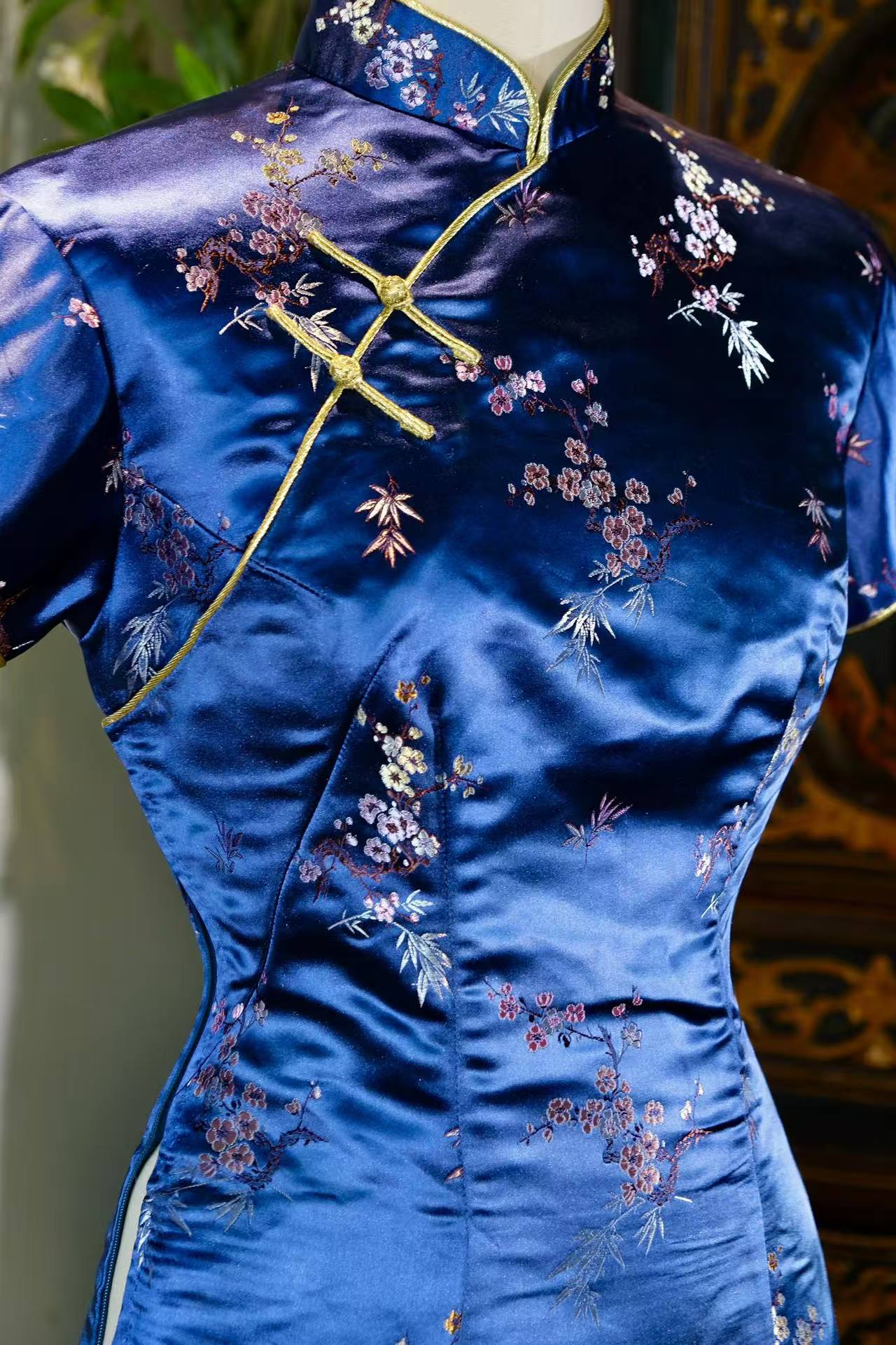
宝蓝织锦缎如深海凝脂,泛着珍珠般的幽光,其上以粉白梅枝与翠竹为纹,构成“岁寒双清”的吉祥意象。梅枝虬曲如铁,花朵或含苞或盛放,花瓣以渐变粉白丝线绣制,蕊心点金,似有暗香浮动;竹叶则以银灰与浅绿丝线勾勒,叶脉清晰如生,与梅枝交错间,暗合“梅须逊雪三分白,雪却输梅一段香”的诗意。
领口与盘扣处饰以金线滚边,斜襟上的一字盘扣如两枚交叠的玉璧,金线缠绕间,既显富贵之气,又暗合“金玉满堂”的民俗寓意。织锦缎的提花工艺使图案隐现于缎面之下,远观如雾中看花,近赏则见针脚细密,每一朵梅花、每一片竹叶皆似从缎中自然生长而出,尽显“锦上添花”的传统工艺精髓。
二、故事:香江裁缝铺里的时光切片
这件旗袍诞生于上世纪五十年代的香港,彼时大陆匠人南渡香江,将苏杭的织锦技艺与海派旗袍的剪裁美学带至维多利亚港。它或许曾是某位南洋商贾夫人的压箱之物,在太平山的舞会上流转生姿;又或是某位书香门第的小姐,穿着它赴一场维多利亚港畔的茶会,衣袂间藏着对故土的思念。
五十年代的香港,是传统与现代的交汇点:旗袍的收腰设计贴合女性曲线,既承袭了民国海派旗袍的“东方韵味”,又融入了西方时装的立体剪裁;而织锦缎的选用,则延续了中国宫廷服饰的奢华基因,却以梅竹纹样的文人风骨,平衡了富丽与清雅。这种“中西合璧”的特质,恰是当时香港社会文化交融的缩影。
三、艺术风格:织锦缎里的“东方美学密码”
从艺术风格看,这件旗袍堪称“传统纹样与现代剪裁的对话”。织锦缎的提花工艺源自宋代“锦工”技艺,至明清时达至巅峰,其“通经断纬”的织法使图案具有浮雕般的立体感,正如《天工开物》所言:“织锦之工,穷极机巧”。而梅竹纹样的选择,则暗合中国文人画“以物比德”的传统——梅花傲雪、竹有节操,既是吉祥符号,更是精神寄托。
剪裁上,旗袍的“S型”曲线通过省道设计自然呈现,腰部的收省与臀部的放摆,既符合人体工学,又暗藏“含蓄中见性感”的东方审美。这种“形神兼备”的设计,使旗袍超越了衣物本身,成为“行走的艺术品”。
四、稀缺性:不可复制的“时光孤本”
如今,五十年代香港产的织锦缎旗袍已属凤毛麟角。彼时的织锦缎多采用真丝为原料,经数十道工序织就,而现代机器织锦难以复刻其手工质感;加之当时的旗袍多为量身定制,每一件都是“独一无二”的存在。据香港服装史学者考证,五十年代香港旗袍作坊多集中于中环与上环,随着城市化进程,这些作坊大多已消失,现存的老旗袍多藏于博物馆或私人藏家手中,市面流通者不足百件。
这件旗袍的稀缺性,不仅在于其年代与工艺,更在于它承载的“文化记忆”——它是香江岁月里的一枚时光切片,是东方美学与现代设计碰撞的火花,更是中国传统服饰在特殊历史时期的“活化石”。正如《诗经》所言:“青青子衿,悠悠我心”,这件旗袍的每一道针脚、每一缕丝线,都在诉说着一个关于美、关于传承、关于时光的故事。
愿这件宝蓝织锦缎旗袍,能成为你衣橱里的“时光信使”,在某个重要的场合,让你与半个世纪前的东方美学,来一场跨越时空的相遇。
Measurements / Size Guide:
Bust / Waist / Hips: 88/68/94 cm
Total Length: 116 cm
Detailed Description:
The royal blue silk brocade is as dense and smooth as deep-sea cream, emitting a pearlescent, ethereal glow. Upon it, pink-and-white plum branches and emerald bamboo form the auspicious imagery of "The Two Purities of Winter." The plum branches are gnarled and powerful like forged iron; the blossoms, either in bud or full bloom, are woven with gradient pink-and-white silk threads. The golden-dotted hearts of the flowers seem to release a faint, drifting fragrance. The bamboo leaves are outlined with silver-gray and light green threads, their veins as clear as if they were alive. Interlacing with the plum branches, they evoke the poetic sentiment: "The plum must concede to the snow three parts of whiteness, yet the snow loses to the plum a segment of fragrance."
The collar and frog buttons are adorned with gold-thread piping. The straight-line "Yi-zi" frog buttons on the diagonal lapel resemble two overlapping jade bi-disks; the entwined gold thread exudes an air of opulence while subtly aligning with the folk blessing of "Gold and Jade Filling the Hall." The jacquard technique of the brocade allows the patterns to emerge and vanish beneath the satin surface—viewed from afar, it is like looking at flowers through a mist; viewed up close, one sees meticulous stitching where every plum blossom and bamboo leaf appears to grow naturally from the satin, fully manifesting the traditional essence of "adding flowers to the brocade."
This qipao was born in 1950s Hong Kong, a time when mainland craftsmen migrated south, bringing the brocade techniques of Suzhou and Hangzhou and the tailoring aesthetics of the Shanghai-style (Haipai) qipao to Victoria Harbour. It might once have been a treasured heirloom of a Southeast Asian merchant’s wife, swaying gracefully at a ball on Victoria Peak; or perhaps it belonged to a lady from a scholarly family, wearing it to a tea party by the harbor, her sleeves hiding a longing for her ancestral home.
Hong Kong in the 1950s was a confluence of tradition and modernity: the cinched waist design hugged the female silhouette, inheriting the "Oriental charm" of the Republican-era Shanghai qipao while integrating the three-dimensional draping of Western fashion. The choice of silk brocade continued the luxurious genes of Chinese imperial court attire, yet balanced opulence with elegance through the scholarly resilience of the plum and bamboo motifs. This "East-meets-West" quality was a microcosm of the cultural fusion in Hong Kong society at the time.
From an artistic perspective, this qipao represents a "dialogue between traditional patterns and modern tailoring." The jacquard process of the brocade originates from the "Jin-Gong" (Brocade Craft) techniques of the Song Dynasty, reaching its peak during the Ming and Qing Dynasties. Its "continuous warp and discontinuous weft" weaving method gives the patterns a relief-like three-dimensionality, as noted in Tiangong Kaiwu: "The craft of weaving brocade exhausts all mechanical ingenuity." The choice of plum and bamboo aligns with the Chinese literati painting tradition of "using objects to signify virtue"—the plum defying the snow and the bamboo possessing integrity; they are both auspicious symbols and spiritual anchors.
In terms of tailoring, the "S-curve" of the qipao is naturally presented through precise darting. The cinching at the waist and the release at the hips are both ergonomic and rooted in the Oriental aesthetic of "sensuality within restraint." This design of "harmony between form and spirit" allows the qipao to transcend being mere clothing and become a "walking work of art."
Today, 1950s Hong Kong-made silk brocade qipaos have become "phoenix feathers and unicorn horns" (extremely rare). The brocade of that era was mostly made of pure silk, woven through dozens of processes that modern machine weaving cannot replicate in texture. Furthermore, qipaos at the time were largely bespoke, making every piece a "one-of-a-kind" existence. According to Hong Kong costume historians, qipao workshops in the 1950s were concentrated in Central and Sheung Wan; with urbanization, most of these workshops have disappeared. Existing vintage qipaos are mostly held by museums or private collectors, with fewer than a hundred pieces circulating on the market.
The scarcity of this qipao lies not only in its age and craft but also in the "cultural memory" it carries—it is a slice of time from the Hong Kong years, a spark from the collision of Oriental aesthetics and modern design, and a "living fossil" of traditional Chinese dress in a unique historical period. As stated in The Classic of Poetry: "Green is your collar, lingering is my heart." Every stitch and every thread of this qipao tells a story of beauty, inheritance, and time.