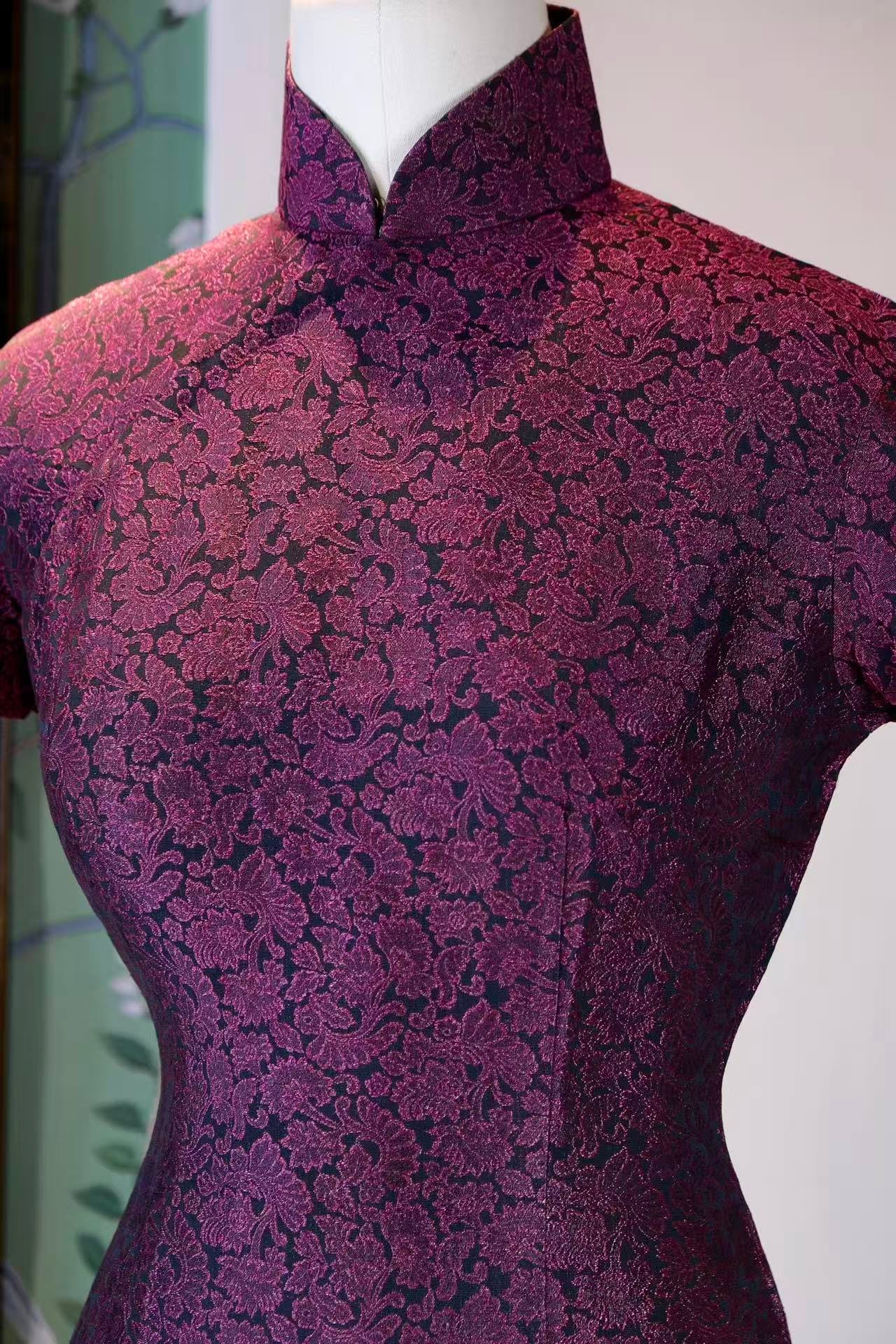
Frosted Plum: The Motif Narrative and Vanishing Craft of 1950s Hong Kong Jacquard Qipao
"Flowers Born from the Loom": A Visual Incantation Upon encountering this Hong Kong antique qipao—a relic submerged in time for half a century—one is instantly captivated by the hidden motifs woven into the ink-stained plum purple. The jacquard pattern uses traditional scrolling lotus as its backbone, yet breaks new ground by integrating the distinct forms of Lingnan Bougainvillea. Every inch of the fabric embodies the exquisite "flowers born from the weave" technique: mulberry silk interwoven with metallic threads. Under light, it creates a shimmering "Purple Qi from the East" (Ziqi Donglai) effect, a contemporary manifestation of the Tiangong Kaiwu description: "Interwoven with gold and brilliant colors, shining like clouds and rosy mists."
The Geometry of Tradition and Locality The pattern layout subtly aligns with the "Fenxin Hua" (Centered Flower) composition found in the Yingzao Fashi (State Building Standards). An S-shaped curve flows throughout the design, while the flower heads form "Meihua Zhuan" (Plum Blossom Seal Script) variants. This synthesis—blending the delicacy of Suzhou and Hangzhou weaving with the local flora of Lingnan—encapsulates the "East meets West" philosophy of the 1950s Hong Kong Jinlun Silk Guild.
Sino-Western Synthesis: A Living Fossil of Modernity While the high collar and slanted bodice define Oriental grace, the jacquard craft carries the DNA of Western textiles. Utilizing British imported Jacquard looms, the garment achieves a sculptural, three-dimensional relief through a "double-layered hidden pattern" technique. This creation of "Chinese skeleton with Western texture" echoes the words of scholar Xu Dishan: "Clothing is the boundary between civilizations, yet the proof of their fusion." In an era where the qipao is becoming a "cultural specimen," this plum-colored masterpiece is a "living fossil" of the modernization of Eastern dress. Its rarity lies not only in its survival—with fewer than a hundred such 1950s jacquard pieces remaining globally, according to the Hong Kong Museum of History—but in its ability to freeze that golden age where Sino-Western aesthetics collided so intensely within a single stitch.