深圳溯源
无法加载取货服务可用情况
衣服尺寸:
胸围/腰围/臀围:84/60/92 厘米
衣长:96 厘米
细节描述:
一、图案解构:繁花织锦里的东方意象
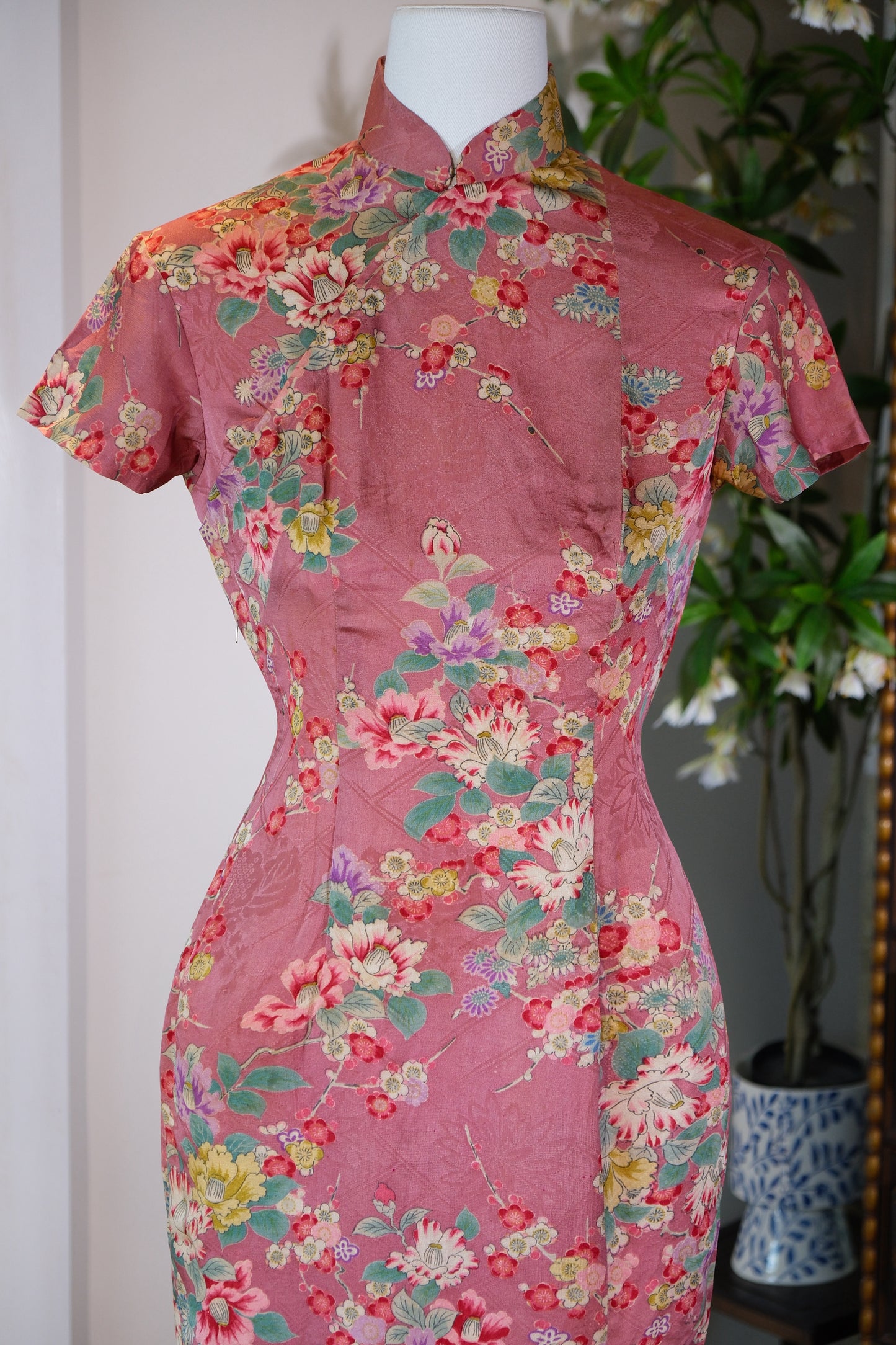
这件旗袍以正绢为地,通体铺陈着繁密而雅致的“百花图卷”,堪称“穿在身上的春日画境”。
- 花卉母题:以牡丹、芍药、海棠、梅花等中国传统吉祥花卉为主体,间杂菊、兰、紫藤等,花型饱满,枝叶舒展,色彩层次丰富——粉、红、黄、紫、绿交织,既见工笔重彩的细腻,又含写意花鸟的灵动。
- 纹样布局:采用“散点式”构图,花朵疏密有致,无明确主花,却处处是焦点,暗合《园冶》“虽由人作,宛自天开”的自然意趣;花瓣边缘晕染过渡自然,可见日本正绢“友禅染”技法的细腻——以手绘或型染呈现渐变效果,使花卉如沾晨露,鲜活欲滴。
- 文化隐喻:牡丹象征富贵,海棠寓意“捷报”,梅花代表坚韧,百花齐放则暗合“万紫千红总是春”的盛世愿景,既承袭明清“百花不落地”纹样的吉祥传统,又融入日式“花见”文化对自然之美的细腻捕捉。
二、工艺溯源:正绢与旗袍的跨洋对话
正绢,即日本传统手工织造的绢织物,以其轻薄透气、光泽柔和、染色持久著称,曾是江户时代贵族与艺伎的专属面料。20世纪50年代,台湾因地理与历史渊源,成为日本正绢的重要流转地,本地匠人将其与传统旗袍工艺结合,诞生了这件“跨文化”的服饰珍品。
- 面料稀缺性:正绢产量极低,且需经“缫丝—织造—染绘”数十道工序,1950年代后,因工业化冲击,手工正绢几近绝迹,存世量稀少。
- 工艺融合:旗袍的立领、斜襟、收腰等典型中式结构,与正绢的日式纹样形成奇妙对话——立领挺括,腰身曲线贴合人体,既保留民国旗袍的“海派风情”,又因正绢的垂坠感增添几分东瀛雅致。
- 时代印记:1950年代的台湾,正处于传统与现代的交汇点,这件旗袍或为当地名媛定制,或是日侨遗珍,承载着战后东亚文化交流的特殊记忆。
三、古董衣的故事:时光里的东方美人
想象1950年代的台北街头,一位身着此旗袍的女子,撑着油纸伞走过青石板路,正绢的光泽在阳光下流转,繁花随步伐轻颤,宛如《长恨歌》中“云鬓花颜金步摇”的现代演绎。她或许是茶馆的老板娘,或许是书香门第的小姐,这件旗袍见证了她的日常——晨起梳妆,午后待客,黄昏散步,每一道褶皱都藏着岁月的温度。
如今,它静立展柜,面料依旧柔软,色彩未褪,却已历经七十余载春秋。正绢的脆弱性使其难以保存,存世的1950年代台湾制正绢旗袍凤毛麟角,每一件都是“可触摸的历史”。正如《考工记》所言:“天有时,地有气,材有美,工有巧,合此四者,然后可以为良。”这件旗袍,正是天时(战后文化交流)、地气(台湾地域)、材美(正绢)、工巧(中式剪裁+日式染织)的完美结晶。
四、艺术风格与稀缺性:不可复制的东方美学标本
- 艺术风格:融合中日美学精髓——中式旗袍的“曲线美”与日式正绢的“纹样美”,既具民国时期的摩登气息,又含传统工艺的典雅韵味,是“东方美学现代化”的早期实践。
- 稀缺性:正绢面料的不可再生性+1950年代台湾制旗袍的存世量稀少+手工染织的独特性,使其成为收藏市场的“潜力股”。据《中国近代服饰史》记载,同期台湾产正绢旗袍多出口海外,国内留存极少,且因面料娇贵,完整保存至今者不足百件。
这件旗袍,不仅是一件衣物,更是一段凝固的时光,一幅流动的画卷,一首无声的诗。它诉说着1950年代东亚的文化交融,见证着传统工艺的巅峰时刻,等待着有缘人,续写它的故事。
Measurements / Size Guide:
Bust / Waist / Hips: 84/60/92 cm
Total Length: 96 cm
Detailed Description:
I. Pattern Deconstruction: Oriental Imagery within the Brocade of Blossoms This Qipao uses Shoken (pure silk) as its base, adorned throughout with a dense and elegant "Scroll of a Hundred Flowers," truly a "spring landscape worn on the body."
Floral Motifs: Centered on traditional Chinese auspicious flowers such as peony, herbaceous peony, crabapple, and plum blossoms, interspersed with chrysanthemum, orchid, and wisteria. The flower shapes are full, the branches are gracefully extended, and the color palette is rich—pinks, reds, yellows, purples, and greens intertwine, showcasing both the delicacy of fine-brush heavy color and the vividness of freehand bird-and-flower painting.
Pattern Layout: Adopting a "scattered" composition, the flowers are spaced with rhythmic density. While there is no single dominant bloom, every spot is a focal point, echoing the natural charm described in Yuan Ye (The Craft of Gardens): "Though made by human hands, it appears as if created by heaven." The natural gradient transitions at the petal edges reveal the finesse of the Japanese Shoken "Yuzen-zome" technique—using hand-painting or stencil dyeing to present a gradual effect, making the flowers look fresh and dew-tipped.
Cultural Metaphors: Peonies symbolize wealth and honor, crabapples imply "joyful news," and plum blossoms represent resilience. The hundred flowers in bloom align with the vision of a prosperous age—"a thousand purples and ten thousand reds are always spring." This both inherits the auspicious tradition of "no flower touches the ground" patterns from the Ming and Qing dynasties and integrates the delicate capture of natural beauty from Japanese "Hanami" (flower viewing) culture.
II. Craftsmanship Origin: A Trans-Oceanic Dialogue between Shoken and Qipao Shoken, referring to traditional Japanese hand-woven pure silk fabric, is renowned for being light, breathable, having a soft luster, and holding dyes durably. It was once the exclusive fabric of nobility and geishas during the Edo period. In the 1950s, due to geographical and historical ties, Taiwan became an important hub for the circulation of Japanese Shoken. Local artisans combined it with traditional Qipao craftsmanship, giving birth to this "cross-cultural" sartorial treasure.
Fabric Rarity: The output of Shoken is extremely low, requiring dozens of processes from "silkworm reeling and weaving" to "dyeing and painting." After the 1950s, due to the impact of industrialization, handmade Shoken nearly vanished, leaving very few surviving pieces.
Fusion of Crafts: The typical Chinese structures of the Qipao—standing collar, diagonal closure, and cinched waist—form a marvelous dialogue with the Japanese Shoken patterns. The standing collar is crisp, and the waistline contours perfectly to the human body, preserving the "Haipai charm" of Republic-era Qipaos while adding a touch of Japanese elegance through the drape of the Shoken.
Imprint of an Era: Taiwan in the 1950s was at the intersection of tradition and modernity. This Qipao might have been custom-made for a local socialite or remained as a relic of a Japanese resident, carrying the special memories of post-war East Asian cultural exchange.
III. The Story of an Antique Garment: An Oriental Beauty in Time Imagine the streets of Taipei in the 1950s: a woman dressed in this Qipao, holding an oil-paper umbrella, walks across a bluestone path. The luster of the Shoken flows under the sun, and the blossoms tremble slightly with her steps—a modern interpretation of "cloud-like hair, flower-like face, and golden hairpins" from the Song of Everlasting Regret. This Qipao witnessed her daily life—dressing in the morning, receiving guests in the afternoon, and strolling at dusk. Every fold hides the warmth of the years.
Today, it stands silently in a display case, the fabric still soft and the colors unfaded after seventy years. The fragility of Shoken makes it difficult to preserve; 1950s Taiwan-made Shoken Qipaos are few and far between—each is a "touchable history." As Kao Gong Ji (The Artificers' Record) states: "Heaven has its seasons, Earth has its Qi, materials have their beauty, and craftsmen have their skill. When these four combine, a fine work is born." This Qipao is the perfect crystallization of its era (post-war cultural exchange), its region (Taiwan), its material (Shoken), and its skill (Chinese tailoring + Japanese dyeing and weaving).
IV. Artistic Style and Rarity: An Irreproducible Specimen of Oriental Aesthetics
Artistic Style: It merges the essence of Chinese and Japanese aesthetics—the "curvy beauty" of the Chinese Qipao and the "patterned beauty" of Japanese Shoken. It possesses both the modern air of the Republic period and the elegant charm of traditional crafts, representing an early practice of "the modernization of Oriental aesthetics."
Rarity: The non-renewable nature of Shoken fabric + the scarcity of 1950s Taiwan-made Qipaos + the uniqueness of hand-dyeing make it a "potential star" in the collection market. According to The History of Modern Chinese Costume, few Taiwan-made Shoken Qipaos from that period remain domestically, as many were exported. Due to the delicate nature of the fabric, fewer than a hundred pieces remain intact today.
This Qipao is more than just a garment; it is a segment of frozen time, a flowing scroll of painting, and a silent poem. It narrates the cultural fusion of East Asia in the 1950s and stands as a witness to the pinnacle of traditional craftsmanship. It now awaits a kindred spirit to continue its story.