深圳溯源
无法加载取货服务可用情况
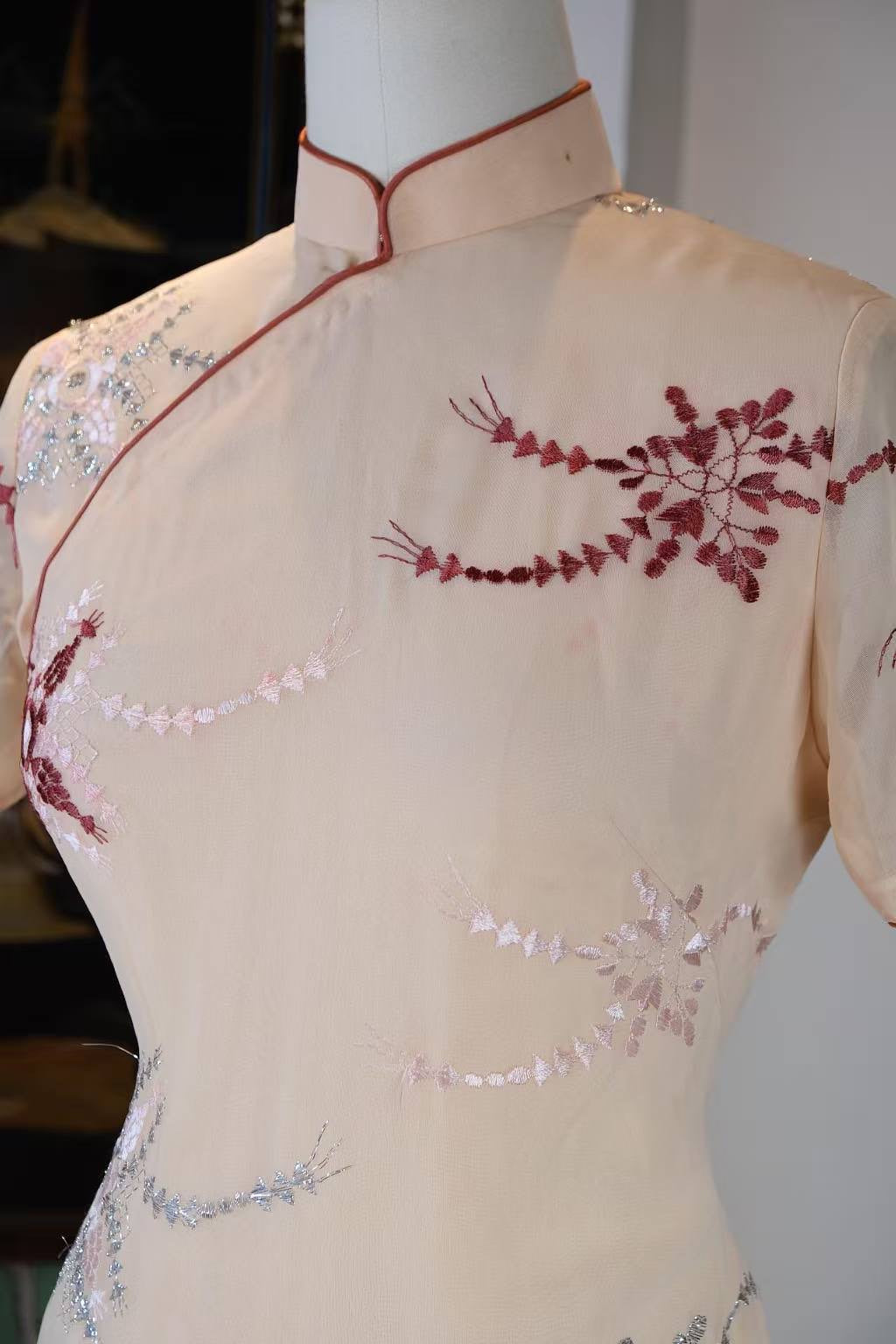
澄纱香绲缀星华——五十年代台湾产机器刺绣古董旗袍
轻抚这件沉睡于时光褶皱中的杰作,
米杏色透纱衣身恰似宣纸,
细观绣线,金属光泽流转如星河。彼时台湾制衣业初兴,
当海派旗袍在大陆渐隐于素色布衣,台湾匠人却以针线续写风华。
半世纪光阴沉淀,让纱面泛起月华般的柔光。它不单是一件衣裳,
【藏家福利价:299】
瑕疵说明: 五十年代孤品,因岁月留痕特价 299 结缘。在古董旗袍界,能历经半世纪风雨仍保持线香绲骨架与星华刺绣的,实属难得。此价格仅为向那个时代的匠心致敬,微瑕不掩其时代风华,是入手中期台湾旗袍史实物的极佳机会。
Running one's fingers over this masterpiece is like hearing the rhythmic hum of sewing machines from a 1950s Taipei alleyway. Its silhouette is defined by the "Incense-Stick" Piping—a deep crimson border winding down the front flap, as slender as a stick of incense. This single line encapsulates the Oriental philosophy of "interplay between the curved and the straight," a tender echo of Shanghai craftsmanship preserved by Taiwanese artisans.
The cream-apricot sheer gauze serves as a canvas of Xuan paper, where machine embroidery takes the place of fine-brush ink lines. The traditional "butterfly among flowers" motif is deconstructed: blossoms shed their realistic forms to become radiant geometric clusters, with silver and crimson silk threads weaving a symmetrical, star-like structure. Even the vines abandon natural curves for zigzag serrations, echoing the Kao Gong Ji (The Record of Artificers): "Heaven has its seasons, Earth its qi, materials their beauty, and craftsmen their skill." Here, the vitality of the passing seasons is condensed into a mathematical rhythm.
Upon closer inspection, the metallic luster of the embroidery flows like a galaxy. In the early days of Taiwan’s garment industry, the precision of imported embroidery machines harmonized with the hand-finishing of local masters. Silver threads trace the sharp angles of the stamens, pink threads create a soft gradient on the petals, and crimson vines use long-and-short stitching to create a rhythm of light and shadow. This is no cold industrial replica; it is the "ingenious spirit" of Tiangong Kaiwu reborn in the machine age.
As the Shanghai-style Qipao faded into plain cloth in the mainland, Taiwanese artisans continued the legacy through needle and thread. These geometric patterns serve as a cultural metaphor within a unique historical context: much like the "radiant ornaments" described in Li Sao (The Lament), the intricate needlework expresses a yearning for ancestral elegance, while the sharp lines of the piping align with the rational spirit of the modern city. It is a masterpiece of diasporic aesthetics—a reconciliation of East and West, tradition and modernity, at the tip of a needle.
After half a century, the gauze emits a soft, lunar glow. It is not merely a garment, but a frozen history of material culture. Every stitch records the lifestyle aesthetics of Cold War-era Taiwan; every shimmer reflects the Chinese woman’s persistence in the tradition of "embroidered elegance." A well-preserved 1950s machine-embroidered Qipao of such caliber is a rare find today—truly a "Lost Treasure of Oriental Raiment" for any collector.
[Exceptional Value: 299]
Condition Note: This 1950s treasure is offered at a special price of 299 due to minor age-related imperfections (微瑕). For a garment that survived the Cold War era with its "incense-stick" piping and geometric embroidery intact, these traces of time are merely "beauty marks" of history. An unbeatable entry point for collectors of Taiwanese textile history.