深圳溯源
无法加载取货服务可用情况
衣服尺寸:
胸围/腰围/臀围:82/66/100 厘米
衣长:97 厘米
细节描述:
【面料:当东方剪裁遇见西方肌理】
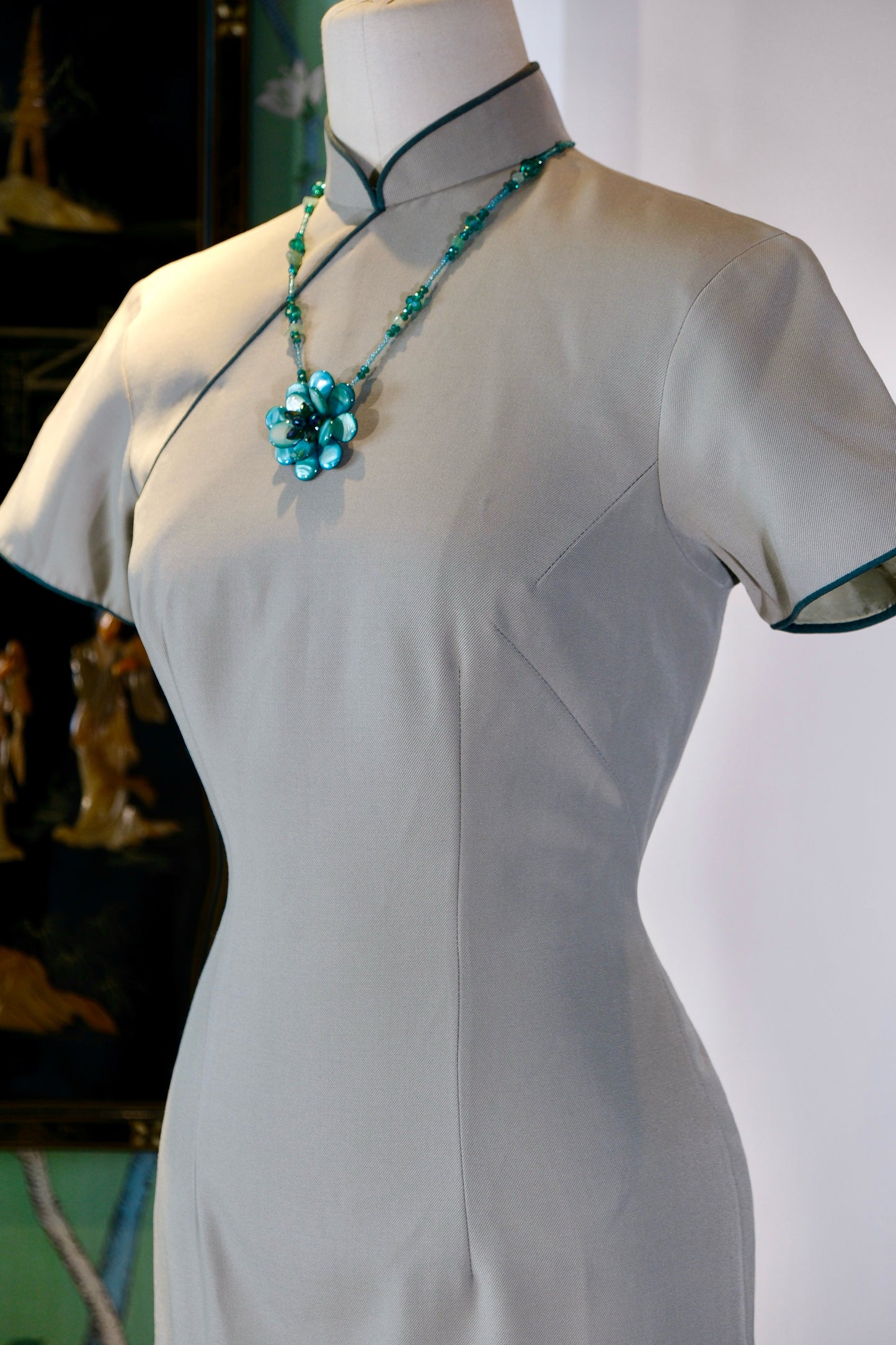
这不仅仅是一件旗袍,更是一段关于“东西交汇”的物质证言。初看其色,如雨后青瓷,温润而内敛;细触其质,却非传统的吴绫越罗,而是五十年代极为罕见的高支数精纺毛料——即彼时所谓的“西装面料”。
在那个东西方文化激烈碰撞的香江岁月,这种面料通常只用于制作考究的男士西装或西式套装。将其用于旗袍,是当时香港裁缝界的一次大胆革新。这种面料摒弃了丝绸的软糯,以特有的挺括与骨感,完美支撑起了改良旗袍的立体剪裁。它使得腰身的收省更加利落,肩部的线条更加平直,正如《长物志》所言“宁古无时,宁朴无巧”,这种材质的硬朗与旗袍线条的柔美形成了一种极具张力的“柔中带刚”之美。
【工艺:线香绲边的极简哲学】
此衣最妙之处,在于“素”。通体无一处刺绣,无一枚盘扣之累赘,仅凭一道深墨绿色的“线香绲”勾勒出领口、大襟与袖口的轮廓。
所谓“线香绲”,乃是滚边工艺中极考功力的一种,细如线香,紧贴边缘,宛如书法中的铁线描。在厚重的西装面料上制作线香绲,难度远超丝绸,稍有不慎便会显得生硬板结。但这件旗袍的滚边却如行云流水,深青色在米灰色底上划出冷峻而优雅的几何分割,完美诠释了包豪斯现代主义美学与东方传统工艺的奇妙共振。
【稀缺:工业文明的绝响】
这件旗袍的稀缺性,不仅在于其存世量的稀少,更在于它代表了旗袍史上的一个特殊断代。
五十年代的香港,是难民、资本与文化的汇聚地。这种西装面料旗袍,往往是当时受过西式教育的知识女性、电影明星或名媛的专属。它象征着一种脱离传统闺阁气息的、独立自信的现代女性形象。随着六十年代化纤面料的普及和成衣工业的兴起,这种使用昂贵进口毛料、全手工定制的“硬身”旗袍迅速退出历史舞台。
【结语】
它静默地伫立,却仿佛诉说着张爱玲笔下那个“到底是上海人”的精致,以及香港特有的“东方之珠”的摩登。它不是轻飘飘的旧梦,而是一份沉甸甸的、有骨架、有风骨的历史档案。这件西装料旗袍,是五十年代都市女性“刚柔并济”精神风貌的最佳注脚。
Measurements / Size Guide:
Bust / Waist / Hips: 82/66/100 cm
Total Length: 97 cm
Detailed Description:
【Fabric: When Eastern Tailoring Meets Western Texture】
This is not merely a Qipao; it is a material testament to the "East meets West" confluence. At first glance, its color is like celadon after rain—warm, moist, and restrained. Yet, upon closer touch, its substance is not the traditional silks of Wu or Yue, but a high-count worsted wool that was exceptionally rare in the 1950s—what was known then as "suit fabric."
During those years in Hong Kong, when Eastern and Western cultures collided intensely, this fabric was typically reserved for sophisticated men’s suits or Western-style ensembles. Utilizing it for a Qipao was a bold innovation by the Hong Kong tailoring circles of the time. This material eschews the softness of silk, using its inherent crispness and "bone" (structural integrity) to perfectly support the three-dimensional silhouette of the modified Qipao. It allows for sharper waist darts and flatter shoulder lines. As The Treatise on Superfluous Things (Chang Wu Zhi) suggests: "Better to be ancient than fashionable; better to be simple than ornate." The hardiness of the material and the grace of the Qipao lines form a tension-filled beauty of "strength within softness."
【Craftsmanship: The Minimalist Philosophy of "Incense-Line" Piping】
The most exquisite aspect of this garment lies in its "plainness." The entire body is free of embroidery or the encumbrance of decorative frog buttons, relying solely on a single "Incense-Line Piping" in deep dark green to silhouette the collar, the large lapel, and the cuffs.
The so-called "Incense-Line Piping" (Xian Xiang Gun) is a technique in edge-rolling that demands supreme skill; it is as thin as a stick of incense, clinging tightly to the edge like the "iron-wire" strokes in calligraphy. Executing this on heavy suit wool is far more difficult than on silk, as the slightest error results in a stiff, clumpy finish. However, the piping on this Qipao flows like moving clouds and flowing water; the deep cyan creates a cold, elegant geometric division against the beige-grey base, perfectly interpreting the wonderful resonance between Bauhaus modernist aesthetics and traditional Eastern craftsmanship.
【Scarcity: An Echo of Industrial Civilization】
The rarity of this Qipao lies not only in its limited survival but in its representation of a specific, transitional era in the history of the Qipao.
Hong Kong in the 1950s was a gathering place for refugees, capital, and culture. These "suit-fabric" Qipaos were often the exclusive domain of Western-educated female intellectuals, movie stars, or socialites. They symbolized a modern female image—independent, confident, and detached from the traditional cloistered atmosphere. With the popularization of synthetic fabrics and the rise of the ready-to-wear industry in the 1960s, these "hard-bodied" Qipaos—hand-customized from expensive imported wool—rapidly exited the stage of history.
【Conclusion】
It stands silently, yet seems to narrate the sophistication of being "a Shanghainese at heart" described by Eileen Chang, as well as the unique modernity of Hong Kong as the "Pearl of the Orient." It is not a light, fleeting dream of the past, but a heavy historical archive with a solid frame and true character. This suit-material Qipao is the finest footnote to the "strength-meets-grace" spirit of 1950s urban women.