深圳溯源
无法加载取货服务可用情况
衣服尺寸:
胸围/腰围/臀围:86/64/94 厘米
衣长:93 厘米
细节描述:
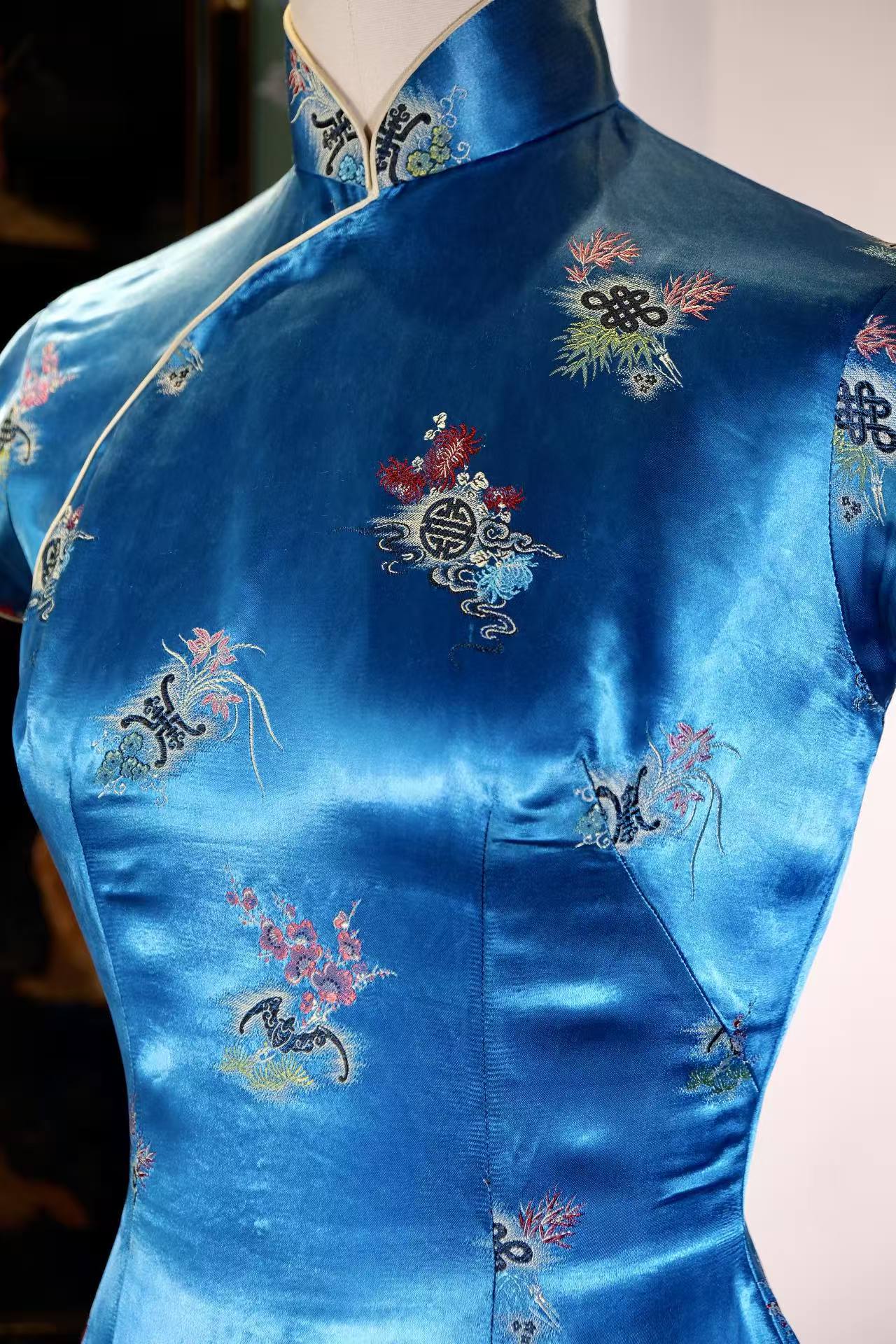
当指尖拂过这套五十年代香港产织锦缎旗袍套装,丝绸的凉滑与暗纹的肌理,像触到半世纪前的时光褶皱。湖蓝色缎面泛着珍珠母贝般的光泽,衣身散落的绣纹,是东方美学的密码本,每一针都藏着旧时光的雅致。
一、衣上纹样:吉祥符号的诗意重组
旗袍与外套的纹样,以“散点式构图”铺陈,似将江南园林的花窗景致绣入衣间。主体纹样分三类:
- 团寿纹与盘长结:圆形团寿纹外绕缠枝纹,取“福寿绵长”之意;黑色盘长结(佛教八宝之一)穿插其间,线条回环贯通,暗合“生生不息”的哲思,是五十年代香港华服中“传统吉祥符号现代化”的典型表达。
- 折枝花卉:粉色梅花与蓝色缠枝莲错落分布,梅花取“傲雪凌霜”的君子品格,缠枝莲则以“莲”谐音“连”,寓意“连年富贵”。花卉旁辅以流云纹,让静态纹样有了“云动花摇”的动态感,呼应《诗经》“蒹葭苍苍,白露为霜”的诗意朦胧。
- 暗纹提花:湖蓝色缎面本身带有细密的暗纹,近看是变体回纹,远观则如粼粼水波,与绣纹形成“明暗相济”的层次,恰似宋代汝窑“雨过天青云破处”的含蓄美学。
二、古董衣的故事:殖民港岛上的东方坚守
这套套装诞生于1950年代的香港——彼时,上海裁缝带着旗袍技艺南迁,在殖民文化的缝隙里,将海派旗袍的“修身曲线”与岭南织锦的“华丽厚重”融合。外套的“对襟立领+盘扣”保留中式服装的端庄,旗袍的“短袖收腰+侧开衩”则注入民国新女性的灵动,是“传统与现代”“东方与西方”碰撞的产物。
据《香港纺织史》记载,五十年代香港织锦缎多采用“双经双纬”工艺,经线用真丝,纬线掺入金银丝,使面料既挺括又闪耀。这套套装的盘扣以米白色缎条盘成“蝴蝶结”造型,每一颗都需匠人手工捏褶、穿引、定型,一套衣的盘扣耗时超3小时,如今机器量产的旗袍已难觅这般“慢工细活”。
三、艺术风格:新古典主义的华服叙事
从艺术风格看,这套套装属于“东方新古典主义”——既承袭清代宫廷织锦的“满工华丽”,又吸收西方立体剪裁的“人体工学”。外套的“箱型廓形”与旗袍的“S型曲线”形成对比,恰似宋代“瘦金体”的刚柔并济;纹样的“散点布局”则借鉴了中国画“留白”的意境,让华丽不至艳俗,端庄不失灵动。
稀缺性在于:五十年代香港织锦缎旗袍存世极少,一是当时面料成本高昂(真丝织锦缎每米需30港币,相当于普通工人半月工资),二是60年代后化学纤维兴起,手工织锦工艺逐渐式微。这套套装保存完好,缎面无脱丝、绣纹无褪色,连盘扣都保持原始形态,堪称“行走的纺织史标本”。
四、结语:穿在身上的时光博物馆
当现代时尚追逐“快消”,这套古董旗袍套装却以“慢工细活”的姿态,讲述着东方美学的永恒。它不仅是衣物,更是一本打开的“文化之书”——翻开它,能看到五十年代香港裁缝的匠心,能触到殖民港岛的东方坚守,更能感受到“衣以载道”的千年传统。
如今,它静静陈列,湖蓝色缎面仍在诉说:真正的经典,从不会被时光褪色,反而会在岁月里,酿成更醇厚的美学佳酿。
Measurements / Size Guide:
Bust / Waist / Hips: 86/64/94 cm
Total Length: 93 cm
Detailed Description:
When your fingertips brush across this 1950s Hong Kong-made brocade qipao suit, the cool smoothness of the silk and the texture of the hidden patterns feel like touching the folds of time from half a century ago. The lake-blue satin surface shimmers with a mother-of-pearl luster, and the embroidered motifs scattered across the body act as a codebook for Oriental aesthetics—every stitch concealing the elegance of bygone days.
The patterns on the qipao and jacket are laid out in a "scattered-point composition," appearing as if the window views of a Jiangnan garden have been embroidered into the garment. The primary motifs fall into three categories:
Round "Longevity" (Shou) and "Endless Knot" (Pan Chang): Circular Shou medallions are encircled by winding vines, signifying "prolonged fortune and longevity." Interspersed among them are black Pan Chang knots (one of the Eight Auspicious Symbols of Buddhism), whose continuous, looping lines align with the philosophy of "ceaseless life." This is a quintessential expression of the "modernization of traditional auspicious symbols" found in 1950s Hong Kong attire.
Sprigs of Flora: Pink plum blossoms and blue intertwining lotuses are distributed in a staggered fashion. The plum blossom represents the noble character of "defying snow and frost," while the lotus (Lian) is a homophone for "continuous," symbolizing "continuous years of wealth." Accompanied by drifting cloud motifs, these static patterns gain a dynamic sense of "moving clouds and swaying flowers," echoing the poetic haze of The Classic of Poetry: "Green, green the reeds; white dew turns to frost."
Jacquard Under-patterns: The lake-blue satin itself features delicate hidden patterns—close up, they reveal a modified "Meander" (fret) pattern; from afar, they resemble shimmering ripples. This creates a layer of "interplay between light and shadow" with the embroidery, much like the subtle aesthetic of Song Dynasty Ru ware: "The color of the sky after rain, where the clouds break."
This suit set was born in 1950s Hong Kong—at a time when Shanghai tailors migrated south with their qipao techniques. In the crevices of colonial culture, they merged the "form-fitting curves" of the Haipai qipao with the "sumptuous weight" of Lingnan brocade. The jacket’s "symmetrical standing collar and pankou buttons" preserve the dignity of Chinese attire, while the qipao’s "short sleeves, cinched waist, and side slits" inject the vitality of the "New Woman" of the Republican era. It is the product of the collision between "tradition and modernity" and "East and West."
According to the History of Hong Kong Textiles, 1950s Hong Kong brocade often utilized a "double warp and double weft" technique, using real silk for the warp and incorporating gold and silver threads into the weft to make the fabric both crisp and radiant. The pankou buttons on this suit are crafted from off-white satin strips into "butterfly knot" shapes; each one required a craftsman to manually pleat, thread, and set, taking over three hours for a single set. Such "slow and meticulous work" is hard to find in today’s mass-produced qipaos.
From an artistic perspective, this suit belongs to "Oriental Neo-Classicism"—inheriting the "full-coverage splendor" of Qing Dynasty court brocade while absorbing the "ergonomics" of Western 3D tailoring. The "boxy silhouette" of the jacket contrasts with the "S-curve" of the qipao, much like the balance of strength and grace in Song Dynasty "Slender Gold" calligraphy. The "scattered layout" of the motifs draws from the "white space" (Liubai) concept in Chinese painting, ensuring the grandeur does not become gaudy and the dignity remains spirited.
Its scarcity lies in the fact that very few 1950s Hong Kong brocade qipaos survive. Firstly, the material cost at the time was exorbitant (silk brocade cost 30 HKD per meter, equivalent to half a month's wage for an average worker). Secondly, after the 1960s, the rise of synthetic fibers caused the manual brocade craft to gradually decline. This suit set is perfectly preserved—the satin has no snags, the embroidery has no fading, and even the pankou buttons maintain their original form. It is truly a "walking specimen of textile history."
While modern fashion chases "fast consumption," this antique qipao suit stands with "slow and meticulous work," telling the eternal story of Oriental aesthetics. It is more than clothing; it is an open "cultural book"—open it, and you see the ingenuity of 1950s Hong Kong tailors, touch the Oriental persistence on a colonial island, and feel the millennial tradition of "garments as vessels of the Way."
Today, as it is quietly displayed, the lake-blue satin continues to speak: true classics are never faded by time; instead, they mature into an even richer aesthetic vintage through the years.