深圳溯源
无法加载取货服务可用情况
衣服尺寸:
胸围/腰围/臀围:110/104/112 厘米
衣长:104 厘米
细节描述:
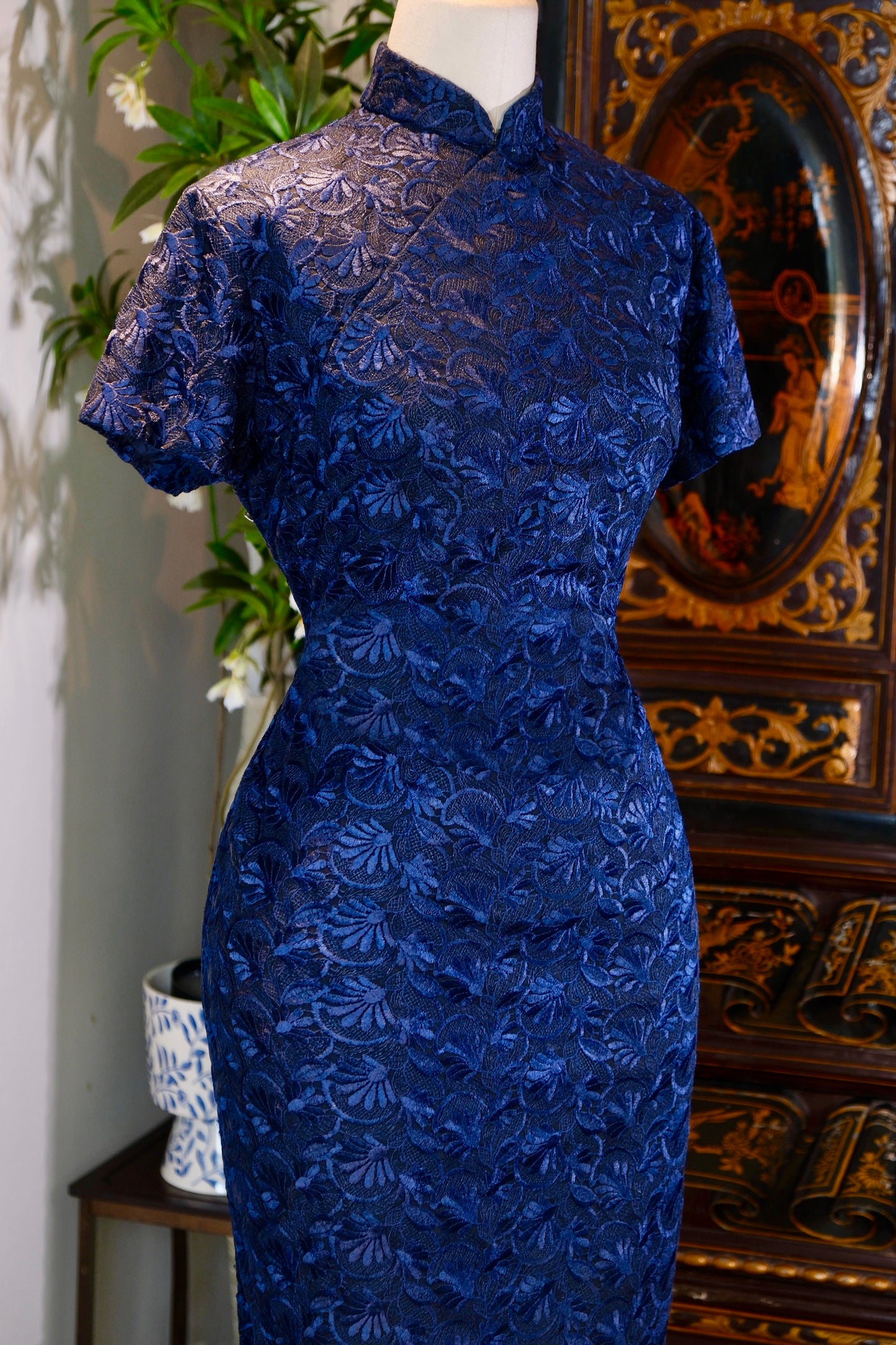
当指尖抚过这件藏蓝色蕾丝旗袍,仿佛触碰到时光的经纬——它以日本进口机绣蕾丝为衣料,在台湾匠人的巧手下裁作旗袍形制,成为上世纪五十年代东亚纺织技艺交融的活化石。衣身通体覆满扇形缠枝纹,每片“扇叶”以细腻的机绣勾勒叶脉肌理,蕾丝的透孔处若隐若现,恰似“轻罗小扇扑流萤”的诗意具象化:扇形在传统意象中喻示“善”与“圆满”,缠枝则暗合“生生不息”的祈愿,二者交织成流动的纹样,在藏蓝底色上泛着幽微光泽,如深夜海浪轻拍礁石,沉静中藏着万千气象。
这件旗袍的故事,要回溯到战后东亚的纺织图景。彼时日本机绣技术已臻成熟,其蕾丝以精准的针距与立体感闻名,而台湾作为当时重要的成衣加工地,匠人深谙旗袍“收腰、立领、斜襟”的形制精髓。二者相遇,诞生了这件“东技西形”的珍品:立领高度恰至下颌,勾勒出东方女性的优雅颈线;斜襟处无多余缀饰,仅以蕾丝本身的纹路为“隐形盘扣”,将传统旗袍的含蓄与现代蕾丝的通透完美融合。据《台湾纺织史》记载,五十年代此类“进口料·本土工”的旗袍多为中产家庭珍藏,存世量不足百件,其稀缺性不仅在于面料的跨国流转,更在于它定格了特定时代“技艺对话”的瞬间。
从艺术风格观之,它兼具装饰艺术的几何秩序与东方美学的写意精神。蕾丝纹样的重复排列暗合“秩序之美”,而扇形边缘的自然卷曲又打破刻板,恰如《考工记》所言“天有时,地有气,材有美,工有巧”——日本机绣的“工巧”、台湾裁剪的“地气”、藏蓝蕾丝的“材美”,在时光中凝为永恒。如今,当我们在博物馆或藏家柜中再见它,那每一针蕾丝都在低语:关于一个时代的开放与坚守,关于一件衣裳如何成为文化的容器,更关于那些被经纬封存的、永不褪色的人间故事。
Measurements / Size Guide:
Bust / Waist / Hips: 110/104/112 cm
Total Length: 104 cm
Detailed Description:
When fingertips brush against this navy-blue lace qipao, it feels as if one is touching the very warp and weft of time. Crafted from imported Japanese machine-embroidered lace and shaped by the skilled hands of Taiwanese artisans, this garment stands as a living fossil of the fusion of East Asian textile techniques from the 1950s. The entire body is covered in an interlocking fan-shaped trailing plant motif (chanzhi). Each "fan blade" uses delicate machine embroidery to outline the texture of leaf veins, while the perforations of the lace create a subtle play of light and shadow. It is a poetic materialization of the line "using a light silk fan to catch fireflies": in traditional imagery, the fan shape symbolizes "kindness" (shan) and "perfection" (yuanman), while the trailing vines imply the wish for "endless life." The two interweave into a fluid pattern that glimmers faintly against the navy-blue base, like midnight waves gently lapping against reefs—calm, yet harboring a vast atmosphere.
The story of this qipao traces back to the post-war textile landscape of East Asia. At that time, Japanese machine embroidery technology had reached maturity, renowned for its precise needle pitch and three-dimensional texture. Meanwhile, Taiwan served as a crucial hub for garment processing, where artisans deeply understood the essence of the qipao’s "cinched waist, standing collar, and diagonal placket." The meeting of the two birthed this treasure of "Eastern technique and Western form": the standing collar height reaches exactly to the jawline, sketching the elegant neckline of an Oriental woman; the diagonal placket features no redundant decoration, using the lace’s own texture as "invisible frog buttons," perfectly merging traditional restraint with modern transparency. According to the History of Taiwan Textiles, such qipaos of the 1950s—characterized by "imported materials and local craftsmanship"—were mostly treasured by middle-class families, with fewer than a hundred pieces surviving today. Its scarcity lies not only in the transnational flow of the fabric but in its capturing of a specific moment of "technical dialogue" between eras.
From an artistic perspective, it possesses both the geometric order of Art Deco and the freehand spirit of Oriental aesthetics. The repetitive arrangement of the lace patterns aligns with the "beauty of order," while the natural curvature of the fan edges breaks any rigidity. As stated in the Kao Gong Ji (The Artificers' Record): "Heaven has its seasons, earth has its vitality, materials have their beauty, and craftsmanship has its ingenuity." The "ingenuity" of Japanese embroidery, the "vitality" of Taiwanese tailoring, and the "beauty" of the navy lace have condensed into eternity through time. Today, when we see it again in a museum or a collector’s cabinet, every stitch of the lace whispers: about an era’s openness and persistence, about how a garment becomes a vessel of culture, and about the worldly stories sealed within the warp and weft that never fade.