蝶影纱梦:清代遗珍里的五十年代风华
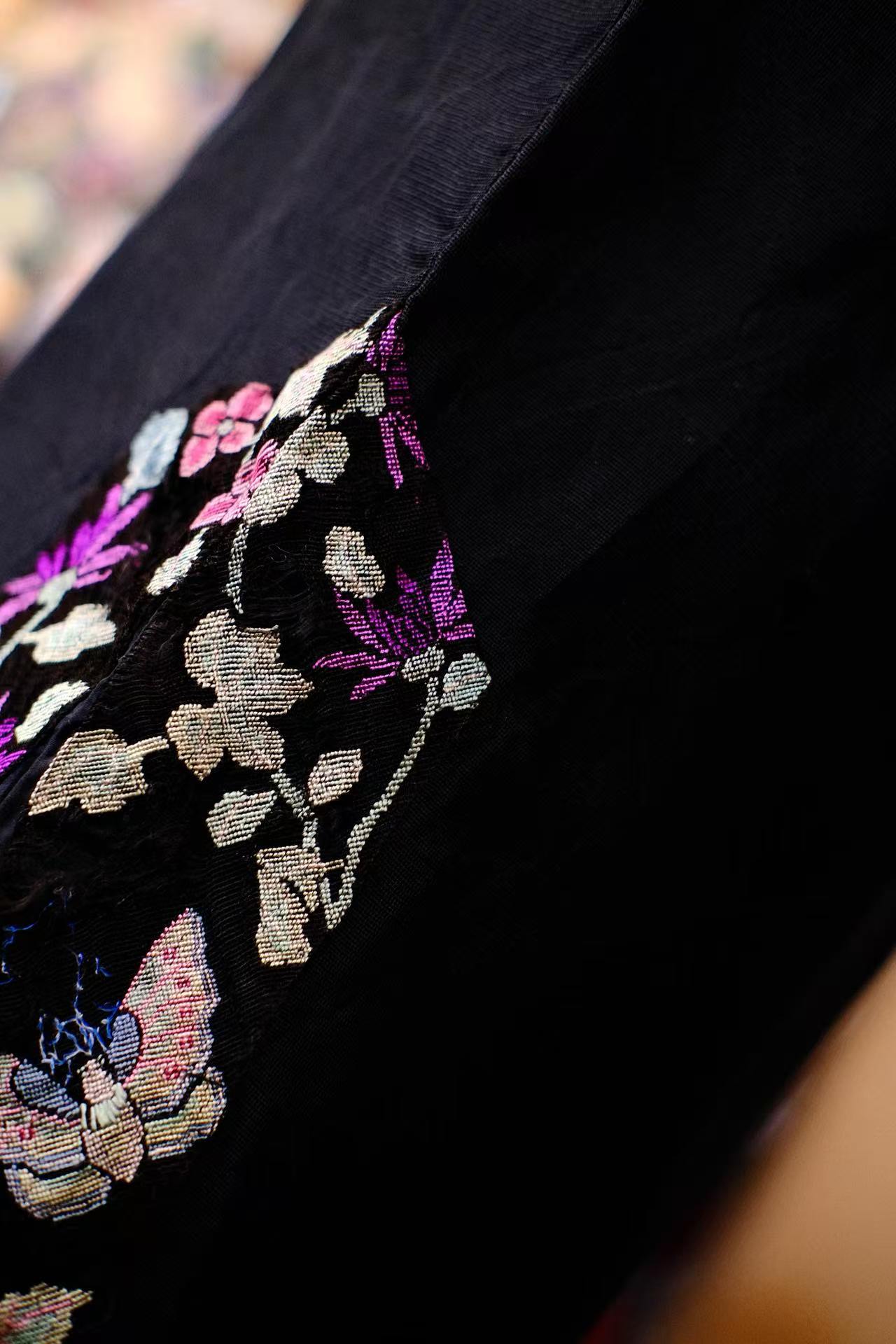
这件五十年代香港产的古董旗袍,是Woo女士衣橱里最“穿越时空”的一件。它以清代芝麻纱面料为底,镶着清代纳纱蝶恋花花边,将两个时代的工艺与美学完美融合,仿佛将百年前的宫廷雅韵与五十年代的摩登风情都藏进了衣褶里。
一、面料与纹样:芝麻纱的轻盈与纳纱的精致
这件旗袍最动人的,是它那如蝉翼般轻盈的质感与细腻的纳纱纹样。
- 色彩:这是一种深邃的“墨黑色”,如同午夜的星空,深邃而不沉闷。这种颜色极衬肤色,显得白皙透亮,自带一种“不怒自威”的贵气。
- 面料:选用的是清代芝麻纱面料,这种面料在光线下会泛出一层细腻的光泽,触感柔软且富有弹性,既有纱的轻盈,又有棉的亲肤,是五十年代香港上流社会女性的心头好。
- 纹样:衣身镶着清代纳纱蝶恋花花边,近看是细腻的花卉与蝴蝶图案,远看却如暗夜中的繁星,低调却不失精致。这种纳纱设计,是那个年代“低调奢华”的最佳诠释——不张扬,却处处藏着细节。
二、点睛之笔:珍珠项链的优雅呼应
这件旗袍搭配了一串天然淡水珍珠项链,与墨黑色的芝麻纱相得益彰。珍珠的圆润光泽与旗袍的纳纱纹样形成微妙的对比,既保留了整体的素雅,又增添了一丝女性的柔美与贵气。
三、衣香鬓影:Woo女士的“穿越时光”
这件旗袍,是Woo女士衣橱中最具“历史感”的一件。
她是一位懂得用历史诠释优雅的女性。在商场上,她运筹帷幄;而在生活中,她又如这芝麻纱般温润细腻。我们可以想象,在一个夏日的夜晚,Woo女士穿着这件墨黑色旗袍,戴着一串珍珠项链,坐在雕花木窗前,手中捧着一杯茶,芝麻纱的光泽与珍珠的温润交织,那一刻,她不再是那个叱咤风云的商人,而是一位享受着宁静时光的优雅女性。
这件旗袍,不仅仅是一件衣服,它是Woo女士生活态度的写照——简约却不简单,贵气却不张扬。它如同一首无声的诗,在时光中静静流淌,诉说着那个年代的从容与优雅。
Butterfly Illusion and Gauze Dream: 1950s Grace Rendered in Qing Dynasty Relics
This 1950s antique qipao, tailored in Hong Kong, represents the most "time-transcending" artifact within Ms. Woo’s wardrobe anthology. Utilizing a historic Zhima gauze fabric from the Qing Dynasty as its primary body, bordered with authentic Qing Dynasty Nasha (counted-stitch gauze) lace featuring a "butterfly courting flowers" motif, it achieves a flawless synthesis of technology and aesthetics from two distinct eras—as if capturing the palace elegance of centuries past and the post-war modernism of the 1950s directly within its structural folds.
I. Fabric and Motif: The Airy Weightlessness of Zhima Gauze and Precision of Nasha Work
The most spellbinding dimension of this qipao lies in its cicada-wing light texture paired with a layout of high-precision historic embroidery:
-
The Depth of Midnight: Enveloped entirely in a singular, absolute "ink black," the tone avoids looking flat or lifeless, resembling instead the infinite depth of a midnight sky. This commanding shade exceptionally flatters the complexion, projecting a brilliant, translucent clarity and an innate, authoritative nobility.
-
The Material Choice: The gown selects historic Qing Dynasty Zhima (sesame-weave) gauze. Highly celebrated among elite high-society women in 1950s Hong Kong circles, this specialized textile offers a subtle, microscopic sheen under ambient light. It masterfully balances the breathability and weightlessness of fine gauze with an organic, skin-friendly comfort, providing a soft stretch that yields a precise silhouette.
-
The Nasha Motif: The edges and placket of the gown are bordered with exquisite Qing Dynasty Nasha embroidered lace featuring a butterflies-among-flowers motif. Up close, the density of the counted-stitch needlework reveals rich, architectural topography; from a distance, however, the configurations soften into a texture resembling stars scattering across a dark sky. This hidden design network serves as the ultimate interpretation of mid-century "understated luxury"—refusing to boast, yet packing calculated precision into every inch of construction.
II. The Defining Detail: The Elegant Resonance of Pearls
This expressive black gown is styled with an integrated strand of natural freshwater pearls, establishing a flawless aesthetic dialogue with the ink-black Zhima gauze canvas. The soft, milky luminescence of the spheres creates a sophisticated counterpoint against the textured Nasha lace work—retaining the overall minimalist purity of the ensemble while introducing a necessary layer of feminine grace and high-society prestige.
III. A Legacy of Grace: Ms. Woo’s "Time Travel"
This qipao stands as the specific artifact that commands the most profound historical presence within Ms. Woo's entire archive.
She was a woman who mastered the art of interpreting peak elegance through historic reverence. In the highly competitive corporate boardroom, she strategized and executed with iron-clad conviction; yet in her private life, she remained as warm, nuanced, and comforting as this delicate gauze. One can easily picture a summer evening, with Ms. Woo wearing this midnight silhouette paired with her signature pearls, seated near a carved wooden window with a cup of tea. As the natural texture of the antique gauze plays against the warm glow of the pearls, the pioneering titan of commerce dissolves into an elegant woman thoroughly enjoying the simple luxury of absolute stillness.
This qipao is far more than an attire; it is a profound manifestation of Ms. Woo’s philosophy of living—minimalist yet deeply complex, noble yet utterly understated. It flows quietly through the passage of time like a silent poem, permanently recording the composure and elegance of a golden era.