深圳溯源
无法加载取货服务可用情况
衣服尺寸:
胸围/腰围/臀围:90/72/98 厘米
衣长:101 厘米
细节描述:
“月光如水水如天,照彻琉璃世界寒。”
——唐·李商隐《无题》
一、衣之形制:暗夜里的流动诗篇
这袭旗袍,是五十年代香港繁华旧梦的遗珠。以进口醋酸缎为底,
立领高耸,勾勒出东方女性的端庄;短袖微收,露出纤腕如玉;
二、绣之华章:潮汕匠人的指尖星河
衣上珠片绣,乃潮汕刺绣之绝艺。潮汕绣以“金碧辉煌,精巧繁复”
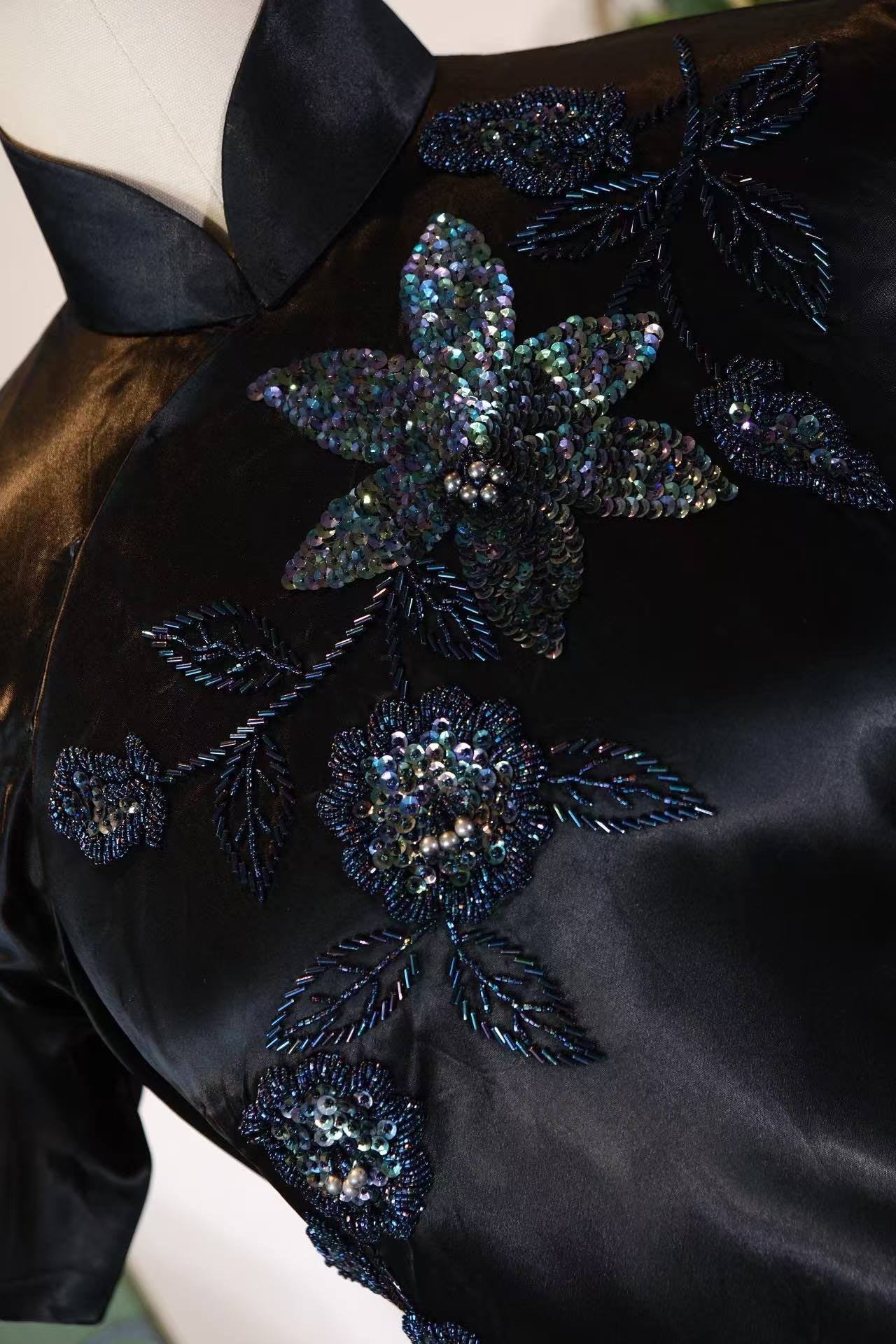
细看那花,瓣如星子,片片层叠,珠光流转,似在暗夜中绽放;
珠片绣之难,在于“以珠代线,以片为墨”。每一颗珠片,
三、衣之故事:香港旧梦里的风华绝代
五十年代的香港,是东西方文化交汇的十字路口。旗袍,
这袭旗袍的主人,或许是某位名媛,或许是某位明星。
四、衣之价值:稀缺与永恒的交响
古董旗袍的价值,不仅在于其工艺之精湛,
它是一段历史的见证,是东西方文化交融的产物,
五、结语:衣以载道,美以传世
“衣者,身之章也。”这袭旗袍,不仅是一件衣裳,
月光如水,衣上珠片闪烁,仿佛在诉说着那些被时光掩埋的故事。
Measurements / Size Guide:
Bust / Waist / Hips: 90/72/98 cm
Total Length: 101 cm
Detailed Description:
"The moonlight is like water, and the water like the sky; it illuminates the world of glaze, piercing and cold." > — Li Shangyin (Tang Dynasty), Untitled
This qipao is a stray pearl from the magnificent old dreams of 1950s Hong Kong. Crafted from a base of imported acetate satin, its texture is as fine as ice-silk, and its luster resembles the brilliance of the moon. It is cool to the touch, carrying a natural grace that flows with every movement. The preciousness of acetate satin in that era lay in the fact that the manufacturing process was not yet fully matured; imported material was particularly rare. Tailoring it into a qipao is akin to wearing the waters of a springtime river—smooth, supple, yet possessing a cold, noble air.
The high mandarin collar stands tall, sketching the dignity of the Oriental woman; the slightly tapered short sleeves reveal wrists as fair as jade. The garment clings closely to the silhouette—from shoulder to waist like willow silk brushing the water, and from waist to knee like drifting clouds touching the earth. The cut of a qipao is a silent poem and a three-dimensional painting, tucking the beauty of feminine curves within restraint and revealing them through motion.
The bead and sequin embroidery on this garment is a supreme art form of Chaozhou (Teochew) embroidery. While Chaozhou work is famous for being "magnificent, gold-decked, and exquisitely complex," the beadwork on this qipao takes a unique path. Using sequins and beads of deep blue, forest green, and silver-grey as its ink, it "paints" a slanted floral spray across the black satin ground.
Look closely at the flowers: the petals are like tiny stars, layered one by one, with a shifting luster that seems to bloom in the dead of night. The leaves are like willow silk, with fine stitching outlined in dark beaded threads, resembling ink-wash on Xuan paper—balanced in density and tone. The floral branch descends diagonally from the left shoulder to the waist, appearing like a crystalline bough plucked from the moonlight, adorned with the chill of dew.
The difficulty of this beadwork lies in "using beads instead of thread and sequins as ink." Every single bead must be led by the artisan’s needle and tethered to the satin one by one; a slight lapse in concentration renders the entire effort futile. On this qipao, the beads are uniform in size and orderly in arrangement, with flowers and leaves growing in harmony—a testament to the artisan’s meticulous craftsmanship, akin to the careful carving and polishing of jade.
Hong Kong in the 1950s was a crossroads where Eastern and Western cultures converged. Here, the qipao, as a symbol of the Oriental woman, was endowed with new life. Imported acetate satin was a product of Western industrial civilization; Chaozhou beadwork was the crystallization of Eastern traditional craft. Their encounter was like a poem of "East meets West," performing a unique elegance in the streets and alleys of Hong Kong.
The owner of this qipao may have been a socialite or a star. She would have put it on in the night, walking into Lan Kwai Fong or a private residence on Victoria Peak. Moonlight would filter through the floor-to-ceiling windows, spilling onto the garment, making the beads shimmer like stars falling into the mortal world. She would move with light, lotus-like steps, her hem fluttering—resembling a woman stepping out of the Night Ferry, carrying the tenderness and melancholy of old times.
The value of an antique qipao lies not only in its exquisite craftsmanship but also in the history and culture it carries. This piece, with its imported acetate satin base and Chaozhou beadwork decoration, produced in 1950s Hong Kong, is a rarity of rarities. Furthermore, having survived over half a century with the beads intact and the satin flawless is truly extraordinary.
It is a witness to history, a product of cultural fusion, a crystallization of the wisdom of Chaozhou artisans, and a remnant of old Hong Kong dreams. To wear it is to wear a stretch of time, a story, and a legacy of grace.
"Clothing is the emblem of the person." This qipao is not just a garment; it is a work of art, a piece of history, and a culture. It uses acetate satin as its paper and bead embroidery as its ink to write the magnificent old dreams of 1950s Hong Kong and perform the graceful beauty of the Oriental woman.
As the moonlight flows, the beads on the garment shimmer, as if whispering stories buried by time. And we, with a gentle touch, can feel the warmth from those old days—that eternal, unfading beauty that belongs to the East.