深圳溯源
50年代 - 翠影凝缃:五十年代港工提花棉旗袍的艺术考释 | 1950s - Emerald Shadows on Pale Scrolls: An Artistic Analysis of a 1950s Hong Kong Jacquard Cotton Cheongsam
50年代 - 翠影凝缃:五十年代港工提花棉旗袍的艺术考释 | 1950s - Emerald Shadows on Pale Scrolls: An Artistic Analysis of a 1950s Hong Kong Jacquard Cotton Cheongsam
无法加载取货服务可用情况
翠影凝缃:五十年代港工提花棉旗袍的艺术考释
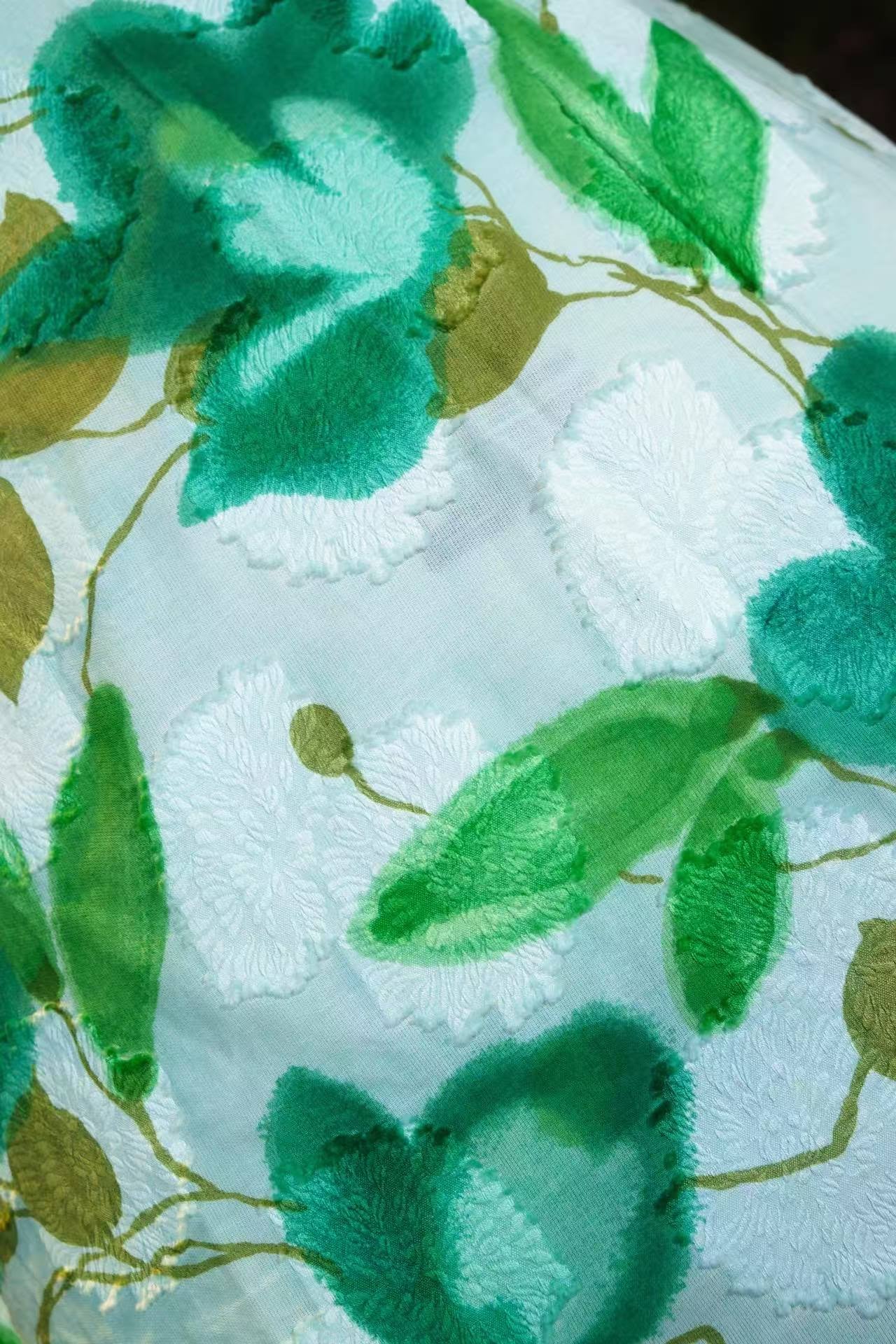
这件珍罕的香港产古董旗袍,以水彩晕染技法为笔、提花棉布为笺,
从艺术溯源看,其图案设计暗合宋代画家米芾“墨戏”理论:“
它不仅是“东方美学现代化”的见证,
Emerald Shadows on Pale Scrolls: An Artistic Analysis of a 1950s Hong Kong Jacquard Cotton Cheongsam
The Fusion of Ink and Loom This rare Hong Kong-made antique cheongsam uses watercolor wash techniques as its brush and jacquard cotton as its paper, condensing the spirit of traditional Chinese "Boneless" (Mogu) floral painting and the aesthetics of Western draping into a single garment. The pale jade-green base resembles clear Xuan paper, upon which vines wind gracefully; green leaves either stretch like open palms or quiver like feathers, with varying ink tones creating a vibrant sense of "flowing greenery." White camellias and golden buds are scattered throughout, their petal edges treated with gradients that mimic ink saturation. Meanwhile, the jacquard weaving provides a subtle tactile texture, giving each petal a three-dimensional, relief-like quality—the very essence of 1950s Hong Kong’s "heavy-work hand-painted jacquard" craft.
The Reinvention of Tradition From an artistic lineage perspective, the pattern design aligns with the "Ink Play" (Moxi) theory of Song Dynasty painter Mi Fu: "Not seeking meticulous detail, but capturing the spirit." Yet, it reconstructs this Oriental expression through the interlacing warp and weft of jacquard cotton. This piece is a living fossil of the fashion history of the "Paris of the Orient." At that time, Hong Kong's textile industry was undergoing a "Reinvention of Tradition" movement, where artisans combined the "negative space" aesthetic of Chinese painting with Western perspective techniques and industrial production. The result was a "New Woman" attire that remained rooted in Chinese charm while embracing modern sensibilities. The composition of winding vines serves as a metaphor for "endless vitality," while the bold interplay of warm and cool greens reflects the color breakthroughs of "Modern Chinese" style in the 1950s.
A Witness to Female Liberation This garment is more than a testament to the modernization of Oriental aesthetics; it is a vessel for a forgotten history of female liberation. The skin-friendly nature of cotton broke the monopoly of silk over the cheongsam, allowing intellectual women to maintain their national identity in the workplace and social spheres without sacrificing lightness and vitality. To touch the slightly raised jacquard patterns is to feel the breath of the painters in mid-century Hong Kong factories, the hum of the looms, and the rustle of a young woman’s skirt as she walked down Queen’s Road. This is the most moving charm of antique fashion: it ensures history is no longer just text in dusty books, but a wearable, perceptible, and inheritable "walking art history."
分享