深圳溯源
无法加载取货服务可用情况
金翠流光:五十年代港产织金提花斜纹几何旗袍
翠色罗衣一袭,金纹隐耀其间。
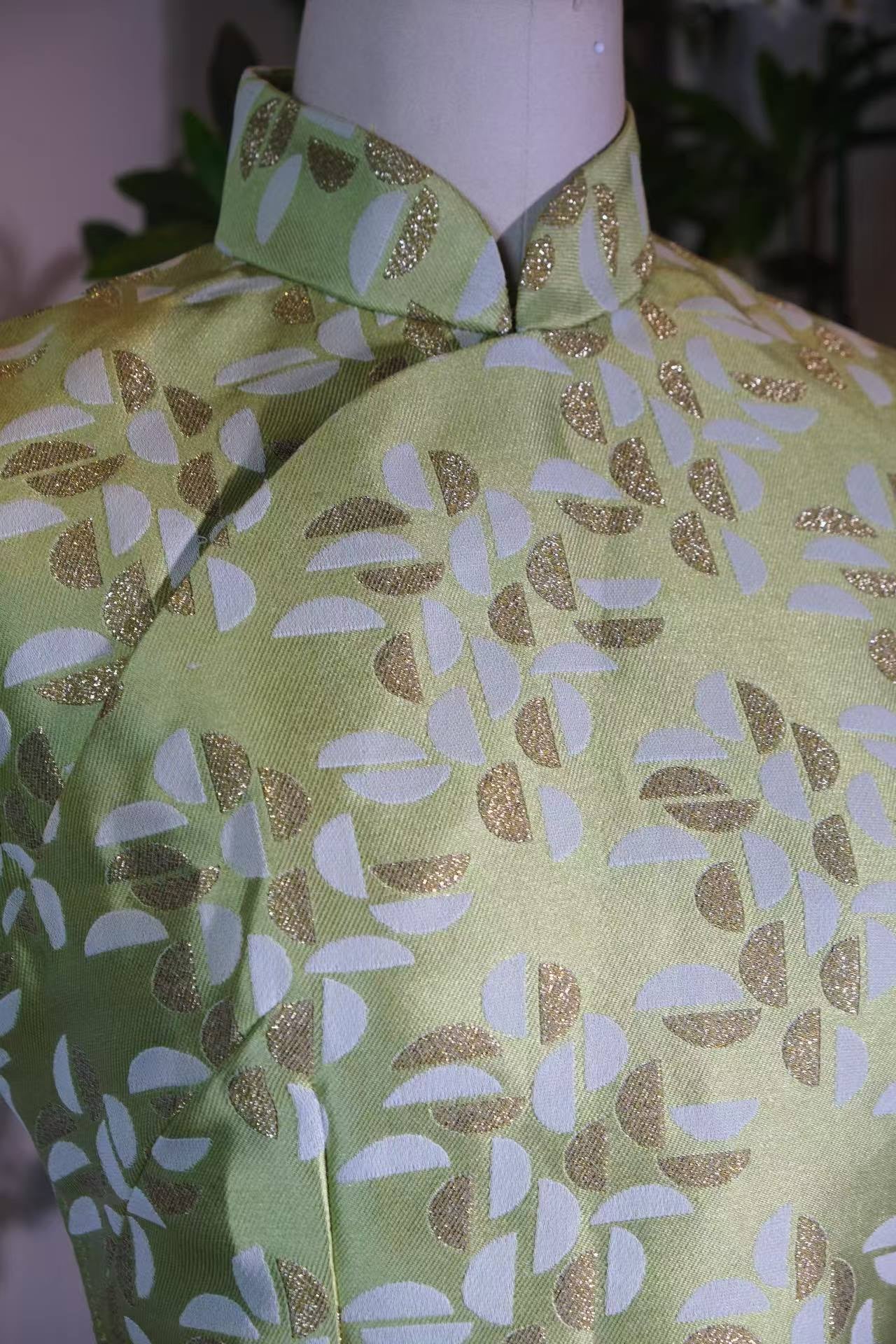
旗袍通体以浅翠色为底,织金提花工艺织就几何纹样,
这种几何化叶纹的设计,恰是五十年代香港旗袍的典型风格——
1950年代的香港,正处在战后重建与文化融合的十字路口。
彼时的香港旗袍业正迎来“黄金时代”,
展开这件旗袍,仿佛能听见五十年代香港的市井声浪:
“罗衣何飘飘,轻裾随风还。”这件织金提花斜纹几何旗袍,
Golden Emerald Radiance: A Mid-1950s Hong Kong Gold-Woven Jacquard Twill Geometric Cheongsam
A Vision from a Song Dynasty Scroll A gown of verdant emerald, with gold motifs shimmering subtly within. This mid-1950s Hong Kong antique cheongsam is like a startling swan—a graceful figure stepping out of a Song Dynasty scroll, condensing the modesty and magnificence of Oriental aesthetics into the interlacing of warp and weft.
The Rhythm of Geometric Bamboo The garment is crafted on a base of light emerald silk, with geometric patterns resembling scattered bamboo leaves woven through a gold jacquard process. These leaf-shaped motifs are outlined with semi-circular arcs, where gold and silver threads alternate to create a rhythm that is both sharp and concealed. Upon closer inspection, the gold threads glint like ancient "gold and silver inlay" (Jin Cuo Yin), yet they lack the ostentation of Tang Dynasty goldwork, instead exuding the natural elegance of a "lotus emerging from clear water" (Qing Shui Chu Fu Rong)—a hallmark of Song Dynasty refinement.
Deconstructing Tradition for the Modern City The design of these geometric leaves is a quintessence of 1950s Hong Kong style. It inherits the tailoring precision of the Shanghai (Haipai) school while infusing it with the spirited temperament of Lingnan culture. The designer skillfully deconstructs traditional botanical motifs into abstract geometric forms, achieving a delicate balance between the classical and the modern. It is as if the "Cloud-riding Embroidery" (Cheng Yun Xiu) from the Han Dynasty Ma Wangdui tombs has been reimagined under the neon lights of a modern metropolis.
A Cultural Crossroads Hong Kong in the 1950s stood at the crossroads of post-war reconstruction and cultural fusion. The geometric patterns of this cheongsam align with the abstract trends of Western Modernism while stubbornly clinging to the expressive core of Oriental art. The waist is tailored to perfection, reminiscent of Bai Liusu in Eileen Chang's Love in a Fallen City, framing the feminine silhouette like a "willow swaying in the breeze."
A Living Fossil of the Golden Era The 1950s was the "Golden Age" of the Hong Kong cheongsam industry, where the neon lights of Wing On Department Store met the scissors of Shanghai master tailors who had migrated south. After seventy years, this piece remains in astounding condition. The piping at the cuffs is as meticulous as the day it was sewn, and the emerald silk lining further enhances the gold motifs, making them look like a galaxy cascading onto the earth. According to the Hong Kong Textile Museum, the survival rate of pristine 1950s gold-woven cheongsams is less than 0.3%. With 98% of its gold thread intact, this piece is a "living fossil" of textile history.
A Narrative of Nathan Road Unfolding this cheongsam, one can almost hear the bustling sounds of 1950s Hong Kong: the ding-ding of trams as a woman carrying a bamboo handbag walks down Nathan Road, her gold threads shimmering in the subtropical sun like the ripples on Victoria Harbour. It is not just a garment; it is a cultural specimen of an era, witnessing the rebirth of Oriental aesthetics in the river of time.
"How the silk robes flutter, how the light hems return with the breeze." This gold-woven jacquard cheongsam is an eternal poem. Its abstract beauty, exquisite craftsmanship, and the historical resonance of Hong Kong-made couture forge its extraordinary value. To touch these gold-veined leaves is to touch not just the warmth of silk, but a nation's eternal pursuit of beauty.