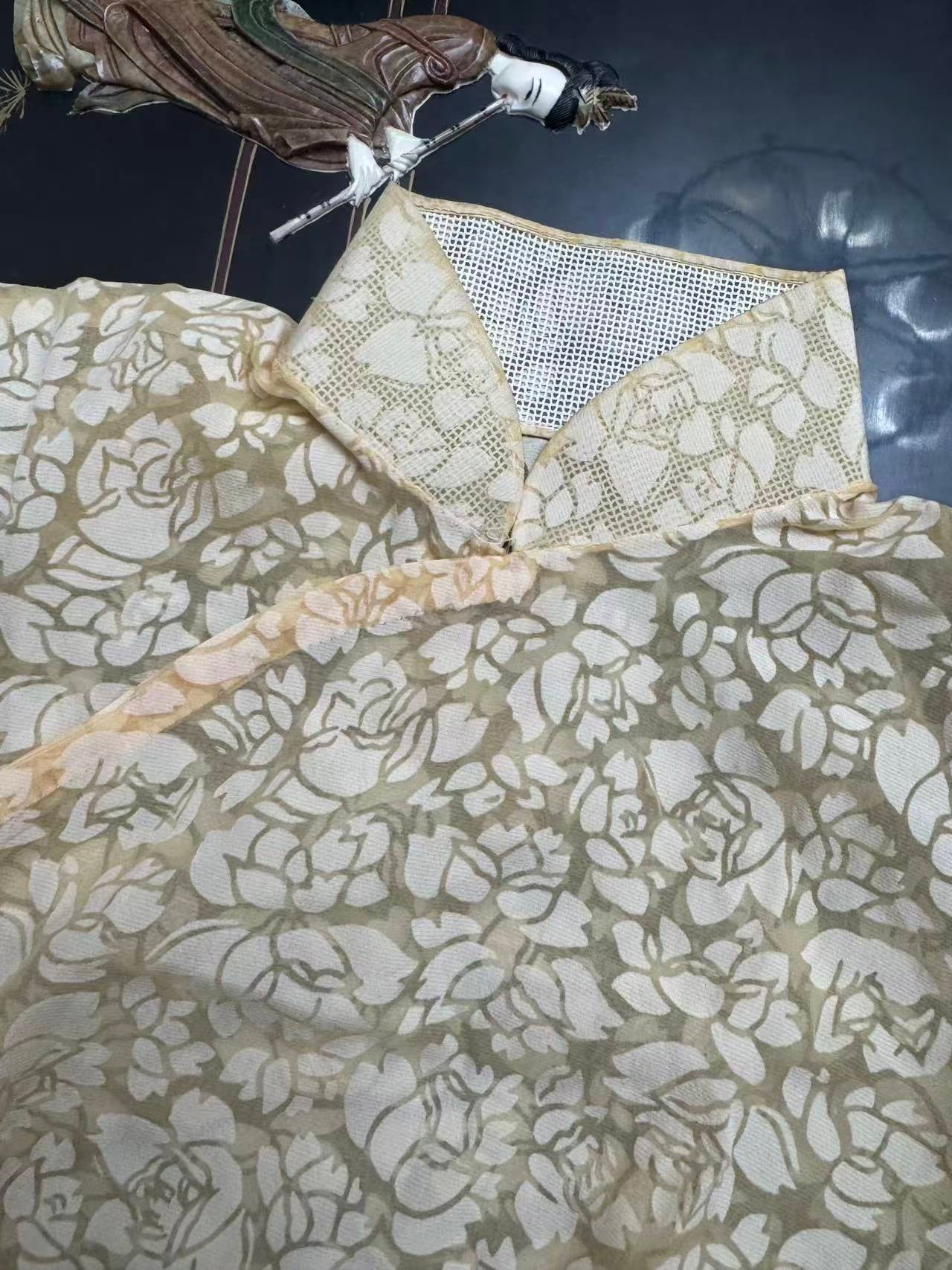
分享一件上世纪五十年代透明领鹅黄玫瑰薄纱旗袍的风雅。
鹅黄浅染,纱影浮动。这件存世稀罕的五十年代古董旗袍,以轻若蝉翼的单层薄纱为底,通身织就缠枝玫瑰暗纹,领口嵌半透明领片,如凝脂映月,将香江的摩登风骨与东方雅韵,揉进每一缕纱线里,成为时光窖藏的美学标本。
旗袍主色调取鹅黄,古称“缃色”,乃传统织染中“春信”的象征——《说文》载“缃,帛浅黄色也”,恰似李煜“砌下落梅如雪乱”的初春意境,又暗合《礼记·月令》“孟春之月,东风解冻”的生机意象。通体玫瑰纹以提花工艺织于薄纱,花瓣层叠如工笔写生,枝蔓蜿蜒似“铁线描”笔意,与海派旗袍常见的牡丹、茉莉不同,玫瑰这一西洋花卉的本土化应用,印证着香港黄金时代东西方审美交融的历史轨迹(参考《中国近代服饰研究》中“玫瑰旗袍多见于沪港高端定制”的论述)。
玫瑰布局遵循“疏可走马,密不透风”的章法:领口、袖口处花簇密集,如《长物志》所言“花影扶疏,浓淡相宜”;裙摆处则以单枝玫瑰点缀,暗合文人画“孤芳自赏”的意趣。薄纱底料的半透明质感,使玫瑰纹在光影流转中若隐若现,恰似苏轼“水月观音”的空灵禅意,赋予服饰超越物质的诗意美感。
今人抚过旗袍,指尖能触到半世纪前的温度:薄纱的轻柔如夜风拂面,玫瑰纹的浮雕感似旧时光影的雕刻。它曾属于某个沪上名媛的衣橱,见证过外滩舞厅的霓虹,也听过霞飞路上的爵士乐——当纱影在岁月中褪色,玫瑰的暗纹却愈发清晰,恰如张爱玲所言:“衣服是一种语言,记录着时代的密码。”
💛 The Poetic Grace of Silk Gauze: A Vintage 1950s Hong Kong Organza Cheongsam with Sheer Collar and Yellow Roses
Dyed a soft goose yellow, with sheer shadows gently shifting. This extremely rare vintage cheongsam from the 1950s uses single-layer light organza (thin silk gauze), fine as a cicada's wing, as its base. It is entirely woven with interlocking rose motifs (缠枝玫瑰暗纹). The collar features a semi-transparent sheer panel (透明领片), like solidified fat reflecting the moon, blending the modern spirit (摩登风骨) of Hong Kong with Oriental elegance into every silk thread, creating an aesthetic specimen preserved by time.
The main color of the cheongsam is goose yellow (鹅黄), historically known as $xiang se$ (缃色), a traditional dye symbolizing "the harbinger of spring." The $Shuowen Jiezi (说文)* records that xiang is "a light yellow color of silk," perfectly capturing the early spring atmosphere of Li Yu's poem, "Plum blossoms falling like scattered snow upon the steps," and subtly aligning with the vital image of "in the first month of spring, the East wind unfreezes the earth" from the Book of Rites: Monthly Ordinances (礼记·月令).
The rose motifs are woven throughout the organza using the jacquard technique (提花工艺). The layered petals resemble detailed realistic painting (工笔写生), and the winding vines mimic the style of "iron-wire brushstrokes" (铁线描). Unlike the peonies and jasmine often seen in Shanghai-style cheongsams, the localized application of the rose, a Western flower, attests to the historical trajectory of East-meets-West aesthetic fusion during Hong Kong's Golden Age (referencing the discussion in Research on Modern Chinese Clothing that "rose cheongsams are often seen in high-end bespoke tailoring in Shanghai and Hong Kong").
The layout of the roses follows the compositional rule of "loose enough for a horse to run through, dense enough to block the wind" (疏可走马,密不透风). The floral clusters are dense at the collar and cuffs, embodying the sentiment from the Records of Superfluous Things (长物志): "The shadow of flowers is sparse yet dense, perfectly suited in light and shade." The skirt hem, conversely, is adorned with single, isolated roses, aligning with the literati painting aesthetic of "solitary appreciation" (孤芳自赏). The semi-transparent texture of the light organza causes the rose motifs to appear and disappear in the shifting light, much like the ethereal, Zen-like quality of Su Shi's "Water Moon Guanyin," lending the garment a poetic beauty that transcends the material.
When one touches the cheongsam today, the fingertips feel the temperature of half a century ago: the softness of the organza is like a night breeze brushing the face, and the relief texture of the roses is like a sculpture of old time and shadow. It once belonged to the wardrobe of a famous socialite from Shanghai, witnessing the neon lights of the Bund dance halls and hearing the jazz on Avenue Joffre (霞飞路). As the sheer fabric fades with the years, the subtle pattern of the roses becomes ever clearer, precisely as Eileen Chang stated: "Clothes are a language that records the era's codes."