深圳溯源
无法加载取货服务可用情况
衣服尺寸:
胸围/腰围/臀围:96/84/100 厘米
衣长:130 厘米
细节描述:
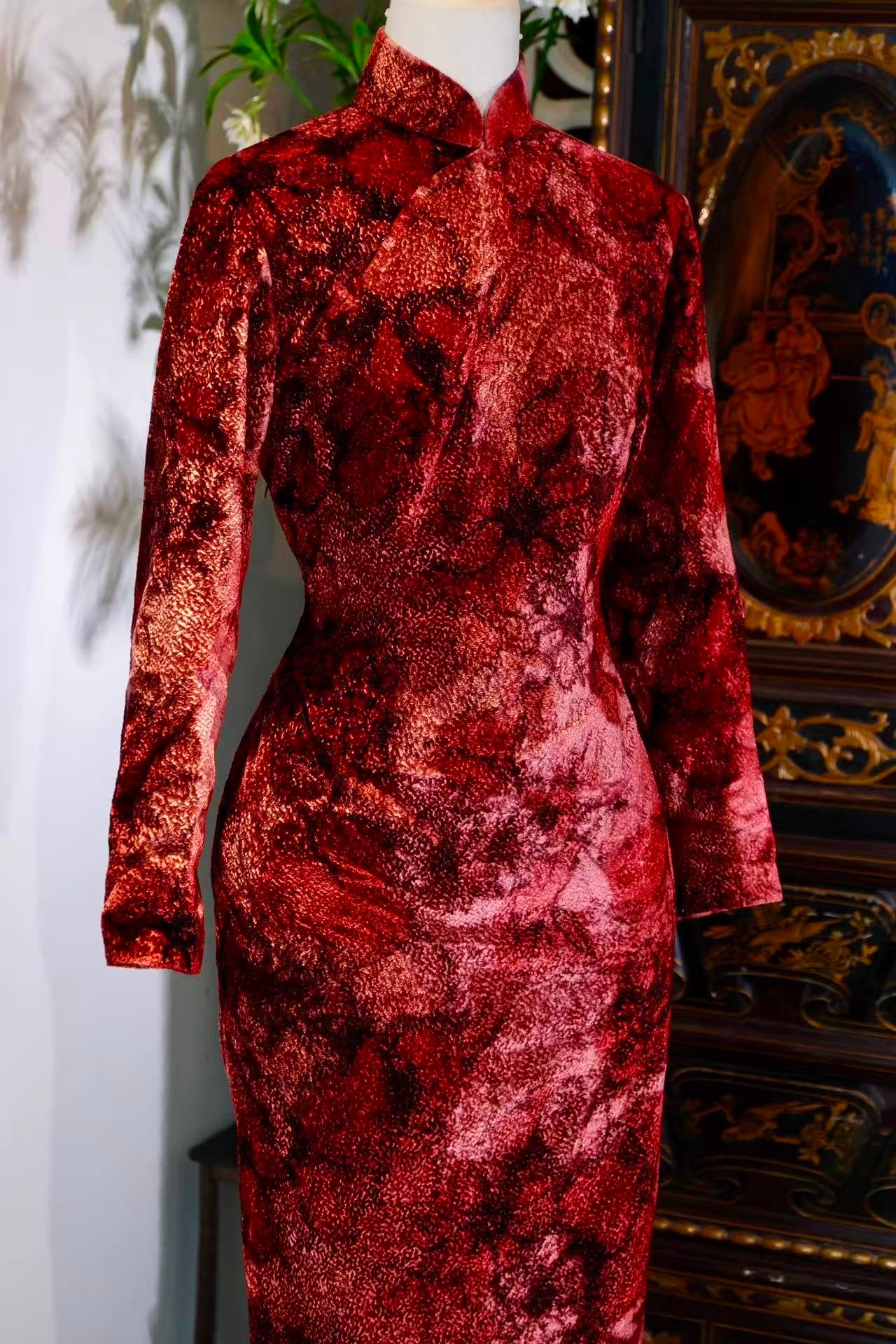
当指尖抚过这件丝绒旗袍的肌理,
一、肌理里的东方密码
这件旗袍最动人的,是它用丝绒织就的“会呼吸的图案”。
你看那斜襟的弧度,是《诗经》里“青青子衿”的婉转;
二、香港古董衣的“黄金时代”
1960年代的香港,是旗袍的“最后黄金时代”。
这件旗袍的产地“香港制造”,正是那个时代的印记。
三、穿在身上的“香港故事”
这件旗袍的每一寸,都藏着1960年代香港的烟火气。想象一下:
它可能是某位名媛的晚宴礼服,也可能是某位影星的戏服。
四、稀缺性:时光的馈赠
如今,1960年代的香港古董旗袍已成“绝版”。
它不仅是衣服,更是一件“活的文物”。当你穿上它,
五、结语:让时光在身上流动
这件旗袍,是东方美学的缩影,是香港黄金时代的见证,
如果你穿上它,请记得:你穿的不是一件衣服,而是一段历史,
Measurements / Size Guide:
Bust / Waist / Hips: 96/84/100 cm
Total Length: 130 cm
Detailed Description:
When your fingertips brush across the texture of this velvet qipao, it feels as if you are touching the very breath of 1960s Hong Kong. The tailors who bowed their heads before sewing machines and the women who traversed beneath neon lights have all dissolved into the hidden patterns of the warp and weft, tucked away within this shade of crimson.
The most moving element of this qipao is the "breathing patterns" woven from velvet. Unlike the flat surface of ordinary prints, its motifs are three-dimensional—the velvet pile shifts under the light, weaving deep and light tones of reddish-brown into abstract cloud patterns, resembling ink-washed mountains. Every inch speaks to the Oriental aesthetic of "the interplay between void and solid." This sense of texture is a hand-crafted warmth that machines cannot replicate. In those years, Hong Kong tailors would repeatedly knead and iron the velvet fabric to let the pile form natural undulations, then use hand-printing to dot the colors, making the patterns "come alive" on the three-dimensional texture.
The curvature of the diagonal closure (Pianjin) echoes the gentleness of the "green, green collar" in the Book of Songs, while the height of the mandarin collar mirrors the dignity of the "cloud-like hair with slanted hairpins" in Song Dynasty paintings. Yet, the luster of the velvet carries the modernist aura of 1960s Hong Kong—a product of the collision between Eastern tradition and Western modernity. It is the "magnificent robe" of Eileen Chang’s prose: possessing both old-world refinement and a new-era edge.
The 1960s was the "last golden age" of the qipao in Hong Kong. As the post-war economy took flight, Eastern and Western cultures converged: tailors from Shanghai brought the techniques of the "Shanghai-style qipao" south, colliding with Hong Kong’s local fashion to birth the "Hong Kong-style qipao." It was more form-fitting than the Shanghai style and more modern than tradition, making it a favorite among socialites and movie stars.
The "Made in Hong Kong" label is the mark of that era. At the time, the Hong Kong garment industry was renowned for its "exquisite handwork." A single qipao underwent dozens of processes—measuring, pattern-making, cutting, sewing, and ironing—each completed by experienced master tailors. The choice of velvet also held a hidden secret: much of the velvet in the 1960s was imported from Europe. Improved by Hong Kong tailors, it preserved the luster of Western fabrics while integrating the restraint of Eastern tailoring—a true fusion of East and West.
Every inch of this qipao holds the vibrant life of 1960s Hong Kong. Imagine Tsim Sha Tsui in 1965: a woman in this qipao, walking down Nathan Road in high heels, the velvet shimmering under neon lights. She resembles Manzhen from Eileen Chang’s Eighteen Springs—her qipao "was moon-white with hidden floral patterns; wearing it, she seemed to step out of old times, yet carried the edge of a new era."
It might have been a socialite’s evening gown or a movie star’s costume. In that era, a qipao was more than clothing; it was a symbol of status. Those who could afford velvet qipaos were mostly from well-to-do families, and within their threads were hidden family glories, the shifts of the era, and even secret romances.
Today, 1960s Hong Kong antique qipaos have become "limited editions." The garment factories of that time have mostly vanished, and the master tailors have retired; the craftsmanship for hand-made velvet qipaos has nearly been lost. That this qipao has been preserved to this day is a miracle—velvet wears and fades easily. To maintain such intact texture and color is a testament to the superb craftsmanship and careful preservation over the decades.
It is not just a garment, but a "living artifact." When you wear it, you travel back to 1960s Hong Kong: the melody of Ye Lai Xiang (Tuberose) in your ears, the lights of Victoria Harbour before your eyes, and you, the protagonist of that era.
This qipao is a microcosm of Oriental aesthetics, a witness to Hong Kong’s golden age, and a gift from time. It uses the texture of velvet to tell the stories of the 1960s, the curve of the closure to sketch the grace of the Oriental woman, and the "Made in Hong Kong" label to remember the brilliance of an era.
If you wear it, please remember: you are not wearing a garment, but a piece of history, a culture, and a persistence for beauty. As Eileen Chang said: "Clothes are a language; what one carries with them is a pocket drama." This qipao is a "Hong Kong memory" worn on the body, waiting for you to perform.