深圳溯源
无法加载取货服务可用情况
衣服尺寸:
胸围/腰围/臀围:98/86/106 厘米
衣长:112 厘米
细节描述:
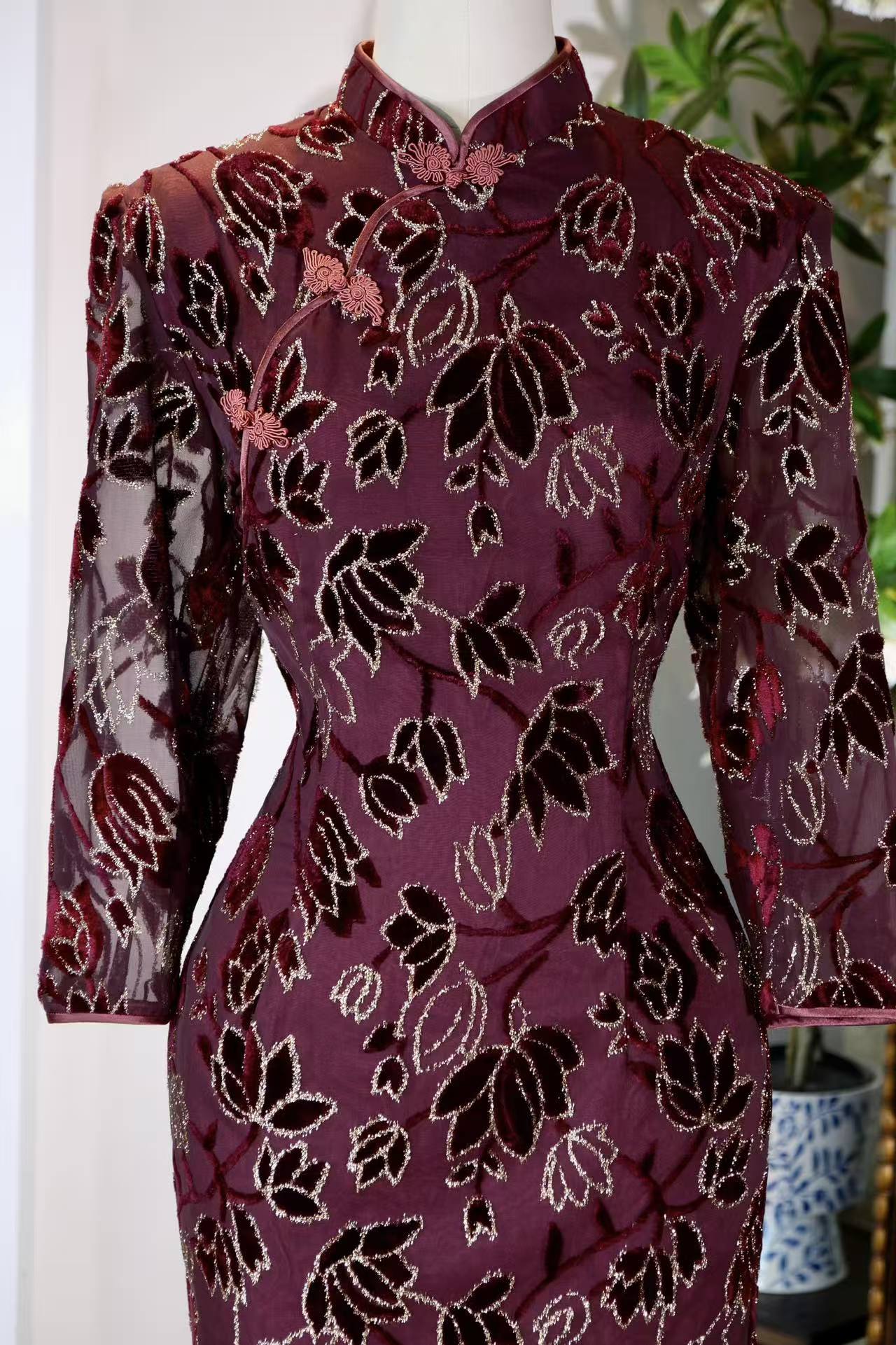
这件旗袍最引人注目的,莫过于其面料——上世纪六十年代意大利进口的织金烧花绒。
- 意大利织金工艺: 这种工艺源于欧洲,以奢华、精细著称。在织造过程中,将极细的金线或银线(此处为仿金的亮丝线)织入底布,形成华丽的底纹或图案轮廓。在光线下,这些线条会闪烁出低调而奢华的光芒,赋予面料一种流动的质感。
- 烧花工艺: 这是一种极具技术难度的后整理工艺。通过化学或物理方法,将绒布表面的部分绒毛“烧”掉,形成通透的镂空效果和绒面与光面之间的质感对比。这使得整件旗袍既有天鹅绒的厚重华贵,又有蕾丝般的轻盈通透,光影层次极为丰富。
- 香港精工: 将如此娇贵且难以驾驭的进口面料,制作成一件线条流畅、贴合身形的旗袍,这背后是香港当时顶尖的裁缝手艺。六十年代的香港,正是东西方文化交融的中心,也是高级定制旗袍的黄金时代。这件旗袍的剪裁、归拔、镶滚、盘扣,无一不体现了那个时代香港裁缝的精湛技艺。
图案解析:藤蔓花叶间的东方意蕴
旗袍上的图案并非简单的装饰,而是充满了东方美学的象征意义。
- 主体纹样: 图案以缠枝花卉和卷草纹为母题。您可以看到,深酒红色的天鹅绒构成了叶片和花朵的形态,它们沿着金色的藤蔓蜿蜒生长,遍布全身。
- 叶片形态: 叶片的轮廓被金色的亮丝线勾勒,内部则是厚实的绒面,形成了强烈的视觉对比。这种处理方式,既保留了传统纹样的古典韵味,又增添了现代设计的立体感和装饰性。
- 花朵点缀: 花朵的形态较为抽象,与叶片融为一体,象征着生生不息、连绵不绝的生命力。
- 整体布局: 图案的布局疏密有致,从肩部到下摆,藤蔓自然垂落,仿佛一幅流动的画卷,完美地衬托出女性身体的曲线美。
古董衣的故事:一件旗袍,一个时代
这件旗袍,不仅仅是一件衣服,更是一个时代的缩影。
- 黄金年代: 上世纪六十年代,是香港旗袍的黄金年代。彼时,上海的优秀裁缝南下香港,将海派旗袍的精髓带到了香江,并与西方的审美和工艺相结合,创造出独具特色的“港派旗袍”。这件旗袍正是那个时代的产物。
- 身份象征: 在那个年代,能够拥有一件采用意大利进口面料、由香港名师定制的旗袍,是身份和品味的象征。它的主人,或许是一位名媛,或许是一位电影明星,她穿着这件旗袍,穿梭于香港的灯红酒绿之中,成为那个时代一道亮丽的风景线。
- 稀缺性: 如今,这样的旗袍已是凤毛麟角。首先,这种意大利进口的织金烧花绒面料本身就极为稀有,当年的产量就很少。其次,能够驾驭这种面料的裁缝手艺也已日渐式微。最后,历经半个多世纪的风雨,能够保存得如此完好的古董旗袍,更是屈指可数。
引经据典:艺术与文化的传承
- 《诗经》有云:“有美一人,清扬婉兮。” 这件旗袍,正是为了衬托这样的“美人”而存在的。它的设计,既含蓄又张扬,既古典又现代,完美地诠释了中国女性的温婉与风骨。
- 《长物志》中论及服饰:“贵精不贵丽,贵新奇大雅,不贵纤巧烂漫。” 这件旗袍,正是“新奇大雅”的典范。它用料奢华却不显俗气,工艺繁复却归于简洁,图案华丽却意境深远。
这件上世纪六十年代的意大利进口织金烧花绒香港产古董旗袍,是一件集东西方工艺之大成、融古典与现代之美于一体的艺术珍品。它不仅是一件可以穿着的华服,更是一件值得收藏和传承的历史文物。它承载着那个时代的记忆,也诉说着中国服饰文化的永恒魅力。
Measurements / Size Guide:
Bust / Waist / Hips: 98/86/106 cm
Total Length: 112 cm
Detailed Description:
The most striking feature of this qipao is undoubtedly its fabric—gold-woven devoré (burn-out) velvet imported from Italy in the 1960s.
Italian Gold-Weaving Craftsmanship: Originating in Europe and renowned for luxury and precision, this process involves weaving ultra-fine gold or silver threads (in this case, imitation gold metallic yarn) into the base fabric to create magnificent underlays or patterns. Under light, these threads shimmer with a subtle, luxurious glow, giving the fabric a fluid texture.
Devoré (Burn-out) Technique: This is a highly technical finishing process. Using chemical or physical methods, portions of the velvet pile are "burned" away to create transparent cut-outs and a textural contrast between the plush velvet and the smooth base. This results in a garment that possesses both the heavy opulence of velvet and the airy transparency of lace, with incredibly rich layers of light and shadow.
Hong Kong Mastery: Turning such delicate and difficult-to-handle imported fabric into a qipao with smooth lines and a perfect fit required the top-tier tailoring skills of Hong Kong at the time. The 1960s in Hong Kong was the heart of East-West cultural fusion and the golden age of haute couture qipaos. The cutting, shaping, bordering, and frog closures of this piece all embody the exquisite craftsmanship of that era’s master tailors.
Pattern Analysis: Oriental Meaning Amidst Vines and Leaves The patterns on the qipao are not mere decorations but are imbued with the symbolic meanings of Oriental aesthetics.
Primary Motif: The pattern uses scrolling flowers and acanthus-like "rolling grass" as its theme. You can see deep wine-red velvet forming the shapes of leaves and blossoms, winding along golden vines across the entire body.
Leaf Morphology: The outlines of the leaves are traced with golden metallic thread, while the interiors are thick velvet, creating a strong visual contrast. This treatment preserves the classical charm of traditional patterns while adding the three-dimensionality and decorativeness of modern design.
Floral Accents: The floral shapes are somewhat abstract, merging with the leaves to symbolize an endless, surging vitality.
Overall Layout: The layout is masterfully balanced; from the shoulders to the hem, the vines fall naturally like a flowing scroll, perfectly accentuating the curves of the female form.
The Story of Antique Clothing: One Qipao, One Era This qipao is more than just a garment; it is a microcosm of an era.
The Golden Age: The 1960s was the golden age of the Hong Kong qipao. At that time, elite tailors from Shanghai migrated south to Hong Kong, bringing the essence of the "Haipai" (Shanghai-style) qipao and blending it with Western aesthetics and techniques to create the unique "Hong Kong-style" qipao. This piece is a quintessential product of that time.
Status Symbol: In that era, owning a custom qipao made from imported Italian fabric by a famous Hong Kong master was a symbol of status and taste. Its owner might have been a socialite or a movie star, gliding through the vibrant nightlife of Hong Kong, becoming a radiant sight of the times.
Scarcity: Today, such qipaos are as rare as phoenix feathers. Firstly, this Italian gold-woven devoré velvet is extremely rare, with very low original production. Secondly, the tailoring skills required to manage such fabric are increasingly scarce. Finally, after more than half a century, antique qipaos preserved in such pristine condition are few and far between.
Classic References: The Inheritance of Art and Culture
The Classic of Poetry (Shijing) says: "There is a beautiful lady, clear-eyed and graceful." This qipao exists precisely to set off such a "beauty." Its design is both subtle and bold, classical and modern, perfectly interpreting the gentle yet resilient spirit of Chinese women.
In Treatise on Superfluous Things (Zhang Wu Zhi), regarding attire, it is noted: "Value refinement over gaudiness, value the novel and elegant over the delicate and cluttered." This qipao is a model of "novel elegance." Its materials are luxurious yet not vulgar; its craftsmanship is complex yet results in a clean silhouette; its patterns are magnificent yet possess deep artistic meaning.
This 1960s Hong Kong-made antique qipao in imported Italian gold-woven devoré velvet is an artistic treasure that integrates the best of Eastern and Western craftsmanship and blends classical and modern beauty. It is not only a piece of wearable haute couture but also a historical relic worthy of collection and inheritance. It carries the memories of an era and speaks to the eternal charm of Chinese clothing culture.