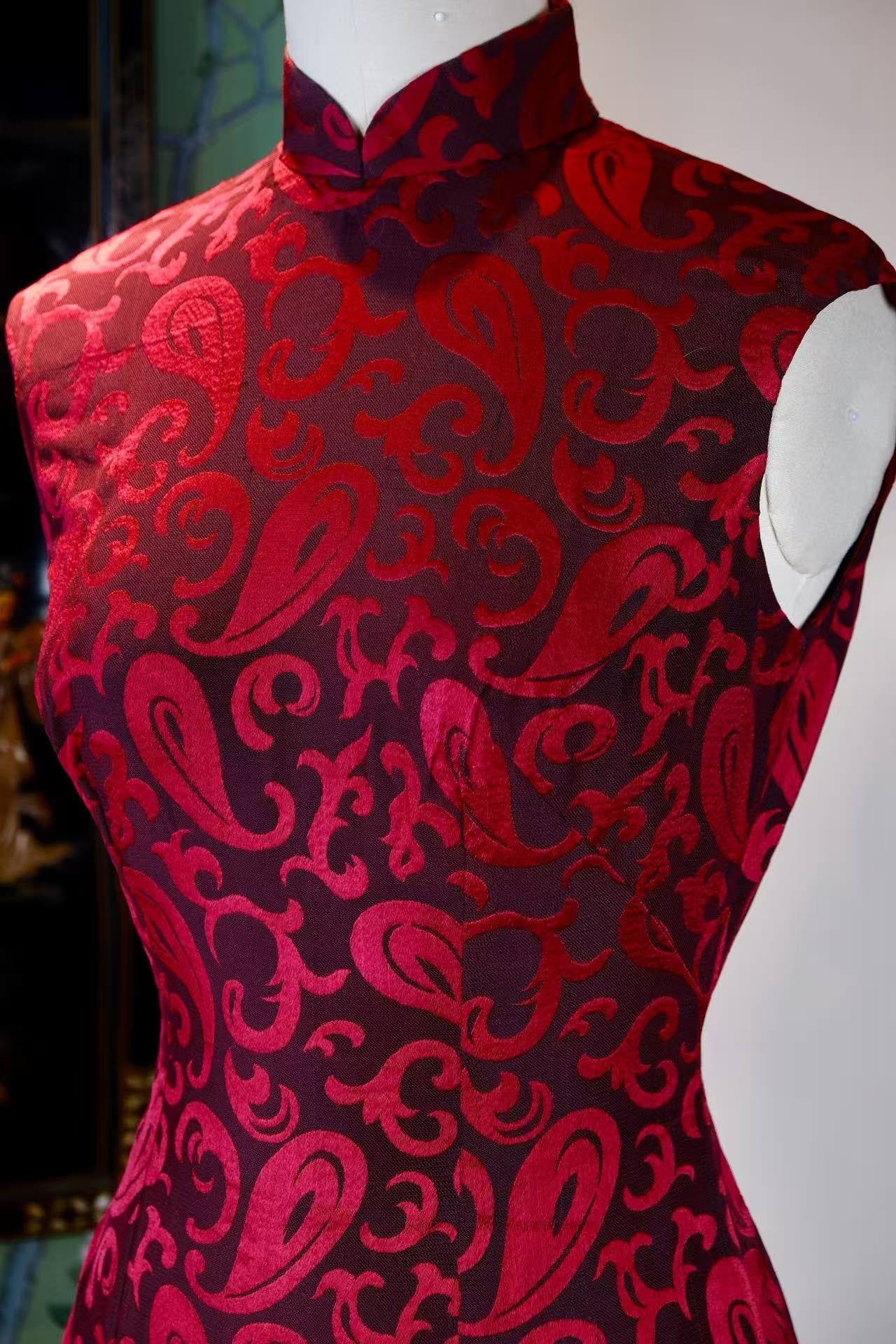
上世纪六十年代香江提花织锦旗袍
此件旗袍为上世纪六十年代香港制式,正是海派旗袍向现代审美转型的关键节点。彼时香港承接沪上工艺,又融汇岭南风物,形成“收腰贴体、开衩及膝”的经典形制。此袍以提花织锦缎为材,无袖设计暗合六十年代摩登风尚,立领高度适中,既存传统端庄,又显新女性之飒爽。腰节线较传统上移三寸,配合下摆自然收拢,恰如《红楼梦》所喻“削肩膀、水蛇腰”,将东方女性的S型曲线勾勒得淋漓尽致,堪称“移动的诗行”。
衣身满布的卷草纹,是解码此袍艺术价值的核心。其纹样并非简单重复,而是以“三重结构”构建:基础层为深绛色暗纹,如云霭般朦胧;中层是亮红色卷草主纹,线条如行云流水,转折处暗合《考工记》“虽由人作,宛自天开”之造化;核心纹样则为 stylized 枸杞果实,与卷草藤蔓缠绕,形成“福寿绵长”的吉祥寓意。
卷草纹的曲线处理尤为精妙——每片叶瓣的弧度皆暗合黄金分割,藤蔓的延伸方式遵循“S”型律动,既保留传统缠枝纹的绵延感,又融入西方装饰艺术的几何美学。这种“中体西用”的纹样设计,正是六十年代香港旗袍的独特标识。
存世的六十年代香港织锦缎旗袍,多因年代久远而褪色、脆化,而此件保存完好,纹样清晰可辨。其面料采用的“双面提花”工艺,需工匠在织机上同步操控百簇综线,方能织出正反如一的立体纹样。这种工艺在1970年代后因成本过高而逐渐失传,使得此袍成为“绝版香江记忆”的物质载体。
当指尖抚过这件旗袍的织锦缎面,仿佛能触摸到六十年代香港的繁华:铜锣湾的霓虹初上,兰桂坊的爵士乐隐约传来,而这件旗袍的主人,或许正挽着爱人的手,步入半岛酒店的舞池。它不仅是一件衣物,更是一部凝固的香江史,一曲东方美学的现代变奏。
1960s Hong Kong Jacquard Brocade Qipao: A Modern Symphony of Oriental Grace
"A flowing line of poetry that captures the soul of a bygone era."
This Qipao is a quintessential specimen of 1960s Hong Kong tailoring, marking the pivotal transition from traditional Shanghai "Haipai" craftsmanship to modern aesthetics. During this era, Hong Kong inherited elite tailoring techniques from Shanghai while integrating Lingnan cultural influences, resulting in the iconic "cinched waist and knee-length slit" silhouette. Crafted from jacquard brocade, its sleeveless design echoes the mid-century modern trend. The standing collar is moderate in height, balancing traditional dignity with the spirited independence of the "New Woman." The waistline, raised three inches higher than traditional cuts, contours the Oriental female "S-curve"—a silhouette famously described in Dream of the Red Chamber as "slender shoulders and a willow waist."
Artistic Decoding: The Triple-Layered Scrollwork
The scrollwork (Juan Cao) motifs covering the body are the key to this garment's artistic value. Rather than simple repetition, the pattern is built upon a "Triple Structure":
-
The Base Layer: A deep crimson subtle pattern, misty as distant clouds.
-
The Middle Layer: Bright red primary scrollwork, with fluid lines that embody the philosophy of Kao Gong Ji: "Though created by man, it appears as a work of nature."
-
The Core Motif: Stylized Goji (Wolfberry) fruits entwined with vines, symbolizing "longevity and boundless fortune."
The curvature of the scrollwork is masterful—the arc of each leaf petal aligns with the Golden Ratio, while the extension of the vines follows an "S-shaped" rhythm. This design flawlessly merges the continuity of traditional Chinese "Intertwining Vines" with the geometric precision of Western Art Deco—a hallmark of 1960s Hong Kong "East-meets-West" design.
A Rare Material Witness
Most 1960s Hong Kong brocade Qipaos have faded or become brittle over time; this piece, however, remains in pristine condition. It features the "Double-sided Jacquard" technique, which required artisans to synchronize hundreds of heddles on a loom to produce a reversible, three-dimensional texture. After the 1970s, this labor-intensive craft was largely abandoned due to high costs, making this robe a rare physical carrier of "out-of-print Hong Kong memories."
Touching this brocade is like feeling the pulse of 1960s Hong Kong: the neon lights of Causeway Bay flickering on, the faint echoes of jazz from Lan Kwai Fong, and perhaps the original owner stepping into the ballroom of The Peninsula. This is more than a garment; it is a frozen segment of Hong Kong history—a modern variation of Oriental aesthetics.