深圳溯源
无法加载取货服务可用情况
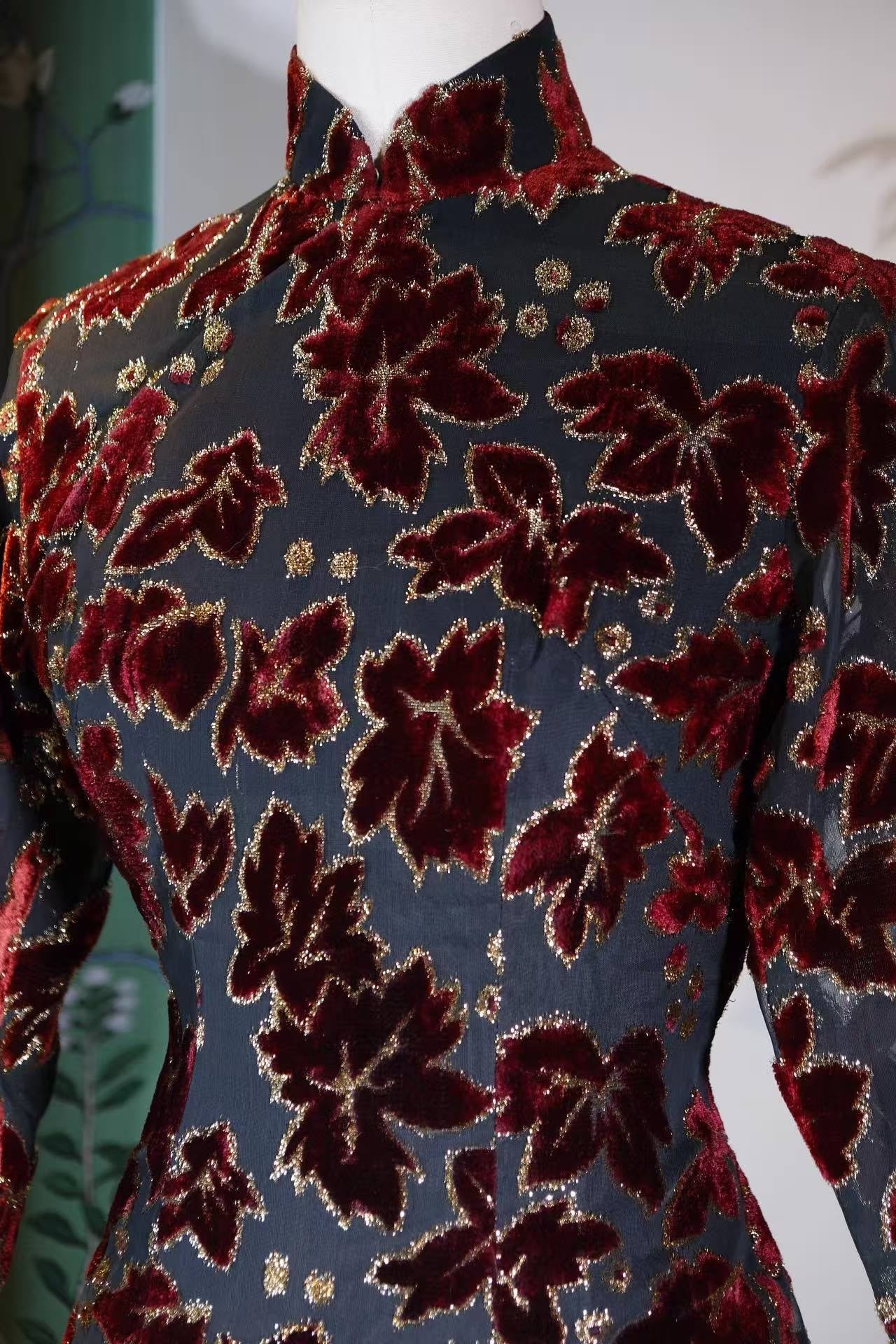
一、图案描述:金线绣出的岁月华章
这件古董旗袍的图案,是时光与工艺共同编织的诗篇。
花朵的形态介于写实与抽象之间,既有东方工笔花鸟的细腻,
这种“织金烧花”的工艺,是将丝绒与金线交织,再通过高温烧制,
二、古董衣的故事:东西方文明的邂逅
这件旗袍诞生于1960年代的香港,
在那个年代,这样一件旗袍,是身份与品味的象征。它的主人,
三、引经据典:艺术风格与稀缺性
这件旗袍的艺术风格,正如张爱玲在《更衣记》中所言:“……
当时的意大利丝绸工坊,采用的是手工织造与烧花工艺,
正如法国时尚史学家丹尼尔·德拉莫特所言:“时尚是流动的艺术,
I. Pattern Description: An Epochal Chapter Embroidered in Gold
The patterns of this antique qipao are a poetic composition woven by time and craftsmanship. Upon a deep grey foundation, wine-red floral motifs bloom in layers like autumn maple leaves. Each petal is grounded in velvet and outlined with gold thread, shimmering with a fluid luster under the light—as if one were wearing a Venetian mural from the Renaissance.
The floral forms dwell between realism and abstraction, possessing both the delicacy of Oriental fine-brushwork (Gongbi) and the opulence of Italian Baroque art. The veins of the petals are embroidered with fine gold threads, winding like capillaries that breathe life into every blossom. Nestled between the flowers are tiny golden beads, reminiscent of morning dew condensed on branches, adding a touch of nimble grace to the entire garment.
The "Gold-Woven Devoré" technique involves interlacing velvet with gold threads and then utilizing high-temperature processing to fuse the two materials into a singular entity. The edges of each pattern are slightly raised, offering a tactile warmth that feels like touching the very texture of time. As the wearer moves, light dances between the gold threads and the velvet, making it seem as if the qipao is breathing, whispering the elegance and luxury of the 1960s.
II. The Story of the Antique: An Encounter Between East and West
This qipao was born in 1960s Hong Kong—an era defined by the intense collision and deep fusion of Eastern and Western cultures. At that time, Hong Kong was the fashion epicenter of Asia and a vital hub for cultural exchange. The fabric of this qipao originated from Como, the silk capital of Northern Italy, which has been synonymous with European silk since the Renaissance. Conversely, the tailoring and craftsmanship embody the ingenuity of Hong Kong tailors, who perfectly harmonized the magnificence of Italian textiles with the demure charm of the traditional Chinese qipao.
In that era, such a qipao was a definitive symbol of status and taste. Its owner might have been a socialite of Hong Kong’s high society or the wife of a diplomat traversing the globe. She might have worn this piece to a premiere at the Lyceum Theatre or danced with international dignitaries at a ball in The Peninsula Hotel. Every fold hides the memory of an era; every golden thread interlaces stories of the East and the West.
III. Allusions and Classics: Artistic Style and Scarcity
The artistic style of this qipao resonates with Eileen Chang’s observation in Chronicle of Changing Clothes: "...Chinese clothing has always followed the body, clinging to it like vines, sketching out the feminine silhouette." This qipao is the ultimate manifestation of that "clinging"—interpreting Oriental reserve through Italian fabric and expressing Oriental aesthetics through Western technique.
Italian silk workshops of that period employed manual weaving and burn-out (Devoré) processes, where a single bolt of fabric could take months to complete. Furthermore, the Hong Kong tailors utilized the traditional "bespoke" craft, meticulously designing every detail from the collar to the cuffs.
As the French fashion historian Danielle de la Motte remarked: "Fashion is fluid art, whereas antique clothing is solidified time." This 1960s Italian gold-woven devoré velvet qipao is precisely such a piece of "solidified time." It is not merely a garment, but a microcosm of an era, a history of civilizational fusion, and an artistic treasure worthy of eternal preservation.