深圳溯源
无法加载取货服务可用情况
衣服尺寸:
胸围/腰围/臀围:88/74/94 厘米
衣长:92 厘米
细节描述:
一、图案解构:一场视觉的“通感”盛宴
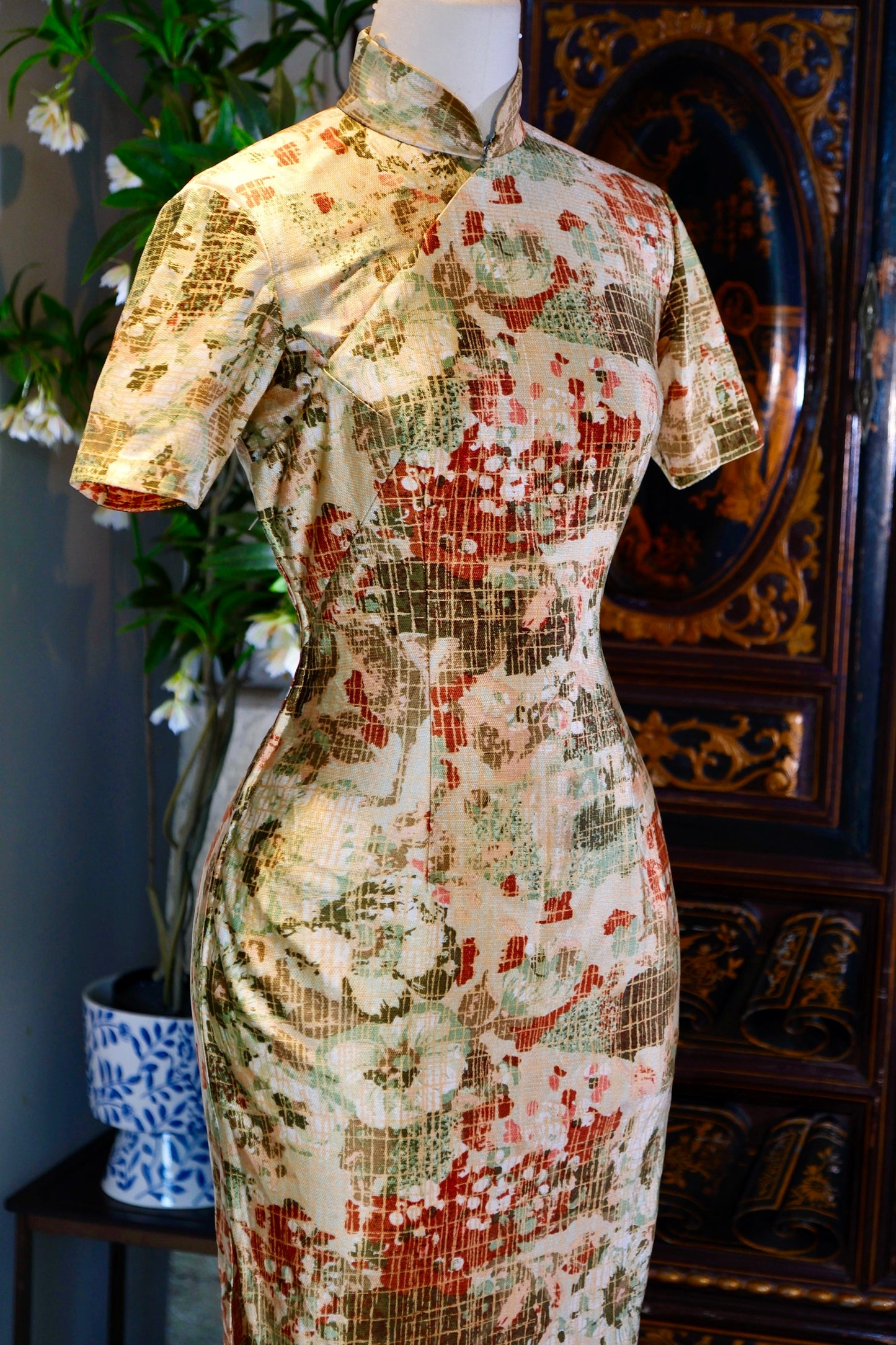
这件旗袍的面料,绝非寻常印花。其图案呈现出一种“新派写意”与“现代几何”交织的复杂肌理,极有可能是上世纪六十年代台湾纺织工业引进新型印染技术后的实验性产物。
- 笔触与墨韵:图案的主体色块,以赭红、苍绿、米黄为主调,呈现出类似中国水墨画中的“泼墨”或“没骨”技法。红绿相间,却不显俗艳,反而有一种历经岁月沉淀后的温润与雅致。这种色彩的晕染感,让人联想到张大千晚年泼彩山水的意境,既有东方的神韵,又带有某种抽象表现主义的张力。
- 几何与秩序:在写意的色块之上,覆盖着一层细密的网格状纹理。这种经纬分明的格纹,打破了传统花卉图案的柔美与无序,注入了一种理性的、现代主义的秩序感。它像是透过窗棂看花,又像是像素化的古典梦境,这种“中西合璧”的设计语言,正是六十年代台湾在现代化进程中,传统文化与现代审美碰撞的真实写照。
- 隐喻:这种图案既不具象为牡丹,也不具象为梅兰,它更像是一种心境的投射。如同李商隐诗云“沧海月明珠有泪,蓝田日暖玉生烟”,这种朦胧的、似是而非的美感,给予了穿着者极大的想象空间。
二、物语:宝岛旧梦,衣香鬓影
这件旗袍诞生于上世纪六十年代的台湾,那是一个特殊的时代。
- 时代的镜像:彼时的台湾,一方面保留着浓厚的民国遗风,另一方面正受到西方文化的强烈冲击。这件旗袍的剪裁——高领、短袖、收腰、开衩,严格遵循了海派旗袍的经典形制,但在面料的选择上却大胆前卫。它不再拘泥于传统的苏绣或丝绸,而是采用了当时更为挺括、耐穿且具有光泽感的混纺或化纤面料。
- 匠心的温度:观察其做工,归拔工艺极其精湛。腰线的收束自然流畅,胸省的转移隐蔽而立体,完全贴合人体曲线。这种“无痕”的剪裁,需要极高的手工技艺。在那个成衣工业尚未完全普及的年代,这极可能出自一位资深裁缝之手,为一位讲究的台湾名媛或知识女性量身定制。
- 稀缺性:六十年代台湾产的高定旗袍,存世量远少于同时期的香港或上海旗袍。随着台湾纺织业的转型和生活方式的西化,这种坚持传统剪裁却又融合现代面料的成衣,成为了那个特定历史时期的“绝响”。它见证了那个年代台湾社会的优雅与变迁,是一件穿在身上的历史文献。
三、结语:时间的玫瑰
这件旗袍,如同一朵盛开在旧时光里的玫瑰,虽经半世纪风雨,依然风姿绰约。
它不是博物馆里冷冰冰的陈列品,而是一段可以触摸的记忆。当你抚摸那带有网格肌理的面料,仿佛能感受到六十年代台北街头微热的晚风,听到留声机里周璇的老歌。
它的美,在于“不完美”的真实——那些细微的岁月痕迹,是时间赋予它的包浆;它的美,在于“克制”的张扬——在经典的轮廓中,用大胆的图案宣告着那个时代的摩登与觉醒。
这不仅是一件衣服,更是一段关于东方美学在现代化浪潮中如何自处、如何新生的动人叙事。
Measurements / Size Guide:
Bust / Waist / Hips: 88/74/94 cm
Total Length: 92 cm
Detailed Description:
The fabric of this qipao is by no means an ordinary print. Its pattern presents a complex texture where "New-School Freehand" (Xieyi) meets "Modern Geometry," likely an experimental product of the Taiwanese textile industry’s introduction of new printing and dyeing technologies in the 1960s.
Brushstrokes and Ink Charm: The primary color blocks—toned in ochre red, pale green, and beige—exhibit techniques similar to "splashed ink" (Pomo) or "boneless" (Mogu) styles in Chinese ink painting. The interplay of red and green is never gaudy; instead, it possesses a warmth and elegance settled through time. This diffused coloring evokes the realm of Zhang Daqian’s late-period splashed-color landscapes—retaining Oriental charm while embracing the tension of Abstract Expressionism.
Geometry and Order: Overlaid upon these freehand color blocks is a layer of fine, grid-like texture. These distinct vertical and horizontal lines break the soft disorder of traditional floral patterns, injecting a sense of rational, Modernist order. It is like viewing flowers through a window lattice, or a pixelated classical dream. This "East-meets-West" design language is a true reflection of the collision between traditional culture and modern aesthetics during Taiwan's modernization in the 1960s.
Metaphor: The pattern does not manifest as a literal peony or plum blossom; it is a projection of a state of mind. Much like Li Shangyin’s poetry—"In the vast sea, under a bright moon, pearls have tears; On Blue Field, in the warm sun, jade engenders mist"—this hazy, ambiguous beauty grants the wearer immense space for imagination.
This qipao was born in 1960s Taiwan, a truly unique era.
Mirror of an Era: Taiwan at that time preserved a strong "Republic of China" legacy while facing the powerful impact of Western culture. The tailoring—high collar, short sleeves, cinched waist, and side slits—strictly follows the classic Haipai (Shanghai-style) silhouette, yet the choice of fabric is bold and avant-garde. It no longer clings to traditional Suzhou embroidery or silk, instead adopting blended or synthetic fabrics that were crisper, more durable, and possessed a modern luster.
The Warmth of Craftsmanship: Observing the workmanship, the stretching and shrinking (Guiba) techniques are exquisite. The waist tapers naturally and smoothly, and the bust darts are concealed yet three-dimensional, perfectly contouring the human form. This "seamless" tailoring required superb manual skill. In an age before the full popularization of ready-to-wear industries, this was likely bespoke, tailored by a senior craftsman for a sophisticated Taiwanese socialite or intellectual woman.
Rarity: Haute couture qipaos from 1960s Taiwan are far rarer than those from Hong Kong or Shanghai of the same period. As the Taiwanese textile industry transformed and lifestyles became Westernized, these garments—which insisted on traditional tailoring while integrating modern fabrics—became the "swan song" of that specific historical period. It is a piece of wearable historical documentation.
This qipao is like a rose blooming in the olden days; though it has weathered half a century of wind and rain, it remains graceful and poised.
It is not a cold exhibit in a museum, but a touchable memory. When you feel the grid-textured fabric, it is as if you can sense the warm evening breeze of a 1960s Taipei street or hear a Zhou Xuan song from an old gramophone.
Its beauty lies in its "imperfect" reality—those subtle traces of age are the patina bestowed by time. Its beauty lies in its "restrained" flamboyance—declaring the modernity and awakening of that era through bold patterns within a classic silhouette.
This is more than just a garment; it is a moving narrative of how Oriental aesthetics found its place and sought rebirth amidst the waves of modernization.