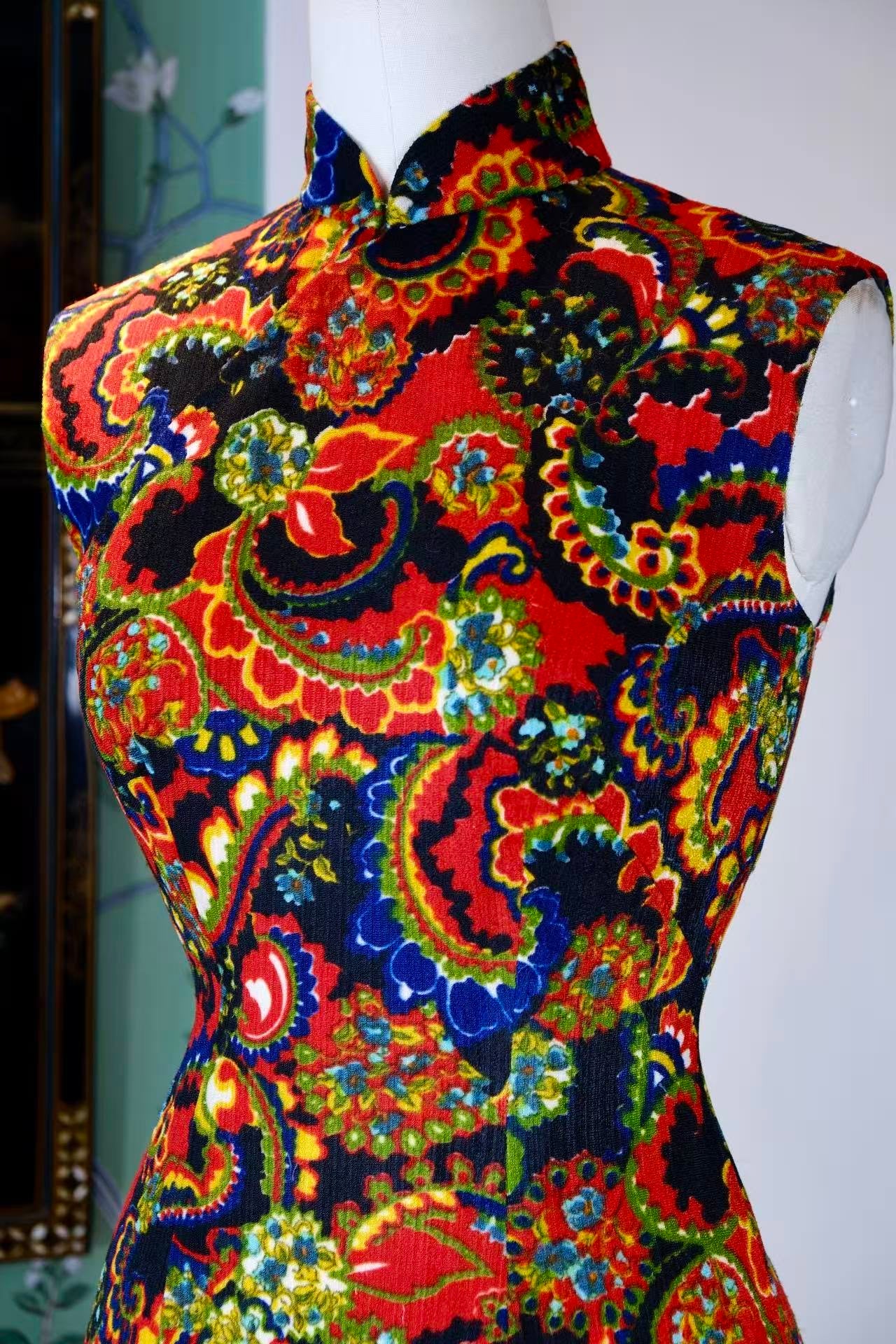
六十年代台湾丝绒印花旗袍:暗夜流光里的东方绮梦
这件六十年代台湾产丝绒印花旗袍,以深邃墨黑为底,恰似夜幕低垂,却在其上铺展一场绚烂至极的视觉盛宴。红、蓝、金、绿诸色交织,构成繁复而和谐的佩斯利纹样,间以细碎花卉点缀,宛如敦煌壁画中飞天散落的璎珞,又似《洛神赋图》里“翩若惊鸿,婉若游龙”的流动韵致。纹样线条婉转如行云流水,既有中式缠枝莲的绵延不绝,又暗含西式巴洛克的华丽繁复,恰是那个年代中西美学碰撞的生动注脚。
丝绒材质在光影下泛着天鹅绒般的柔光,触手生温,仿佛能触摸到六十年代台湾纺织业的黄金岁月。彼时台湾正从传统手工业向现代纺织业转型,这件旗袍的印花工艺细腻精准,色彩经年不褪,足见当年匠人对织造技艺的极致追求。而无袖修身剪裁,则巧妙融合了旗袍的传统韵味与现代女性的摩登风姿,既显东方女性的婉约曲线,又透着六十年代“新女性”的独立精神。
作为六十年代台湾古董旗袍的珍稀遗存,它不仅是衣饰,更是一段历史的活化石。彼时台湾旗袍在保留海派旗袍精髓的同时,更融入本土文化特色,这件旗袍的纹样设计便暗含台湾民间艺术的色彩美学,其稀缺性更在于丝绒材质在旗袍制作中的罕见运用——丝绒娇贵难侍,印花更需精湛技艺,故存世者寥寥。
正如张爱玲所言:“衣服是一种语言,随身带着的是袖珍戏剧。”这件旗袍,正是六十年代台湾社会变迁、文化交融的袖珍戏剧。它静默无言,却以斑斓色彩与细腻肌理,诉说着那个年代的风华绝代,见证着东方美学在时光长河中的永恒流转。
1960s Taiwanese Printed Velvet Qipao: An Oriental Dream Amidst Midnight Radiance
This 1960s printed velvet Qipao, crafted in Taiwan, uses a deep, ink-black base as its canvas—resembling a descending night curtain upon which a magnificent visual feast unfolds. Interweaving shades of red, blue, gold, and green form a complex yet harmonious Paisley pattern, interspersed with delicate floral embellishments. It evokes the scattered jade pendants of flying apsaras in Dunhuang murals, while capturing the fluid grace of "As light as a startled swan, as graceful as a swimming dragon" from the Ode to the Nymph of the Luo River. The winding lines flow like moving clouds, inheriting the continuity of Chinese intertwining lotuses while embracing the opulent complexity of Western Baroque—a vivid footnote to the collision of Eastern and Western aesthetics of that era.
I. Texture and Craft: The Warmth of Golden Years
Under the interplay of light and shadow, the velvet emits a soft, swan-like glow, warming to the touch as if one could feel the golden years of Taiwan's textile industry in the 1960s. At that time, Taiwan was transitioning from traditional handicrafts to modern textiles; the precision of this Qipao's printing and its unfading colors testify to the artisans' ultimate pursuit of weaving craft. The sleeveless, slim-fit tailoring skillfully merges the traditional charm of the Qipao with the modern poise of women, highlighting the graceful curves of the Oriental silhouette while reflecting the independent spirit of the "New Woman" of the sixties.
II. Cultural Value: A Living Fossil of History
As a rare survival of 1960s Taiwanese antique Qipaos, this garment is more than an ornament—it is a living fossil of history. Taiwanese Qipaos of that period preserved the essence of the Shanghai style while integrating local cultural characteristics; the pattern design here subtly reflects the color aesthetics of Taiwanese folk art. Its scarcity is further heightened by the rare use of printed velvet in Qipao construction—velvet is notoriously difficult to handle, and printing upon it requires exquisite skill, making surviving pieces exceedingly few.
III. Conclusion: A Miniature Drama of Cultural Fusion
As Eileen Chang famously remarked: "Clothing is a language, a miniature drama one carries around." This Qipao is precisely that—a miniature drama of social change and cultural fusion in 1960s Taiwan. Though silent, it speaks of an era’s peerless elegance through its brilliant colors and delicate textures, witnessing the eternal flow of Oriental aesthetics through the long river of time.