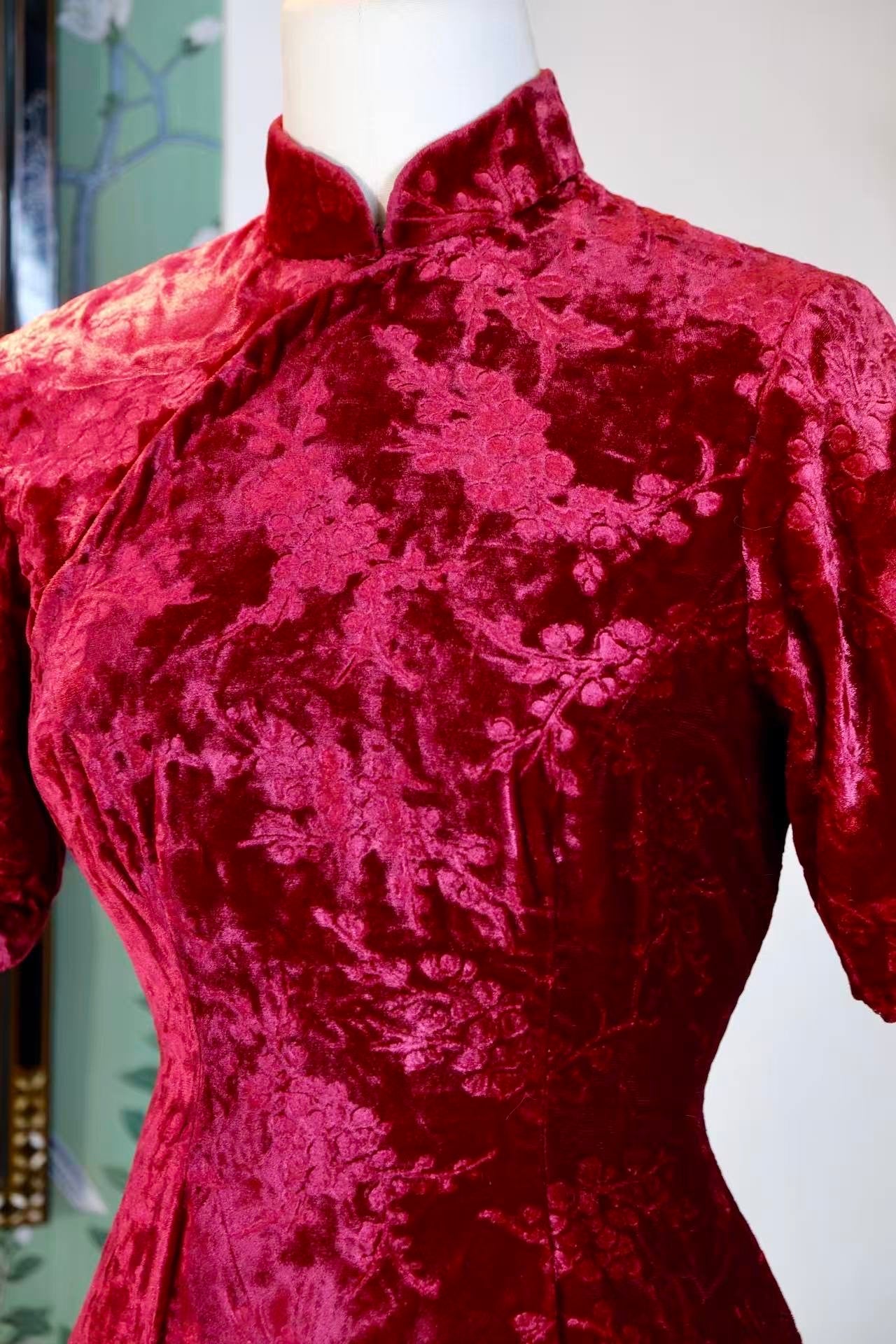
1960s Taiwanese Embossed Velvet Antique Qipao: A Swan Song of Heritage and Post-War Aesthetics
This 1960s antique Qipao from Taiwan stands as a swan song, merging the lingering winds of the Republican era with post-war aesthetics. Against a rich burgundy velvet base, the faint, shimmering patterns of intertwining peonies and plum blossoms serve as the modern incarnation of the classic line from The Classic of Poetry: "The peach tree is young and elegant; brilliant are its flowers." Furthermore, it aligns with the "ancient and endearing" object aesthetics described in The Treatise on Superfluous Things (Chang Wu Zhi). The embossing technique grants the floral totems a relief-like hierarchy under the interplay of light and shadow—much like the freehand spirit of the "boneless" (mogu) technique in Song Dynasty court paintings—infusing the philosophy of "concealing strength within softness" into every inch of its texture.
I. Historical Narrative: A Rare Testimony
The scarcity of this Qipao lies in the unique historical narrative it carries. In 1960s Taiwan, traditional handicrafts faced a difficult transition amidst the tide of modernization; consequently, the time-consuming and labor-intensive velvet embossing craft gradually became a lost art. The local Taiwanese velvet used in this fabric, due to the raw material rationing of the era and the proprietary nature of the techniques, is a treasure that is almost impossible to find in contemporary production.
II. Cultural Memory: Poetry in Motion
As fingertips brush across this half-century-old velvet peony, one touches more than the warmth of fabric—one touches the poetic continuation of the Oriental lifestyle aesthetics depicted in Six Records of a Floating Life: "Plain clothes and simple food, a life of happiness." This Qipao is truly a historical poem worn upon the body. Its artistic value and collective significance echo Eileen Chang’s famous metaphor: "Life is a gorgeous robe," revealing an irreproducible luster under the gentle friction of time.