深圳溯源
无法加载取货服务可用情况
衣服尺寸:
胸围/腰围/臀围:86/68/94 厘米
衣长:92 厘米
细节描述:
一、图案描述:色彩与纹样的交织
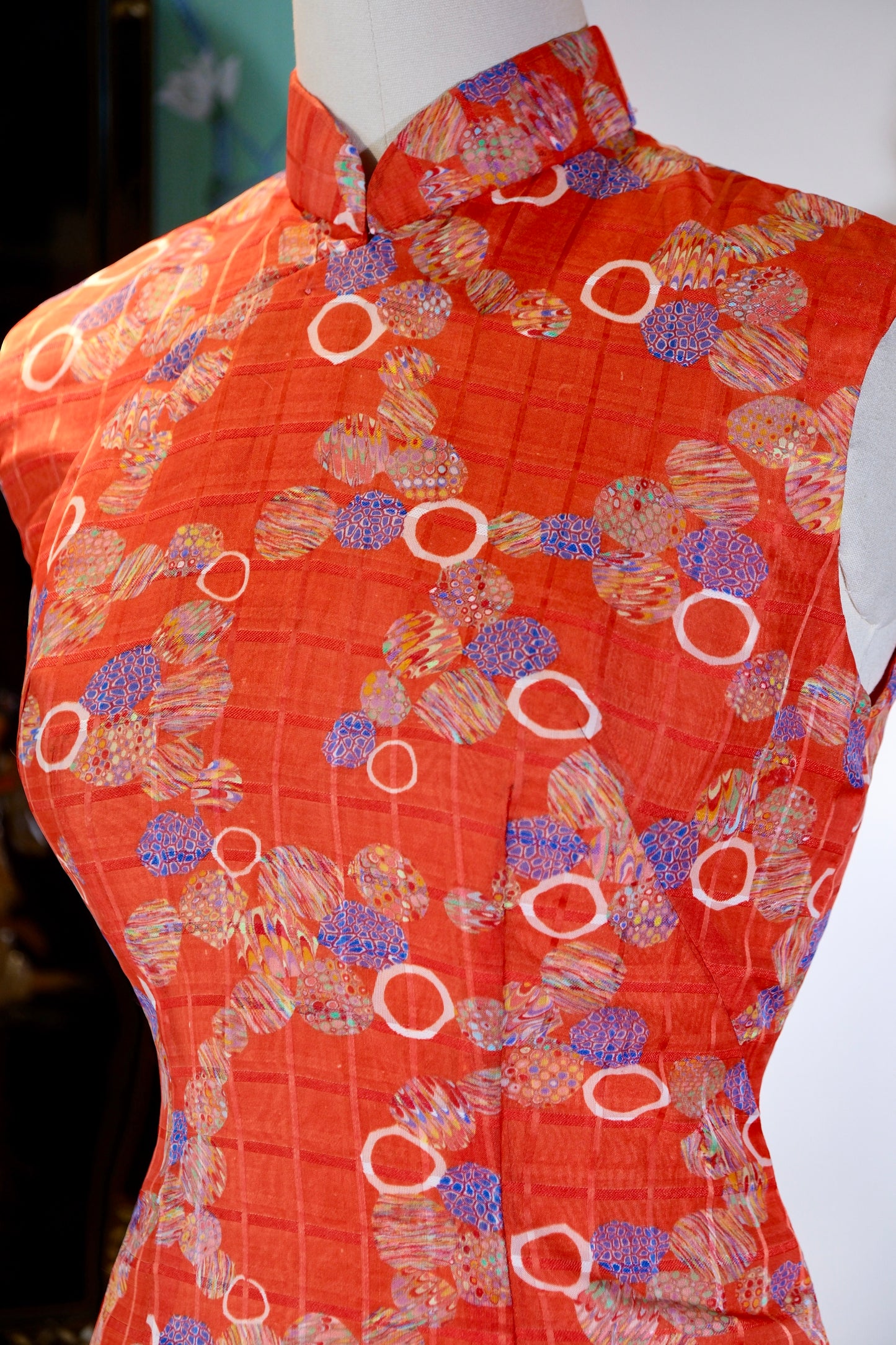
这款上世纪六十年代台湾产的古董旗袍,以提花薄纱为底,染色工艺赋予其独特的艺术质感。旗袍主色调为温暖的橙红色,如夕阳余晖般柔和而富有活力。其上布满由白色圆环、紫色与金色交织的抽象花卉纹样,圆环似串珠般串联起散落的“花簇”,形成灵动而富有韵律的图案。这些纹样既非写实花卉,也非纯粹几何,而是融合了东方传统纹样的意象与西方现代艺术的抽象感,呈现出六十年代特有的“中西合璧”美学——既有《诗经》“桃之夭夭,灼灼其华”的烂漫,又暗合彼时西方波普艺术对几何图形的解构,在薄纱的半透质感中,更显朦胧雅致,仿佛将一整个春天的生机与六十年代的摩登气息凝固于方寸之间。
二、古董衣的故事:时光里的东方风华
这件旗袍诞生于上世纪六十年代的台湾,彼时正值战后经济复苏与文化交融的黄金年代。台湾作为中西文化碰撞的前沿,旗袍设计既保留了传统旗袍的立领、收腰、开衩等经典形制,又大胆吸收西方服饰的剪裁理念与图案风格,形成独特的“海派遗韵+南洋风情+现代主义”混合美学。提花薄纱面料在当时属高端材质,多用于重要场合的礼服,其轻盈透气的特性既适应台湾湿热气候,又彰显了穿着者的身份与品味。
据考,六十年代台湾旗袍业曾迎来“最后的辉煌”,名媛、影星皆以定制旗袍为风尚,而这件旗袍的图案设计,受到当时台湾纺织业引进的日本“友禅染”“墨流染”等技法影响(以手绘或型染呈现细腻纹样),又融入本土对“吉祥纹样”的创新演绎——白色圆环或暗含“圆满”之意,紫金色花卉则象征富贵与高雅,整体图案既符合传统审美,又跳脱出清代旗袍的繁复堆砌,展现出六十年代女性追求“优雅而不失个性”的精神风貌。
三、艺术风格与稀缺性:不可复制的时代印记
从艺术风格看,这件旗袍堪称“六十年代东方现代主义”的典范。其图案打破了传统旗袍“花鸟鱼虫”的写实框架,以抽象化、几何化的手法重构东方意象,与同时期西方设计师如伊夫·圣罗兰(Yves Saint Laurent)的“蒙德里安裙”形成跨文化的呼应,却更具东方含蓄之美。薄纱提花工艺要求极高的织造精度,而印花色彩的渐变与叠加,更需匠人手工调色,每一件都是“孤品”——正如《考工记》所言:“天有时,地有气,材有美,工有巧,合此四者,然后可以为良。”这件旗袍正是“天时(六十年代文化交融)、地气(台湾地域特色)、材美(提花薄纱)、工巧(手工印花)”的完美结合。
稀缺性方面,上世纪六十年代台湾产的高品质古董旗袍存世量极少。彼时成衣工业化尚未普及,多数旗袍为手工定制,且薄纱面料易损,能完整保存至今者凤毛麟角。加之其图案设计的独特性(既非传统苏绣,也非西方印花,而是台湾本土创新的“抽象吉祥纹”),更使其成为研究六十年代东亚服饰史、中西美学交融的“活化石”。正如法国服装史学家丹纳在《艺术哲学》中所说:“艺术品的本质是把一个对象的基本特征,尤其是重要特征表现出来。”这件旗袍所承载的,不仅是六十年代台湾女性的时尚记忆,更是一个时代文化碰撞与创新的精神符号。
四、结语:穿越时光的优雅邀约
当你凝视这件旗袍,仿佛能看见六十年代台北街头的摩登女性,身着它漫步于林荫道,薄纱随步履轻扬,橙红与紫金在阳光下流转生辉。它不仅是一件衣服,更是一段凝固的历史,一种跨越时空的美学宣言。如今,这件孤品级的古董旗袍静候有缘人,让六十年代的风华,在你的衣橱中续写新的传奇——毕竟,真正的经典,从不会被时光遗忘,只会在岁月中愈发熠熠生辉。
Measurements / Size Guide:
Bust / Waist / Hips: 86/68/94 cm
Total Length: 92 cm
Detailed Description:
Produced in 1960s Taiwan, this antique qipao uses jacquard gauze as its base, with dyeing techniques granting it a unique artistic texture. The primary palette is a warm orange-red, soft yet vibrant like the lingering glow of a sunset. It is adorned with abstract floral motifs interwoven with white rings, purple, and gold. The rings link scattered "floral clusters" like strings of pearls, creating a rhythmic and dynamic pattern. These motifs are neither purely realistic nor strictly geometric; instead, they fuse traditional Oriental imagery with Western modern abstraction. This presents the quintessential "East-meets-West" aesthetic of the 1960s—possessing the romanticism of the Classic of Poetry ("The peach tree is young and elegant; brilliant are its flowers") while subtly echoing the Western Pop Art deconstruction of geometric forms. Within the semi-transparent texture of the gauze, it appears hazy and refined, as if the vitality of an entire spring and the modern flair of the 1960s have been solidified within its threads.
This qipao was born in 1960s Taiwan, a golden age of post-war economic recovery and cultural fusion. As a frontier of cultural collision, Taiwanese qipao design preserved classic forms—standing collars, cinched waists, and side slits—while boldly absorbing Western tailoring concepts and pattern styles. This formed a hybrid aesthetic of "Haipai legacy, Nanyang flair, and Modernism." Jacquard gauze was a high-end material at the time, mostly reserved for formal gowns. Its light, breathable nature adapted to Taiwan's humid subtropical climate while signaling the wearer’s status and taste.
Records suggest the Taiwanese qipao industry enjoyed its "final glory" in the 1960s, with socialites and film stars setting the trend for bespoke commissions. The pattern design of this piece was influenced by Japanese techniques introduced to the Taiwanese textile industry, such as Yuzen and Suminagashi (using hand-painting or stencil-dyeing for delicate motifs), while integrating local innovations of "auspicious patterns." The white rings may imply "perfection and reunion" (Yuanman), while the purple-gold flowers symbolize wealth and elegance. The overall pattern aligns with traditional aesthetics yet breaks free from the heavy redundancy of Qing Dynasty styles, reflecting the 1960s woman’s pursuit of "elegance without losing individuality."
Artistically, this qipao is a definitive example of "1960s Oriental Modernism." The pattern shatters the realistic framework of traditional "flowers, birds, and insects," reconstructing Oriental imagery through abstract and geometric methods. It shares a cross-cultural resonance with Western contemporaries like Yves Saint Laurent’s "Mondrian Dress," yet retains a more subtle, Eastern reserve. The jacquard gauze process required extreme weaving precision, and the gradient layering of printed colors demanded manual dye-mixing by master craftsmen, making every piece a "unique specimen." As noted in the Kao Gong Ji: "Heaven has its seasons, Earth its vitality, materials their beauty, and craftsmen their skill. When these four combine, a masterpiece is born." This qipao is the perfect union of "Season" (1960s cultural fusion), "Vitality" (Taiwanese regional characteristics), "Beauty" (jacquard gauze), and "Skill" (hand-printing).
Regarding rarity, high-quality antique qipaos from 1960s Taiwan are extremely scarce. In an age before the full popularization of industrial ready-to-wear, most qipaos were bespoke. Gauze is a delicate fabric, making well-preserved examples from this era a rarity. Furthermore, the uniqueness of the pattern—neither traditional Suzhou embroidery nor purely Western print, but a local Taiwanese "abstract auspicious motif"—makes it a "living fossil" for studying East Asian costume history and Sino-Western aesthetic fusion. As French historian Hippolyte Taine stated in The Philosophy of Art: "The essence of a work of art is to manifest the essential features of an object." This qipao carries not just the fashion memories of 1960s Taiwanese women, but a spiritual symbol of an era's cultural collision and innovation.
When you gaze upon this qipao, it is as if you can see the modern women of 1960s Taipei strolling down tree-lined boulevards, the gauze swaying with their steps, and the orange-red and purple-gold shimmering in the sunlight. It is more than a garment; it is solidified history and a timeless aesthetic manifesto. Today, this unique antique qipao awaits its destined owner, allowing the grace of the 1960s to write a new legend in your wardrobe—after all, true classics are never forgotten by time; they only shine more brilliantly through the years.