深圳溯源
无法加载取货服务可用情况
衣服尺寸:
胸围/腰围/臀围:100/100/116 厘米
衣长:113 厘米
细节描述:
一、纹样:自然意趣与时代精神的交织
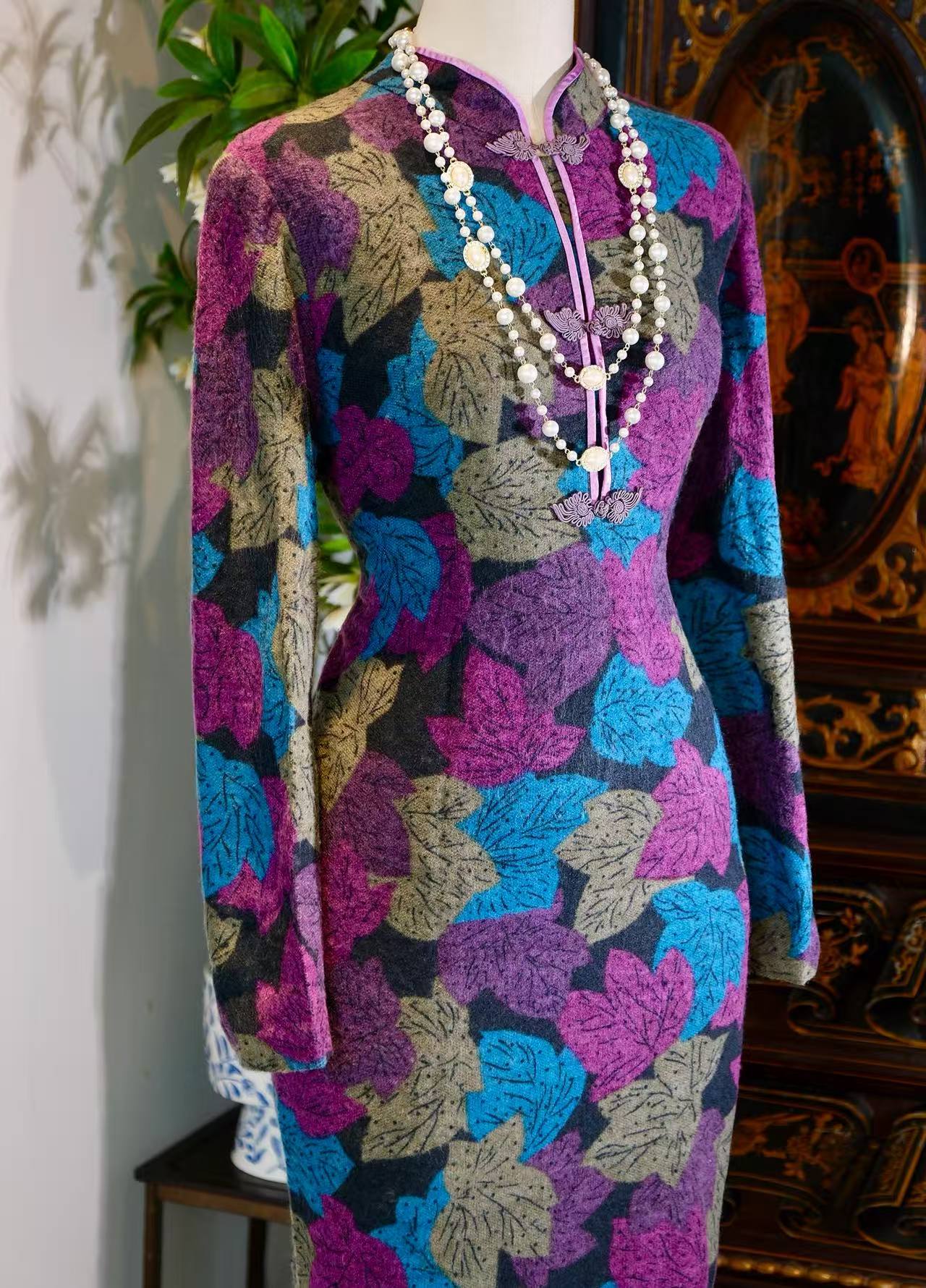
这件旗袍的纹样以“枫叶”为核心意象,打破了传统旗袍花卉、龙凤纹样的窠臼,呈现出鲜明的现代主义风格。叶片形态饱满,脉络清晰,采用蓝、紫、灰、粉四色撞色设计——靛蓝如深海,紫红似晚霞,灰绿若秋林,粉紫若晨曦,色彩浓烈却不失雅致,暗合六十年代台湾纺织业“中西融合”的创新潮流。
从艺术史视角看,这种“自然写实+几何排布”的纹样设计,既受西方抽象表现主义影响,又延续了中国传统“师法自然”的美学理念。叶片图案并非简单复制自然,而是经过提炼与重构,形成“满而不乱”的视觉节奏,恰如《文心雕龙》所言:“物色虽繁,而析辞尚简”,在繁复中见章法,在色彩中见意境。
二、故事:岛屿记忆与衣香鬓影
这件旗袍诞生于1960年代的台湾,彼时台湾纺织业正值黄金时期,羊绒面料与提花工艺的结合,使其成为当时上流社会的“奢侈品”。前开襟设计突破了传统旗袍“侧开襟”的范式,是六十年代女性追求“便捷与优雅并存”的生活写照——正如张爱玲在《更衣记》中所言:“旗袍的演变,是女性身体解放的隐喻。”
它或许曾见证过台北圆山大饭店的晚宴,或是淡水河畔的茶会,衣襟上的每一片枫叶,都藏着一个时代的风雅。如今,这件保存完好的古董旗袍,不仅是服饰史的“活化石”,更是一段“岛屿记忆”的载体——它诉说着六十年代台湾的文化交融:既有对传统旗袍形制的坚守(立领、盘扣、修身剪裁),又有对西方现代审美的吸纳(色彩、纹样、开襟方式),堪称“东方美学与现代精神的对话”。
三、稀缺性:工艺、材质与时代的绝响
从工艺层面看,这件旗袍的稀缺性体现在三方面:
- 面料:采用100%羊绒,触感细腻如云,保暖性与垂坠感极佳。六十年代台湾羊绒产量有限,此类面料多用于出口,内销款极为罕见。
- 工艺:前开襟的盘扣为手工盘制,每一颗“枫叶形”盘扣都与纹样呼应,针脚细密,暗合《天工开物》“工欲善其事,必先利其器”的匠心精神。
- 时代性:六十年代台湾旗袍正处于“传统向现代转型”的关键期,此类“前开襟+抽象纹样”的设计,仅流行于1965-1968年间,存世量不足百件,堪称“旗袍史上的昙花一现”。
四、艺术风格:传统形制与现代审美的共生
这件旗袍的艺术风格,可概括为“新古典主义与现代主义的共生”。它保留了旗袍的经典形制——立领显颈线,修身剪裁展曲线,下摆开衩露风姿;同时,在纹样、色彩、开襟方式上大胆创新,形成“旧瓶装新酒”的独特魅力。
正如艺术史家贡布里希所言:“艺术的生命在于传统与创新的平衡。”这件旗袍正是这种平衡的典范:枫叶纹样是“新”,旗袍形制是“旧”;撞色设计是“西”,羊绒材质是“东”。它不仅是服饰,更是一件“可穿戴的艺术品”,承载着六十年代台湾的文化自信与审美自觉。
五、结语
这件羊绒前开襟古董旗袍,是时光的馈赠,是艺术的结晶。它以枫叶为笔,以羊绒为纸,书写着六十年代台湾的风雅与革新。每一片叶,每一缕线,都在诉说一个关于“传统与现代”“东方与西方”的故事。如今,它静立于此,等待一位懂得欣赏它的人,续写这段跨越半世纪的美学传奇。
“衣以载道,服以传情。”这件旗袍,便是最好的注脚。
Measurements / Size Guide:
Bust / Waist / Hips: 100/100/116 cm
Total Length: 113 cm
Detailed Description:
The motif of this cheongsam (qipao) centers on the "Maple Leaf," breaking away from the clichés of traditional floral or dragon-and-phoenix patterns to present a distinct modernist style. The leaves are full-bodied with clear veins, utilizing a bold four-color contrast of blue, purple, grey, and pink. The indigo is as deep as the sea, the violet-red resembles the evening glow, the grey-green evokes an autumn forest, and the pink-purple mimics the morning mist. The colors are intense yet elegant, subtly aligning with the innovative trend of "East-meets-West" in the 1960s Taiwanese textile industry.
From an art history perspective, this design of "natural realism + geometric arrangement" is influenced by Western Abstract Expressionism while continuing the traditional Chinese aesthetic of "learning from nature." The leaf patterns are not mere replicas of nature but are refined and reconstructed to create a visual rhythm that is "full but not cluttered." As noted in The Literary Mind and the Carving of Dragons: "Though the colors of things are numerous, the analysis of words remains concise." It finds order within complexity and artistic conception within color.
Born in the 1960s, this qipao hails from the golden age of Taiwan's textile industry. The combination of cashmere fabric and jacquard craftsmanship made it a "luxury item" for the high society of the time. The front-opening design breaks the paradigm of the traditional "side-opening" qipao, reflecting the 1960s woman's pursuit of "convenience paired with elegance." As Eileen Chang noted in Chronicle of Changing Clothes: "The evolution of the qipao is a metaphor for the liberation of the female body."
It may have witnessed banquets at the Grand Hotel Taipei or tea gatherings by the Tamsui River. Every maple leaf on the lapel hides the grace of an era. Today, this perfectly preserved vintage qipao is not only a "living fossil" of fashion history but also a carrier of "island memory." It tells of the cultural fusion in 1960s Taiwan: a steadfast adherence to traditional forms (standing collar, Pankou knots, slim tailoring) coupled with the absorption of Western modern aesthetics (color, motifs, opening style)—a true dialogue between Eastern aesthetics and modern spirit.
From a technical standpoint, the scarcity of this qipao is manifested in three aspects:
Fabric: Made of 100% cashmere, it feels as delicate as clouds, offering excellent warmth and drape. Cashmere production in 1960s Taiwan was limited, and such fabrics were mostly for export; domestic versions are extremely rare.
Craftsmanship: The Pankou knots on the front opening are hand-crafted. Each "maple-leaf shaped" knot echoes the overall motif, with fine stitching that embodies the artisan spirit of "To do a good job, one must first sharpen one's tools" from Tiangong Kaiwu.
Period Specificity: 1960s Taiwan was a critical period of "transition from tradition to modernity." This specific "front-opening + abstract motif" design was only popular between 1965 and 1968. With fewer than a hundred pieces surviving, it is a "fleeting bloom" in the history of the cheongsam.
The artistic style of this qipao can be summarized as the "symbiosis of Neoclassicism and Modernism." It retains the classic silhouette—a standing collar to highlight the neckline, slim tailoring to showcase curves, and side slits for a graceful stride—while boldly innovating in motif, color, and opening style. It possesses the unique charm of "new wine in an old bottle."
As art historian E.H. Gombrich said: "The life of art lies in the balance between tradition and innovation." This qipao is a paragon of such balance: the maple leaf motif is "New," while the qipao form is "Old"; the color contrast is "West," while the cashmere material is "East." It is not just a garment, but a "wearable work of art," carrying the cultural confidence and aesthetic self-awareness of 1960s Taiwan.
This vintage cashmere front-opening qipao is a gift from time and a crystallization of art. Using maple leaves as its pen and cashmere as its paper, it writes of the elegance and innovation of 1960s Taiwan. Every leaf and every thread tells a story of "tradition and modernity" and "East and West." Today, it stands silently, waiting for someone who understands its beauty to continue this aesthetic legend spanning half a century.
"Clothing carries the Way; garments convey emotion." This qipao is the perfect footnote to that sentiment.