深圳溯源
无法加载取货服务可用情况
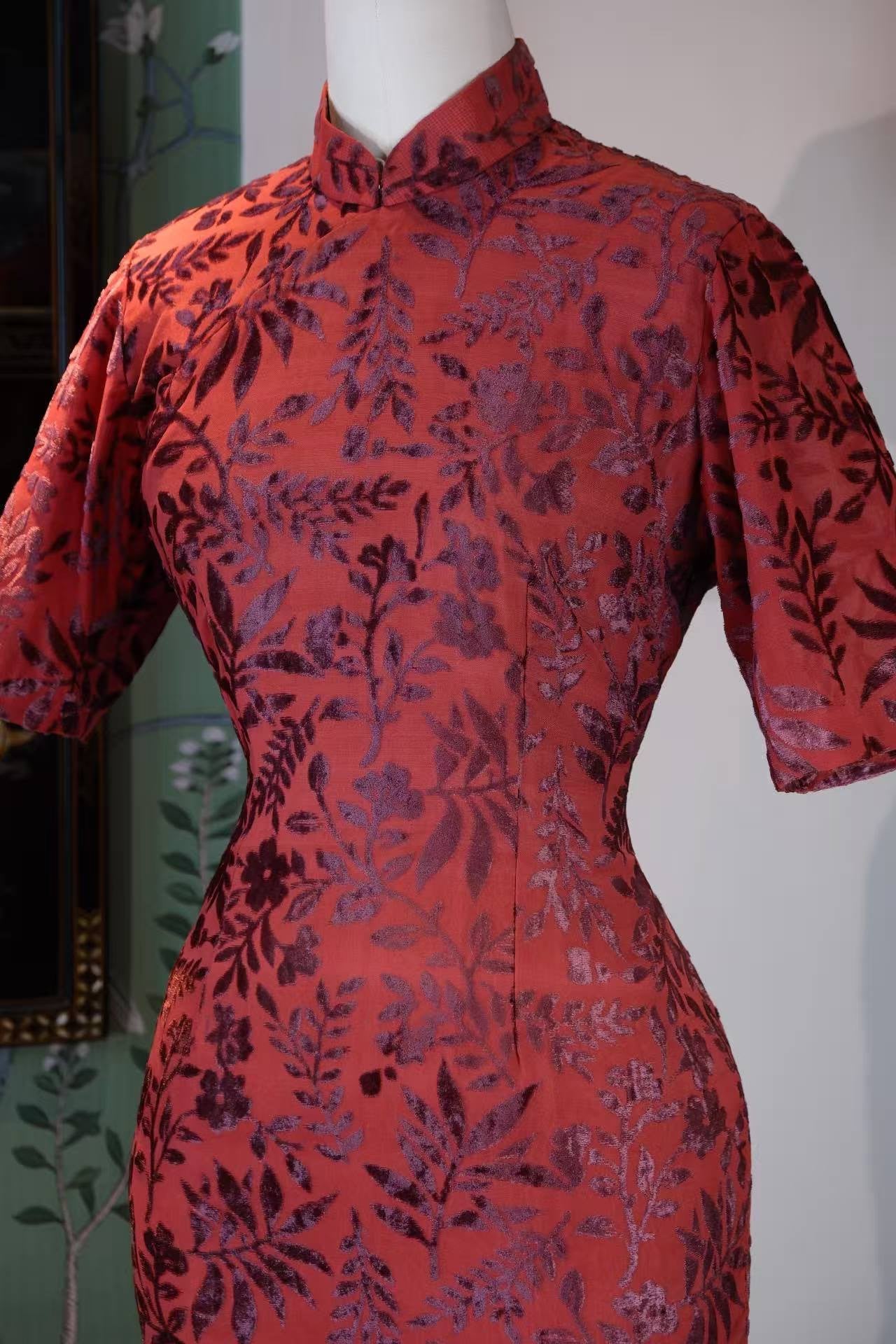
六十年代台湾烧花丝绒旗袍:绛红绒上的时光拓片
秋霜降后,枫林染血,那是大自然的烧花——
一、图案:植物纹样的生命诗学
旗袍上的烧花图案,并非简单的装饰,
二、工艺:稀缺性的时光密码
烧花丝绒(Burnout Velvet)本源于欧洲,却在六十年代的台湾焕发东方新生。
三、风骨:旗袍里的时代剪影
立领高至颔首,袖口短至盈握,修身剪裁勾勒出六十年代女性的“
结语:穿在身上的历史标本
这件旗袍,是六十年代台湾的“纺织史诗”:烧花是自然的拓片,
"After the autumn frost, the maple forest is dyed blood-red—that is nature’s own burn-out." In the 1960s, Taiwanese artisans captured these earthly textures on velvet, transforming them into the grain of this antique Qipao. Against a crimson velvet ground, deep purplish-brown vines and branches climb and entwine—stretching with the vitality of "The peach tree is young and elegant" from The Classic of Poetry, or winding with the grace of "Orchids and angelicas bloom in solitude" from The Songs of Chu. Every inch is a classical aesthetic echo of "woven patterns and bird-like insignias."
The burn-out patterns are not mere decorations, but a "rubbing-style tribute" to nature by 1960s Taiwanese textile craft. The foliage is outlined with realistic strokes; leaf veins resemble the "flying white" (Feibai) technique of calligraphy, and vines connect like gossamer threads. Blossoms—some in bud, some in full bloom—align with the gardening philosophy of Yuan Ye: "Though created by man, it appears as a work of nature." The magic lies in the burn-out (Devoré) process—where high-temperature etching removes the pile to reveal the base color, like mottled traces left by time on red silk. This endows the botanical motifs with both the primitive simplicity of "bronze and stone rubbings" and the fluid spirit of "boneless flower-and-bird" paintings.
Burn-out Velvet originated in Europe but found a new Oriental life in 1960s Taiwan. At that time, Taiwan's textile industry was in transition; artisans used hand-carved blocks and botanical dyes to fuse Chinese motifs with Western techniques. Every inch of velvet underwent over ten processes: weaving, dyeing, burning, and polishing. The scarcity of this piece lies in its status as a "sole survivor of its era." Taiwanese Qipaos of the 1960s carried the tailored bones of Republican Shanghai-style while incorporating the innovative blood of local craft—much like the cultural nostalgia found in Pai Hsien-yung’s Taipei People. The warmth of old times is frozen within every fold of the velvet.
The standing collar rises to the chin, and the sleeves are shortened to a hand's breadth; the slim-fit tailoring silhouettes the "willow-like waist" of the 1960s woman. This is a modern translation of the Dream of the Red Chamber description: "Quiet as a delicate flower reflected in the water." It stands as witness to the "East-meets-West" fashion of post-war Taiwan. Under the light, the crimson velvet flows with the luster of an old film reel, evoking the silhouettes of women in Qipaos beneath the arcade buildings of Southern Taiwan—elegant, resilient, concealing the "dignity of the past and the expectations of the new world."
Conclusion: A Wearable Historical Specimen This Qipao is a "textile epic" of 1960s Taiwan: the burn-out is a rubbing of nature, and the velvet is a vessel of time. Every inch of the pattern speaks to the ancient wisdom that "craft is poetics." Viewing it today is like opening a yellowed volume of the General History of Taiwan: Craft Records. The branches on the crimson velvet are still growing the aesthetic codes of that era—scarce, because time cannot be replicated; precious, because craftsmanship flows forever.