深圳溯源
无法加载取货服务可用情况
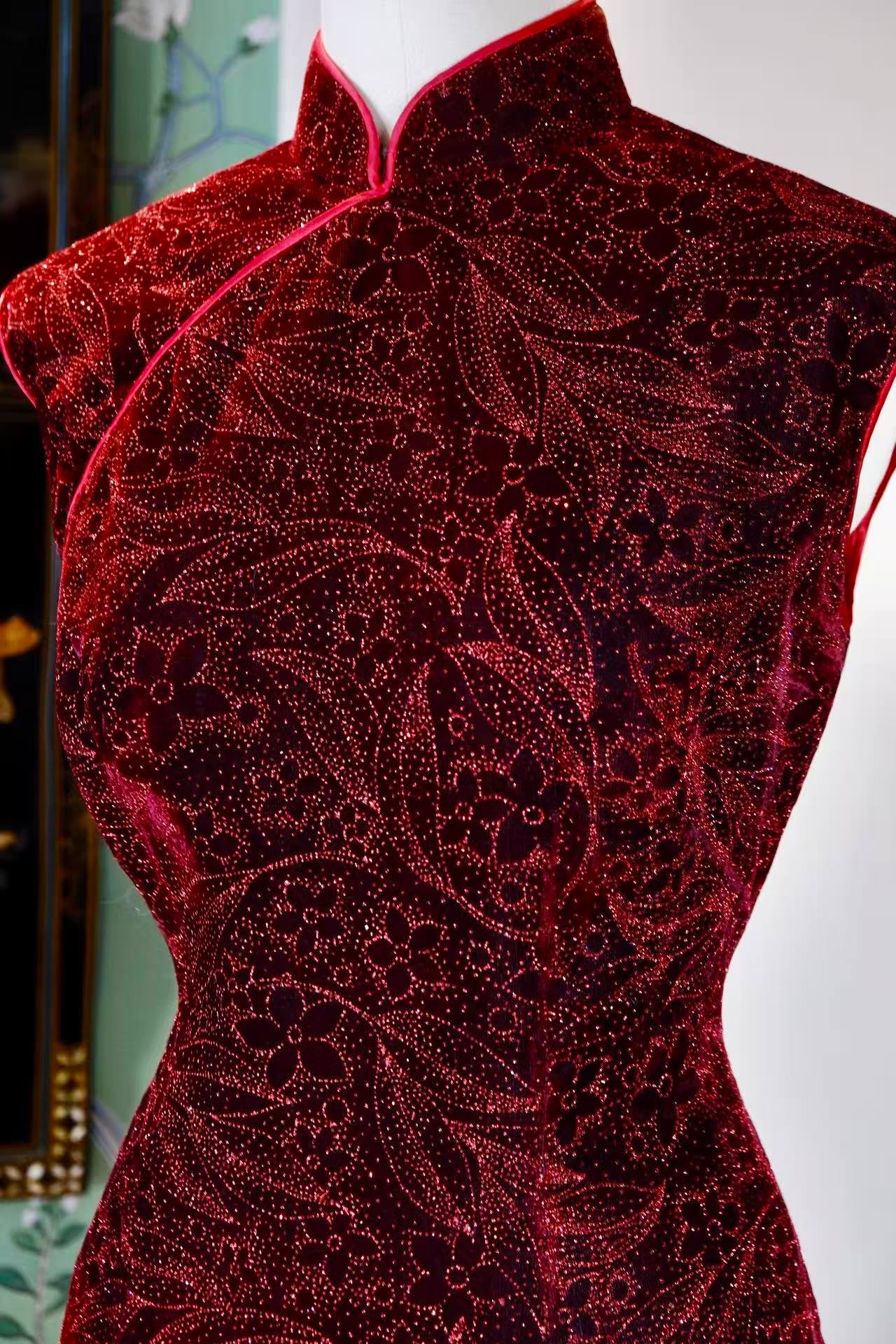
六十年代台湾金丝绒烫闪片线香绲旗袍:织锦上的浮光掠影
当丝绒的暗涌遇上闪片的星芒,一件衣裳便成了流动的诗卷。
一、图案:缠枝暗涌,星辉入画
旗袍的图案以缠枝花卉为主题,枝蔓蜿蜒,花蕾含苞,叶片舒展,
更妙的是,图案中的花卉并非平面的刺绣,而是以烫闪片工艺呈现。
二、工艺:线香绲边,寸锦寸金
旗袍的绲边采用线香绲工艺,绲条细如线香,边缘整齐,线条流畅,
金丝绒的面料本身亦是这件旗袍的亮点。其绒面丰满,光泽柔和,
三、文化:台海遗珍,匠心永续
这件旗袍产自上世纪六十年代的台湾,
如今,这样的古董旗袍已极为罕见。
结语
“云想衣裳花想容,春风拂槛露华浓。”
When the dark undercurrents of velvet meet the starlit brilliance of sequins, a garment transforms into a flowing scroll of poetry. This 1960s antique Qipao from Taiwan acts as a frozen frame in time, concealing the era's elegance and ingenuity within the warp and weft of its threads and the glimmer of its sequins.
The motifs center on intertwining florals (Chanzhi)—vines wind gracefully, buds prepare to bloom, and leaves stretch in lines that flow like moving clouds. This pattern inherits the traditions of Ming and Qing brocades, such as "intertwining lotus" and "intertwining peony," while integrating the innovations of 1960s Taiwanese craftsmanship to create a more spirited and natural look. The cyclical nature of the vines symbolizes endless vitality, while the lushness of the blooms echoes the imagery of "The peach tree is young and elegant; brilliant are its flowers" from The Classic of Poetry, conveying a prayer for a beautiful life.
Exquisitely, the blossoms are not flat embroidery but are rendered through a heat-transfer sequin process. Countless tiny sequins are dotted among the foliage like stars, refracting light into a delicate yet dazzling brilliance—as if the starlight of the night sky were solidified upon the velvet. This craft not only enhances the opulence of the Qipao but also endows it with an artistic tension: "stillness within motion, motion within stillness." When the wearer walks, the sequins sway, mimicking flowers trembling in the wind; when standing still, it resembles a serene Gongbi (meticulous) flower-and-bird painting, elegant and solemn.
The piping utilizes the "Incense-Line" (Xianxiang Gun) technique—the trim is as slender as a stick of incense, with perfectly neat edges and fluid lines. This not only outlines the silhouette but also provides a sharp contrast to the heavy texture of the gold velvet, adding a layer of refinement. While this technique was popular during the Republican era, this 1960s piece brings it to its pinnacle, where the width of the piping perfectly complements the velvet’s grain without overshadowing the overall aesthetic.
The gold velvet itself is a highlight. Its pile is full and lush with a soft luster, feeling as light as a cloud yet appearing extraordinarily noble due to the sequin embellishments. The combination of velvet and heat-transfer sequins preserves traditional elegance while embracing modern innovation—a classic example of "new wine in an old bottle."
Produced in 1960s Taiwan, this Qipao was born during a booming period for the local textile industry, where the fusion of traditional handcraft and modern technology birthed unique sartorial works. It is more than a garment; it is a witness to history—carrying the wisdom of Taiwanese artisans and reflecting the era's pursuit of beauty and its commitment to tradition.
Today, such antique Qipaos are extremely rare. It is not just a wearable work of art, but a piece of cultural heritage worthy of collection. To wear it is to feel the breeze of 1960s Taiwan streets, hear the whispers of velvet against sequins, and touch the splendor buried by time.
Conclusion "Clouds remind me of her clothes, and flowers of her face; the spring breeze brushes the threshold, thick with dewy radiance." This Qipao uses intertwining florals as its canvas, sequins as its ink, and "incense-line" piping as its brush to paint a flowing masterpiece. It stands as a treasure of Qipao history and a vivid manifestation of the spirit where "clothing carries the Tao."