深圳溯源
无法加载取货服务可用情况
六十年代意大利进口烧花丝绒织金旗袍:东方形制与西方织艺的绝代风华
这件诞生于上世纪六十年代的台湾古董旗袍,
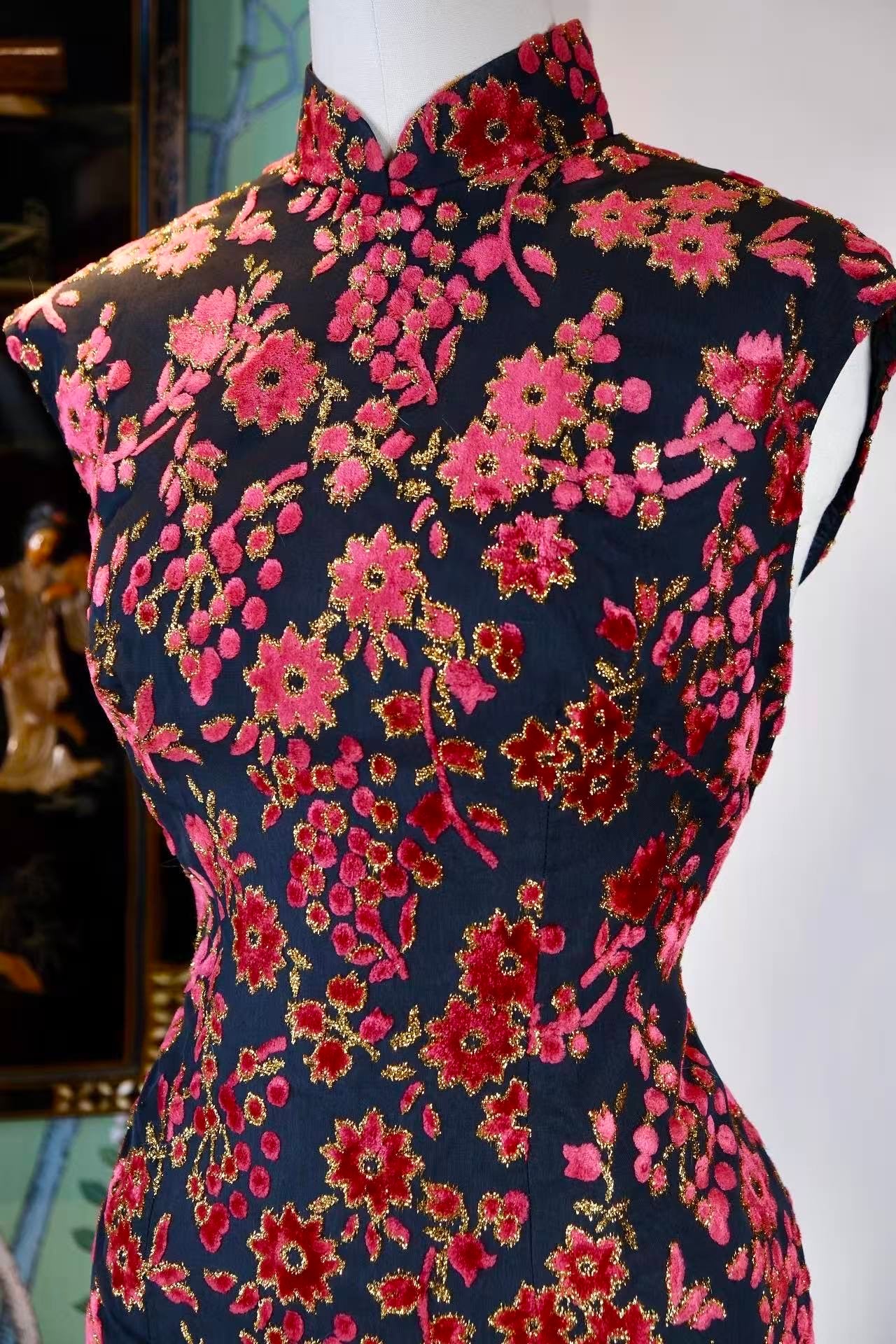
旗袍所用面料为意大利进口烧花丝绒,
旗袍上的花卉图案突破传统中式纹样的对称规制,
作为台湾产古董旗袍,其剪裁深谙东方女性的曲线美学:高领紧收,
六十年代的台湾旗袍,正处于传统与现代的转型期:
当意大利的织金工艺遇上东方的旗袍形制,
Crafted in 1960s Taiwan, this antique Qipao features imported Italian burn-out velvet with gold brocade as its soul. It fuses the opulence of Western weaving with the grace of the Oriental Qipao, standing as a peerless masterpiece of East-West aesthetic convergence.
The fabric—Italian burn-out velvet—was considered a pinnacle of luxury in the 1960s. Against an ink-black velvet base, the dual processes of cutting (pile-work) and gold-weaving (Jacquard) create a texture where the velvet is as serene as black jade and the gold threads flow like a galaxy. The crimson and pink floral motifs are rendered through the "burn-out" (Devoré) technique—partially removing the pile to reveal the underlying gold-woven pattern. This creates a relief-like effect where blossoms appear three-dimensional, their golden stems shimmering against the dark ground. It evokes the magnificent imagery of "golden threads and precious gems" described in Dream of the Red Chamber, yet possesses the precision and cool elegance of modern textile art.
The floral patterns break away from the symmetrical constraints of traditional Chinese motifs, adopting a Western realistic style. Pink and vermilion flowers are scattered with natural grace; petals are layered as if real, while gold-threaded vines wind like wandering dragons. It embodies the ornate complexity of Baroque art while subtly aligning with the Chinese "broken-branch" painting tradition. As the Song Dynasty master Guo Xi wrote in The Lofty Message of Forests and Streams: "Mountains take water as their blood and vegetation as their hair." This design condenses natural vitality into the fabric; every flower seems to bloom quietly in the night, a metaphor for the new life sparked by the collision of East and West in the 1960s.
This Taiwanese antique Qipao demonstrates a profound mastery of the Oriental feminine silhouette. The high, tight collar elongates the neck, while the sleeveless design exposes the shoulders and arms—preserving traditional dignity while embracing 1960s modernism. The side slits reaching the calf allow for a glimpse of movement, capturing the subtle beauty of "Her artful smile so dimpled, her beautiful eyes so clear" from The Classic of Poetry. The tension between the heavy fabric and the body-conscious cut echoes Eileen Chang’s insight in Chronicle of Changing Clothes: "Within the stillness of the Qipao lies the exquisite heart of a woman."
1960s Taiwanese Qipaos were in a transformative period: inheriting the meticulous craft of the Shanghai style while experimenting with imported materials under Western influence. The use of Italian burn-out velvet pushed this "Sino-Western fusion" to the extreme—at that time, such fabrics were mostly reserved for European Haute Couture, and those that found their way to the East were exceedingly rare. Today, after half a century, the velvet remains as smooth as swan's down, the gold thread retains its luster, and the flowers are as vivid as ever—a true "living fossil" of textile and fashion history.
Conclusion When Italian weaving meets the Oriental Qipao, and when 1960s modernity collides with traditional aesthetics, this garment becomes more than an object; it is a solidified history of civilizational dialogue. It carries the hidden threads of material exchange during the Cold War and witnesses the persistence and innovation of Taiwanese artisans. Standing silently in time, the faint glow of the velvet seems to echo the rustle of Qipaos on 1960s Taipei streets, intertwined with the hum of Italian looms—narrating a splendor that never fades.