深圳溯源
无法加载取货服务可用情况
衣服尺寸:
胸围/腰围/臀围:96/84/98 厘米
衣长:123 厘米
细节描述:
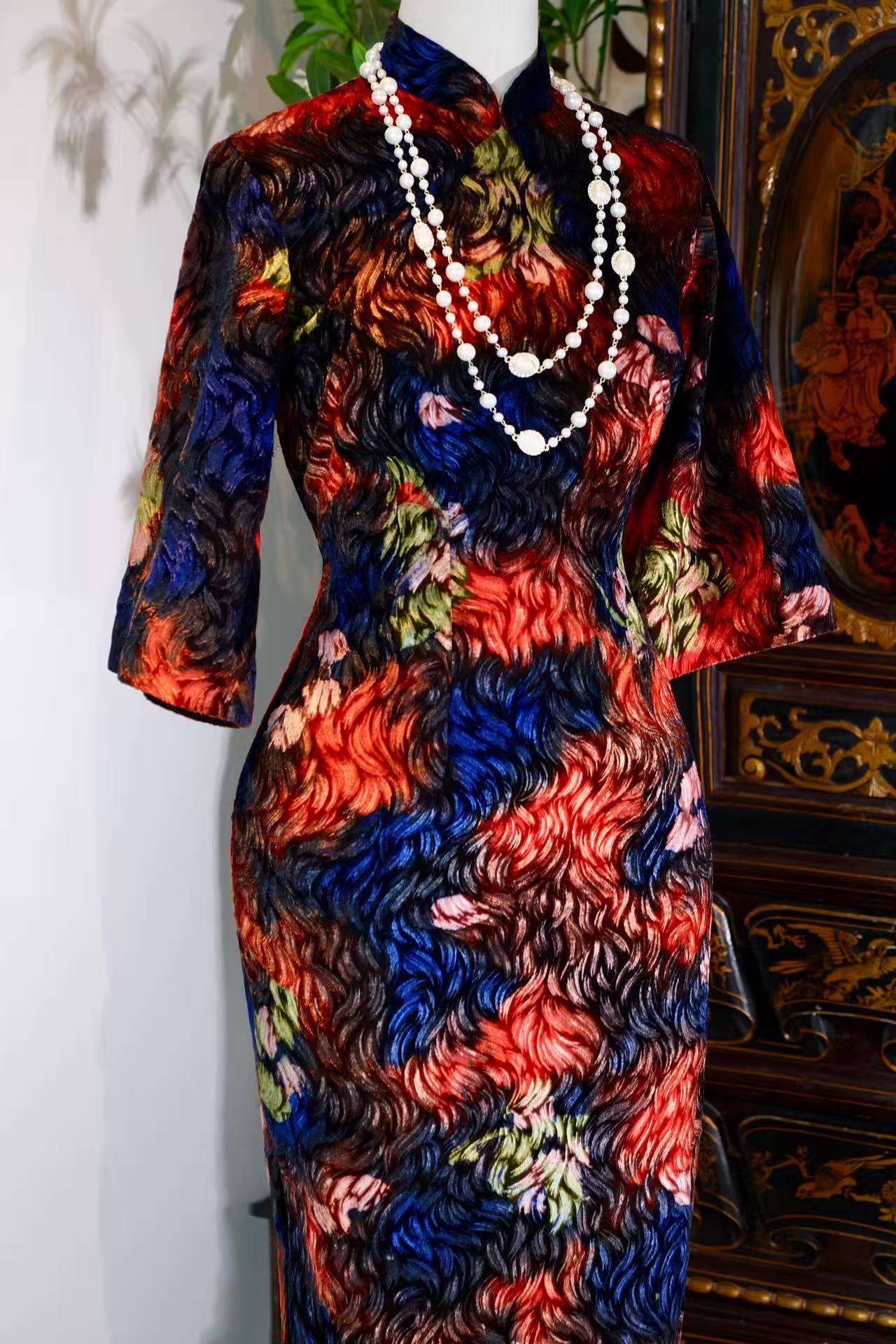
此件旗袍采用手绘晕染工艺,以“泼彩写意”之姿,将传统工笔花鸟的细腻与现代抽象艺术的张力熔于一炉。深红与靛蓝为主调,如《千里江山图》的青绿与赭石碰撞,晕染出层叠的牡丹与缠枝纹样——花瓣边缘以“退晕法”渐变为粉紫、橙红,仿佛被晚风拂过的晚霞,又似《洛神赋》中“翩若惊鸿,婉若游龙”的动态韵律。衣身暗藏黑色丝绒底纹,如《红楼梦》中“软烟罗”的朦胧质感,行走时光影流转,似有暗香浮动。袖口与下摆的纹样疏密相间,恰合“计白当黑”的东方美学,留白处似水墨洇染,又似时光沉淀的斑驳印记。
古董故事与艺术风格
1960年代的香港,是中西文化碰撞的“东方之珠”。彼时旗袍从传统宽袍大袖转向修身剪裁,而手绘工艺则成为名媛贵妇彰显品味的“无声宣言”。此件旗袍的晕染技法,暗合张大千晚年“泼彩山水”的革新精神——以水为媒,让色彩在面料上自然流淌,形成“似与不似之间”的意境。
其稀缺性更体现在“时代密码”中:立领高度较五十年代降低2厘米,贴合当时“新女性”追求舒适的理念;侧缝开衩隐于纹样间,既保留传统含蓄,又暗藏摩登气息。珍珠项链的搭配,呼应了1960年代好莱坞影星如格蕾丝·凯利的优雅风潮,而旗袍本身却以东方水墨为魂,恰如张爱玲所言:“旗袍是装在瓶子里的月光,一晃动就碎成满地星河。”
《考工记》云:“天有时,地有气,材有美,工有巧,合此四者,然后可以为良。”此旗袍正合“四美”:天时(六十年代香港文化交融的黄金期)、地气(沪港工艺传承)、材美(进口丝绒)、工巧(手绘晕染)。其纹样中的牡丹,取自《诗经》“有女同车,颜如舜华”的意象,而缠枝纹则暗合佛教“生生不息”的哲学,每一件都是“孤品”——因手绘时画师的心境、笔触力度皆不可复制,正如《兰亭序》的“之”字各有姿态。
如今,这件旗袍不仅是服饰,更是一部“穿在身上的艺术史”。它见证过中环夜总会的霓虹闪烁,也聆听过太平山顶的涛声,其上的每一道晕染,都是时光写给东方的情书。正如沈从文在《中国古代服饰研究》中所言:“服饰是凝固的历史,而古董衣,是历史在呼吸。”
Measurements / Size Guide:
Bust / Waist / Hips: 96/84/98 cm
Total Length: 123 cm
Detailed Description:
This qipao employs a hand-painted ombré technique, utilizing a "splashed-color freehand" (Pocai Xieyi) style that fuses the delicacy of traditional fine-brush flower-and-bird painting with the tension of modern abstract art.
The palette is dominated by deep crimson and indigo, echoing the collision of malachite green and ochre found in the classic "A Thousand Li of Rivers and Mountains."
The Technique of Fading: Using the "Retreating Gradient" (Tuiyun) method, the petal edges transition into lavender and orange-red, resembling sunset clouds brushed by an evening breeze—a dynamic rhythm akin to the "fluttering like a startled swan" described in the Ode to the Goddess of the Luo River.
Texture and Depth: The black velvet substrate offers a hazy, ethereal texture reminiscent of the "Soft Smoke Gauze" (Ruanyan Luo) from Dream of the Red Chamber. As the wearer moves, light and shadow ripple across the fabric like floating fragrances.
Composition: The density of the patterns at the cuffs and hem adheres to the Eastern aesthetic of "treating white space as black" (Ji Bai Dang Hei). The negative spaces resemble ink soaking into paper or the mottled traces of time’s sediment.
1960s Hong Kong was the "Pearl of the Orient," a melting pot of East and West. During this era, the qipao shifted from traditional loose forms to body-conscious tailoring, and hand-painted artistry became a "silent declaration" of status for socialites and noblewomen.
The ombré technique used here mirrors the innovative spirit of Zhang Daqian’s late-period "splashed-color landscapes"—using water as a medium to let color flow naturally across the fabric, creating an artistic realm "between likeness and unlikeness."
The Era’s Code: The standing collar is 2 cm lower than those of the 1950s, reflecting the "New Woman’s" pursuit of comfort. The side slits are subtly hidden within the patterns, preserving traditional modesty while hinting at modern flair.
The Style Synthesis: When paired with pearls, it evokes the elegance of 1960s Hollywood icons like Grace Kelly, yet the soul remains Eastern ink. As Eileen Chang famously remarked: "The qipao is moonlight trapped in a bottle; one shake, and it shatters into a galaxy across the floor."
According to the ancient text Kao Gong Ji: "The season has its time, the earth has its qi, the material has its beauty, and the craft has its skill. When these four combine, a masterpiece is born." This qipao embodies these "Four Beauties":
Time: The golden age of 1960s Hong Kong cultural fusion.
Qi: The lineage of craftsmanship traveling from Shanghai to Hong Kong.
Material: High-end imported velvet.
Skill: The irreproducible hand-painted ombré.
The peony motif draws from the Classic of Poetry imagery of "a lady in the carriage, her face like a hibiscus flower," while the scrolling vines (Chanzhi) symbolize the Buddhist philosophy of "endless life." Each piece is a unique "original"—just as each "of" (zhi) character in the Lantingji Xu has its own posture, the artist’s mood and brush pressure at the moment of creation can never be replicated.
Today, this qipao is not just clothing; it is a "wearable history of art." It has witnessed the neon flickers of Central’s nightclubs and heard the waves at Victoria Peak. Every stroke of color is a love letter written by time to the East. As Shen Congwen noted in Researches on Ancient Chinese Costumes: "Clothing is frozen history; antique garments are history breathing."