深圳溯源
无法加载取货服务可用情况
衣服尺寸:
胸围/腰围/臀围:90/74/96 厘米
衣长:108 厘米
细节描述:
【藏品档案】
- 年代: 20世纪60年代
- 产地: 香港
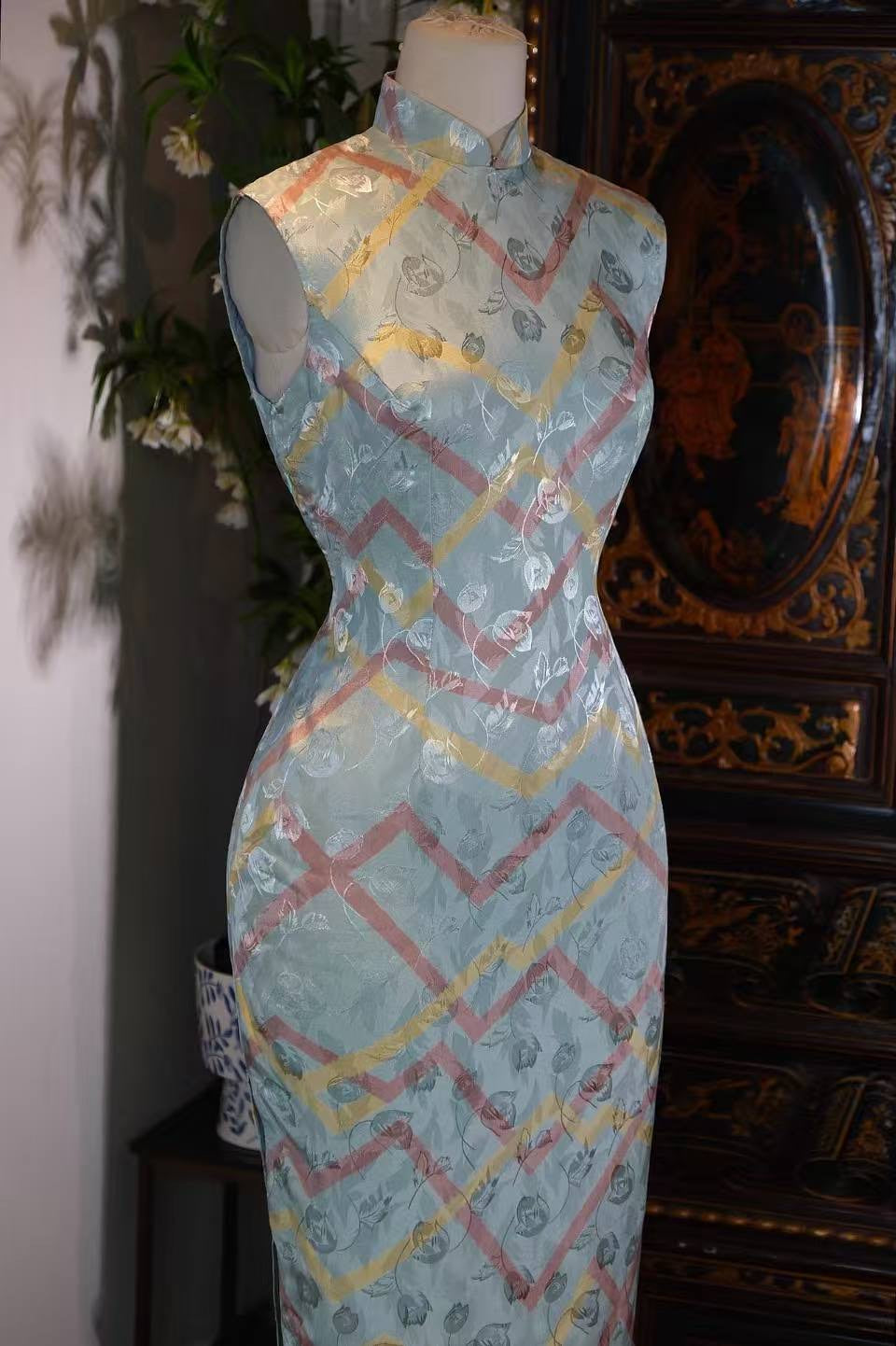
- 工艺: 几何暗纹提花织造
- 主题纹样: 郁金香(Tulip)变体暗纹
- 风格: 海派遗韵与南洋摩登的交融 图案解构:几何秩序下的生命隐喻
这件旗袍的图案设计,是典型的“新古典主义”几何美学。
- 外在的秩序——几何骨架
画面以斜向的锯齿纹(Zigzag)与菱形格为经纬,
- 内在的生命——郁金香暗纹
若驻足细看,几何网格的间隙中,隐匿着含苞待放的郁金香。
艺术评注: 这种“几何框架+自然暗纹”的设计, 古董衣语:香港浮世绘的摩登诗篇
这件旗袍不仅是一件衣物,更是一部穿在身上的香港断代史。
1. 海派衣钵的南渡
上世纪60年代,是上海裁缝南下香港的高峰期。他们将“
2. “东方好莱坞”的时尚镜像
60年代的香港,是张爱玲笔下“华丽而苍凉”的城市,
3. 工业与手作的绝响
在那个尚未完全机械化的年代, 引经据典:风华绝代的注脚
若论这件旗袍的风骨,恰如张爱玲在《更衣记》中所言:“
这件旗袍,正是那部“袖珍戏剧”的最佳剧本。
它没有张爱玲笔下那件“热烈得近乎悲壮”的红绿配色, 结语
结语
这是一件穿越了半个世纪烟云的时间信物。
它不仅是一件可以穿在身上的艺术品,
Measurements / Size Guide:
Bust / Waist / Hips: 90/74/96 cm
Total Length: 108 cm
Detailed Description:
Era: 1960s
Origin: Hong Kong
Craftsmanship: Geometric Jacquard Weaving
Theme: Stylized Tulip Variations
Style: A fusion of Shanghainese legacy and Nanyang (South Seas) modernism
The pattern design of this qipao is a hallmark of "Neoclassical" geometric aesthetics. Eschewing the literal complexity of traditional Suzhou embroidery, the designer employed a rigorous, almost architectural composition to build visual tension.
External Order — The Geometric Framework The visual field is defined by diagonal zigzags and rhombic grids, weaving a dynamic rhythm into the warp and weft. Intersecting lines of reddish-brown and goose-yellow break the monotony of traditional vertical qipao lines, imparting a fluid sense of modernity. This geometric language echoes the "Space Age" aesthetic of the 1960s on Oriental silk, symbolizing the vigor and order of post-war Hong Kong.
Internal Life — Hidden Tulip Motifs Upon closer inspection, budding tulips are hidden within the gaps of the geometric mesh. These blossoms do not overwhelm; instead, they are integrated into the base as a "hidden jacquard" (Jacquard). Against a pale blue-grey ground, tulip buds in shades of grey-blue and cream droop gracefully with stretching leaves. This "blossoms within grids" technique aligns with the Chinese painting principle of "Sparse enough for a horse to gallop through, yet dense enough to stop the wind," wrapping Western romantic florals within an Oriental rational order to create a subtle, profound visual dialogue.
Artistic Commentary: This design—combining a geometric frame with natural hidden motifs—is a milestone of the highly mature Hong Kong textile industry in the 1960s. It preserves the warm luster of silk while creating a rich textural relief through jacquard weaving, truly a "flowing sculpture."
This qipao is more than a piece of clothing; it is a wearable history of a specific era in Hong Kong.
The Southward Migration of Shanghainese Craftsmanship The 1960s saw the peak of Shanghainese tailors migrating south to Hong Kong, bringing the sophisticated tailoring of the "Shanghai-style qipao" to Victoria Harbour. The cut of this garment is exceptionally refined: a high collar, sleeveless design, and side slits that follow the human silhouette like flowing water, reflecting the era's aesthetic pursuit of feminine liberation. It is no longer the wide sleeves of the late Qing or early Republican periods, but the confident armor of a modern urbanite.
Fashion Mirror of the "Hollywood of the East" Hong Kong in the 1960s was the "magnificent yet desolate" city of Eileen Chang’s prose and the era of Shaw Brothers films sweeping Asia. The colors presented here—grey-blue base with warm-toned geometry—are the vintage hues common in the film stock of that time. It belongs under the neon lights of Lan Kwai Fong as much as it does weaving through the skyscrapers of Central. It stands as a silent witness to Hong Kong’s transformation from an entrepôt to an industrial city.
The Swan Song of Industrial Handcraft In an era not yet fully mechanized, such complex jacquard fabrics required immense weaving skill. Every inch of fabric embodies the ingenuity of Hong Kong’s textile workers. Today, this specific fabric—marrying classical floral imagery with modern geometric composition—is out of print. It is a "living fossil" representing the peak of Hong Kong aesthetics during a specific historical window.
Regarding the character of this qipao, it mirrors Eileen Chang’s insight in Chronicle of Changing Clothes: "To those who cannot speak, clothes are a language; what one carries with them is a pocket drama."
This qipao is the perfect script for that "pocket drama." It lacks the "intense, almost tragic" red-green palettes of Chang’s descriptions, opting instead for an elegance where "silence speaks louder than words." It evokes the imagery of Song Dynasty poet Zhou Bangyan: "Morning sun on the leaves dries the overnight rain; across the clear, round water, the lotuses lift themselves one by one." Those tulip buds—清丽 (pure), 挺拔 (upright), and growing freely within geometric order—mirror the temperament of this qipao: finding flair within rules and vitality within order.
This is a time capsule that has traveled through half a century of mists. It carries the neon shadows of 1960s Hong Kong, encapsulates the exquisite skills of Shanghainese tailors, and speaks to the swan song of Eastern and Western aesthetic collisions through its unique tulip jacquard.
It is not just a wearable work of art; it is a historical memory worthy of preservation. When you put it on, you become the one who continues this magnificent old dream.