深圳溯源
无法加载取货服务可用情况
衣服尺寸:
胸围/腰围/臀围:110/98/108 厘米
衣长:108 厘米
细节描述:
一、衣上花笺:一场色彩与工艺的视觉盛宴
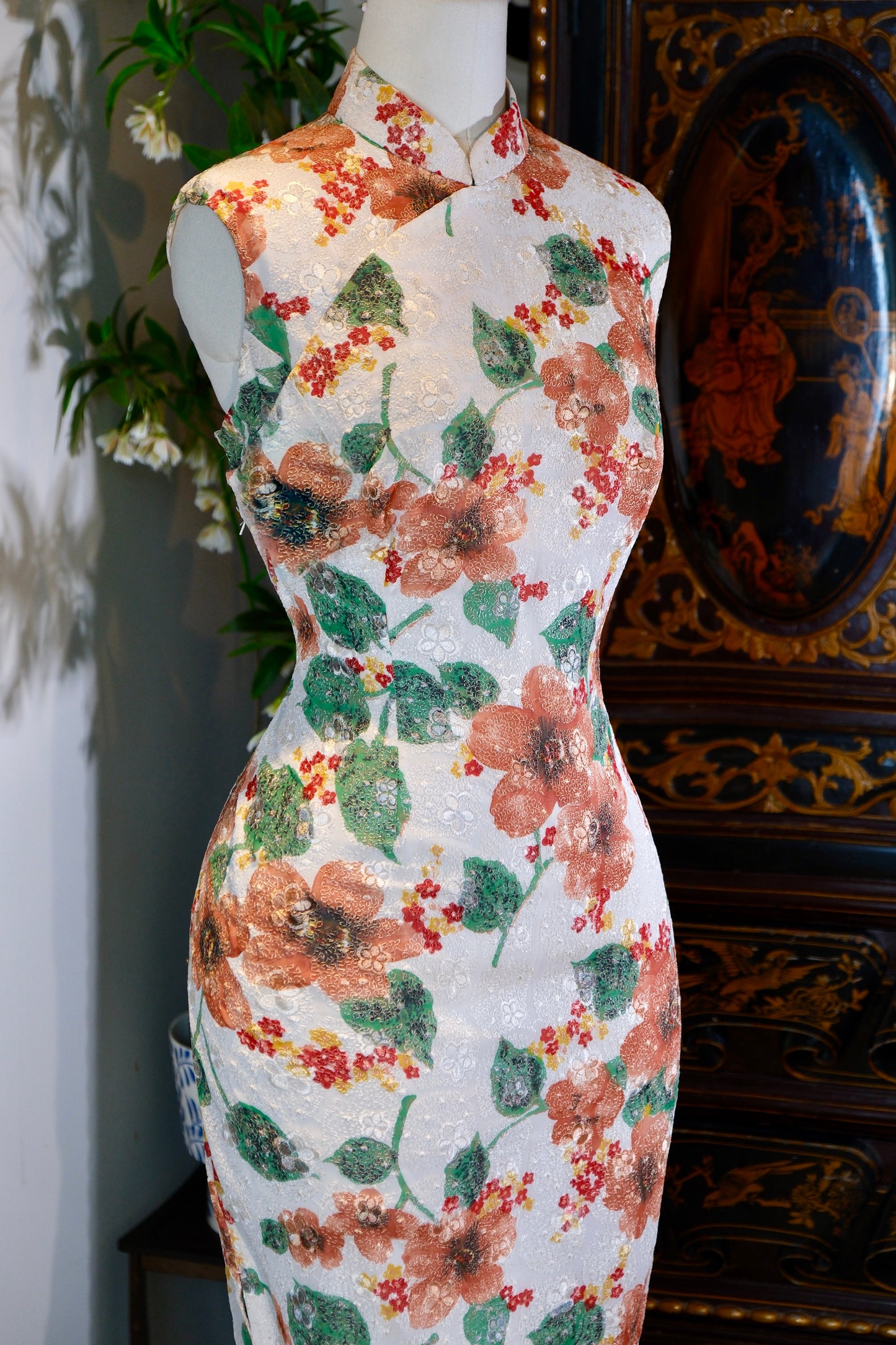
这件旗袍的底色如宣纸般素净,仿佛为花朵预留了绽放的舞台。衣身满布橙红与浅粉交织的蔷薇状花卉,花瓣以机绣勾勒细密纹路,仿若工笔画中的“双钩填彩”,既保留了传统刺绣的立体感,又因机器工艺的精密而呈现出独特的“肌理之美”。叶片以墨绿与翠绿晕染,脉络清晰如宋人花鸟画中的“丝毛”技法,而点缀其间的红黄小碎花,则似《诗经》中“桃之夭夭,灼灼其华”的生动注脚,为整体增添了几分灵动与生机。
尤为精妙的是,机绣与印花的结合让图案呈现出“远观有势,近看有质”的层次:远看是繁花似锦的春日盛景,近观则可见每一针脚都暗藏西洋几何美学的对称与秩序,恰如钱钟书所言“东海西海,心理攸同”,东方花意与西方技法在此达成微妙平衡。
二、衣以载道:一件旗袍里的时代密码
上世纪六十年代的香港,正处于东西方文化碰撞的漩涡中心。这件旗袍的诞生,恰是那个时代的缩影——它采用意大利进口的机绣面料,却保留着中式旗袍的经典廓形:立领斜襟、收腰放摆,线条流畅如“吴带当风”,既承袭了民国时期“文明新装”的革新精神,又暗合了西方高级时装对“人体曲线美”的追求。
在彼时的香港,这样的旗袍绝非寻常衣物。它可能是某位名媛出席舞会的“战袍”,也可能是富家小姐的“压箱宝”。正如张爱玲在《更衣记》中所写:“各人住在各人的衣服里”,这件旗袍的每一处细节都在诉说着主人的身份与品味:机绣的精密暗示着对“西洋摩登”的向往,而花卉图案的东方意蕴,则是对本土文化根脉的坚守。它如同一封未寄出的信,封存着六十年代香港上流社会的浮光掠影,也见证着殖民语境下东方服饰的“创造性转化”。
三、孤品之珍:稀缺性背后的艺术史价值
从艺术风格而言,这件旗袍融合了多重美学基因:花卉图案的写意性源自中国传统绘画,机绣技法的几何感呼应着欧洲装饰艺术运动(Art Deco)的余韵,而整体的色彩搭配则暗合了六十年代西方“波普艺术”对鲜艳色块的偏爱。这种“混血”特质,使其成为研究“全球服饰史”的珍贵样本——它打破了“东方服饰=传统守旧”的刻板印象,证明了东方审美在现代性进程中的主动选择与重构。
从稀缺性来看,六十年代香港虽为成衣制造中心,但采用意大利进口面料、结合机绣与印花工艺的旗袍仍属凤毛麟角。加之岁月流转,此类保存完好、图案清晰的古董旗袍已极为罕见。它不仅是衣物,更是一件“可穿戴的艺术品”,其价值早已超越物质本身,成为连接过去与现在、东方与西方的文化符号。
四、结语:衣香鬓影里的时光对话
抚摸着这件旗袍的肌理,仿佛能触摸到六十年代香港的风:维多利亚港的海风裹挟着西洋香水的气息,而旗袍上的蔷薇却倔强地散发着东方庭院的芬芳。它让我们想起木心笔下的“从前的日色变得慢”,也让我们思考:当全球化的浪潮席卷而来,服饰如何成为文化身份的“软铠甲”?
这件意大利机绣印花旗袍,以其独特的艺术风格、深厚的时代内涵与稀缺的历史价值,为我们提供了一个绝佳的观察窗口。它不仅是衣橱里的珍品,更是时光长河中的一叶扁舟,载着东方的雅韵与西洋的技法,驶向永恒的审美之境。
Measurements / Size Guide:
Bust / Waist / Hips: 110/98/108 cm
Total Length: 108 cm
Detailed Description:
I. Floral Script on Fabric: A Visual Feast of Color and Craft The base color of this qipao is as pristine as Xuan paper, seemingly reserving a stage for the blossoms to unfold. The body is adorned with sprawling rose-like flowers in an interlacing of orange-red and pale pink. The petals are outlined with machine embroidery to create dense textures, reminiscent of the "double-outline and color-filling" technique in traditional Gongbi painting. It preserves the three-dimensional feel of traditional embroidery while presenting a unique "aesthetic of texture" through the precision of mechanical craft. The leaves are washed in shades of dark and emerald green, with veins as clear as the "silk-hair" technique found in Song Dynasty bird-and-flower paintings. Meanwhile, the scattered small yellow and red florets serve as a vivid footnote to the Book of Songs: "The peach tree is young and elegant; brilliant are its flowers," adding a touch of vitality and spirit to the whole.
Most exquisite is the fusion of machine embroidery and printing, which grants the pattern a layered depth described as "grandeur from afar, substance from within." From a distance, it is a flourishing spring scene; up close, one discovers that every stitch harbors the symmetry and order of Western geometric aesthetics. As the scholar Qian Zhongshu noted, "East and West, the minds are the same"—Oriental floral intent and Western technique reach a subtle equilibrium here.
II. The Garment as a Vessel: Deciphering the Era within a Qipao Hong Kong in the 1960s was at the vortex of the collision between Eastern and Western cultures. The birth of this qipao is a microcosm of that era—it utilizes machine-embroidered fabric imported from Italy while retaining the classic silhouette of the Chinese qipao: the standing mandarin collar, diagonal closure, cinched waist, and flared hem. Its lines flow like "Wu’s sashes caught in the wind," inheriting the reformist spirit of the "Civilized New Attire" from the Republican era while aligning with the Western haute couture pursuit of the "beauty of human curves."
In the Hong Kong of that period, such a qipao was by no means an ordinary garment. It might have been a socialite's "armor" for a ball or a treasured heirloom of a wealthy family's daughter. As Eileen Chang wrote in Chronicle of Changing Clothes: "Everyone lives in their own clothes." Every detail of this qipao speaks of the owner's status and taste: the precision of the machine embroidery hints at a longing for "Western Modernity," while the Oriental resonance of the floral patterns represents a steadfast adherence to local cultural roots. It is like an unmailed letter, sealing the fleeting glimpses of Hong Kong’s high society in the 1960s and witnessing the "creative transformation" of Oriental dress within a colonial context.
III. The Rarity of a Unique Piece: Artistic Value Beyond Scarcity In terms of artistic style, this qipao merges multiple aesthetic genes: the freehand nature of the floral patterns stems from traditional Chinese painting; the geometric sense of the machine embroidery echoes the remnants of the European Art Deco movement; and the overall color palette aligns with the 1960s Western Pop Art preference for vibrant color blocks. This "hybrid" nature makes it a precious specimen for the study of "Global Fashion History"—it shatters the stereotype that "Oriental dress equals traditional conservatism," proving the active choice and reconstruction of Oriental aesthetics in the process of modernity.
Regarding scarcity, although Hong Kong was a center for ready-to-wear manufacturing in the 1960s, qipaos featuring imported Italian fabric combined with both machine embroidery and printing remained exceptionally rare. Furthermore, with the passage of time, such well-preserved antique qipaos with clear patterns have become extremely scarce. It is more than a garment; it is a "wearable work of art," its value long transcending the material itself to become a cultural symbol connecting past and present, East and West.
Conclusion: A Dialogue of Time Amidst Fragrance and Shadows Feeling the texture of this qipao, one can almost touch the wind of 1960s Hong Kong: the breeze from Victoria Harbour carries the scent of Western perfume, yet the roses on the qipao stubbornly emit the fragrance of an Oriental courtyard. It reminds us of Mu Xin’s words, "In the past, the days moved slowly," and prompts us to reflect: as the tide of globalization sweeps in, how does clothing become the "soft armor" of cultural identity?
This Italian machine-embroidered printed qipao, with its unique artistic style, profound era-specific connotations, and scarce historical value, provides us with an excellent window for observation. It is not merely a treasure in a wardrobe, but a small boat in the long river of time, carrying Oriental elegance and Western technique toward an eternal realm of aesthetics.