深圳溯源
无法加载取货服务可用情况
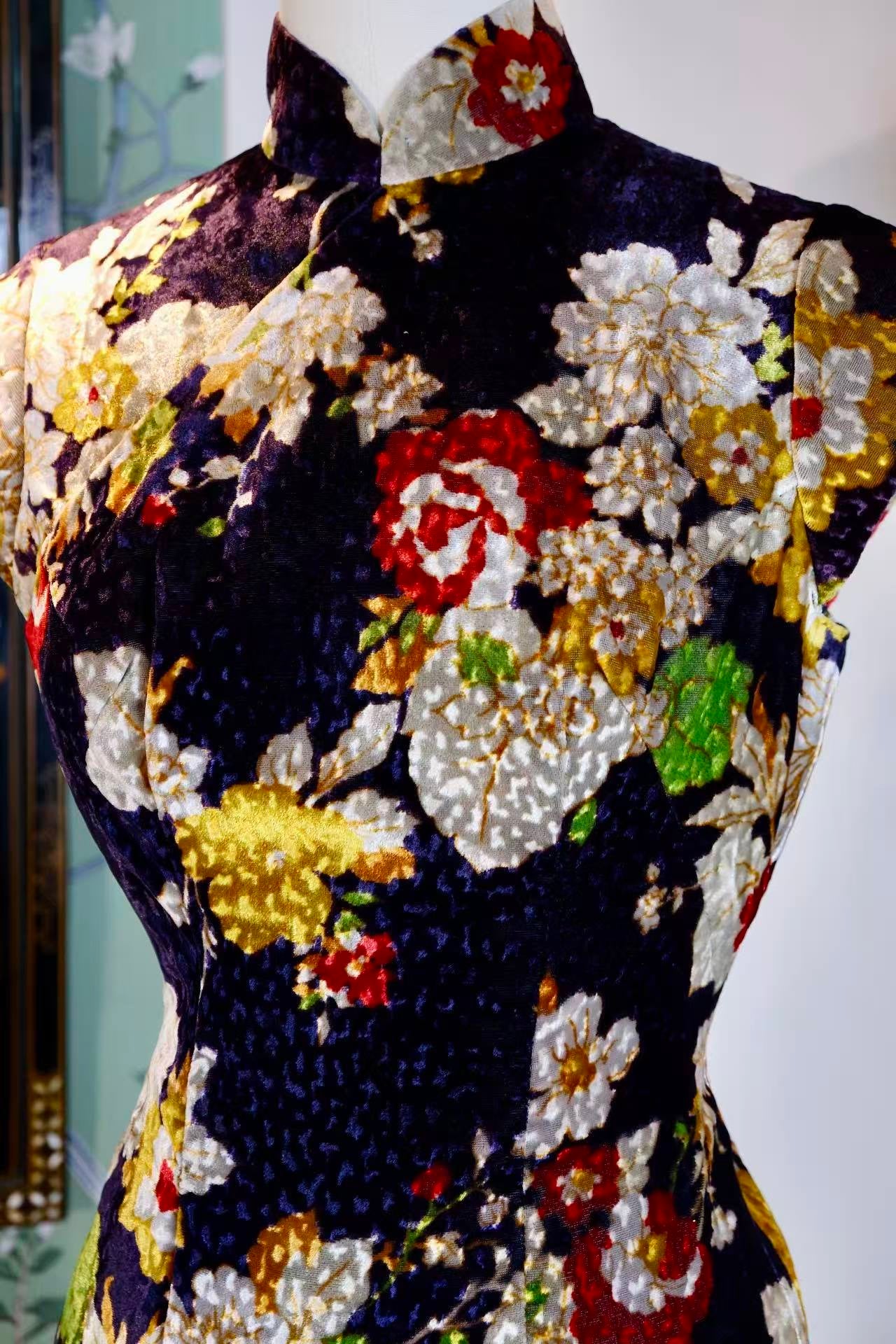
六十年代香港压花丝绒古董旗袍:繁华落尽见真淳
这件诞生于上世纪六十年代的香港压花丝绒旗袍,
旗袍上的图案堪称一场视觉的盛宴:大朵的白牡丹雍容华贵,
从艺术风格来看,这件旗袍完美诠释了六十年代香港旗袍的“海派”
其稀缺性更在于时代背景的特殊性。六十年代的香港,
今日凝视这件旗袍,仿佛能看见六十年代的香港街头:
This 1960s embossed velvet Qipao from Hong Kong is like a solidified poem of time. It condenses the golden era—a period defined by the collision and fusion of Eastern and Western cultures—into an eternal elegance upon its lapels. Against a velvet base as deep blue as the night, floral patterns in red, white, gold, and green bloom in layers through the embossing process. It seems to meld the majesty of the Great Tang with the refinement of the Republican era, narrating a legend of "yesterday's splendor, today's treasure" amidst the shifting light and shadow.
The patterns on the Qipao are a visual banquet: large white peonies exude opulence, their petal edges outlined in gold, reminiscent of the "golden hairpins and flowery faces" described in The Song of Everlasting Regret. Red plum blossoms offer the scholarly charm of "sparse shadows slanting across shallow water," while golden chrysanthemums bloom with the majestic momentum of "the whole city clad in golden armor." These flowers are not randomly placed but are artfully distributed using the traditional Chinese "broken-branch" (Zhezhi) composition. The intertwining stems hide auspicious meanings of "unbroken continuity," and every embossed texture is as three-dimensional as a relief sculpture—touching it feels like feeling the focused breath of the artisan before the loom.
From an artistic perspective, this piece perfectly interprets the essence of the "Shanghai Style" (Haipai) in 1960s Hong Kong. It preserves classic elements—standing collar, diagonal bodice, and side slits—while boldly integrating innovations in Western fabric technology. Embossed velvet, originally exclusive to European aristocratic gowns, was ingeniously grafted onto the Oriental Qipao by Hong Kong tailors, creating a unique aesthetic of "Chinese essence with Western utility." As Eileen Chang wrote in Chronicle of Changing Clothes: "Chinese clothing, upon reaching Hong Kong, seemed to be touched by magic; it kept the old rules while sprouting new patterns." This Qipao is that magic materialized: the deep blue base symbolizes Oriental calm and restraint, while the brilliant floral patterns mirror the neon lights of Victoria Harbour, finding a delicate balance between conservative tradition and flamboyant modernism.
Its scarcity is rooted in its unique historical context. In the 1960s, Hong Kong was transitioning from an entrepôt to a light industrial center. Qipao production began moving from "bespoke" to "ready-to-wear," yet this piece retains the soul of hand-embossing and single-unit tailoring, witnessing the "Last Bespoke Era." The embossed velvet fabrics of the time were largely dependent on imports, featuring complex processes and high costs. Finding a piece that has been perfectly preserved with its original luster is exceedingly rare. It is a living fossil of fashion history and a material carrier of the "Oriental Pearl's" rising years—the undulating floral veins on the fabric mirror the ardent aspirations of Hong Kong people for a better life.
Conclusion Gazing at this Qipao today is like seeing the streets of 1960s Hong Kong: a woman in an improved Qipao, carrying a bamboo handbag, strolling past a "Ding Ding" tram. The velvet glows softly in the sun, and the embossed patterns sway gently with her steps, perfectly blending Oriental grace with urban vitality. It has long transcended the realm of clothing to become a cultural symbol connecting past and present, East and West—displaying, after the splendor has settled, the unique artistic charm and spirit of its time.